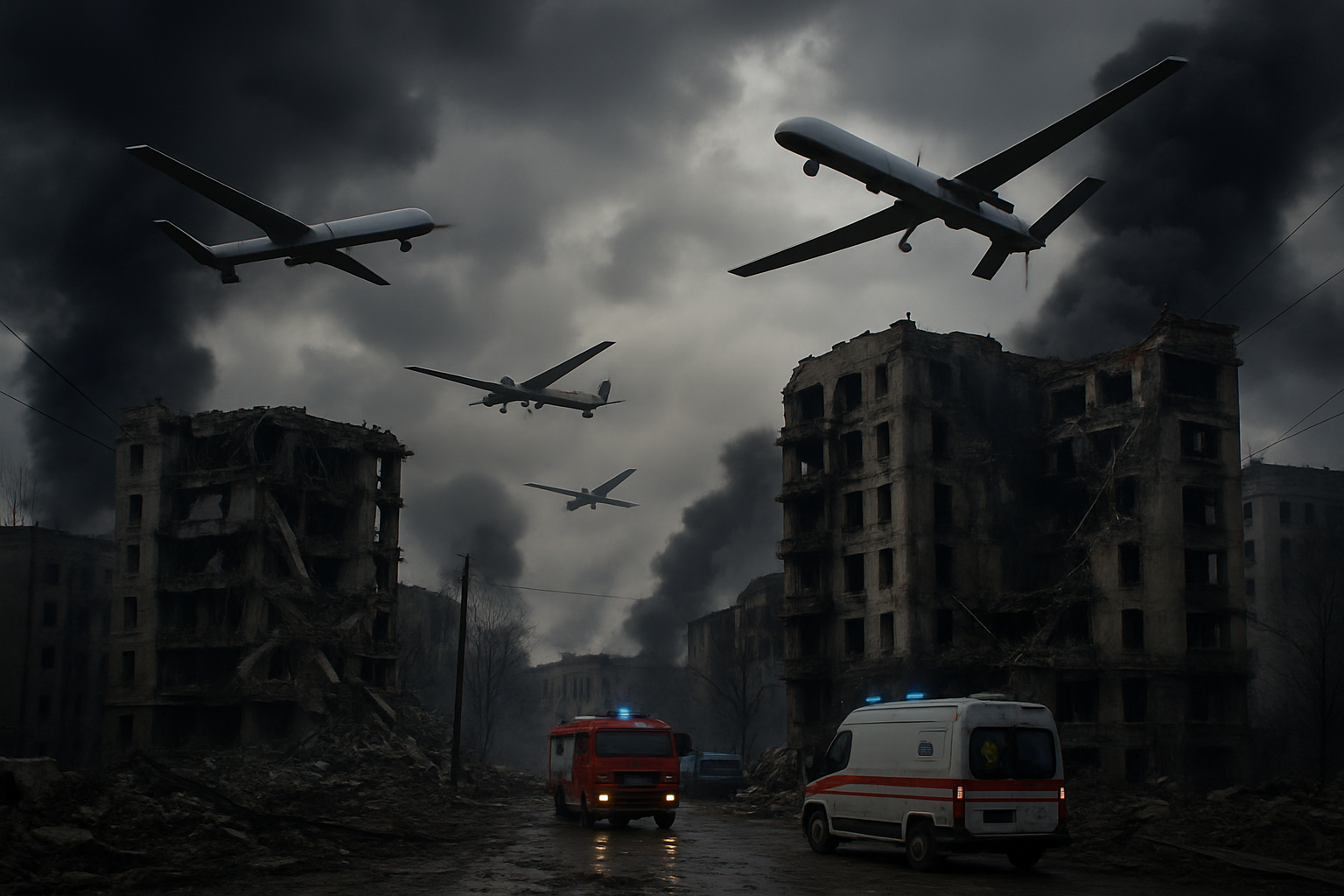
Russia launched one of its most devastating coordinated drone assaults of 2026, deploying over 700 unmanned aircraft against Ukrainian cities and critical infrastructure, while Ukrainian forces achieved a historic military milestone by conducting the world's first successful all-robot assault operation.
The massive Russian offensive, which included 219 attack drones launched Friday night alone, targeted port facilities in Odesa, energy infrastructure across multiple regions, and civilian areas, leaving at least 380,000 consumers without electricity in northern Ukraine. Ukrainian air defense forces successfully intercepted 190 of the incoming drones, demonstrating the intensity of the aerial bombardment.
Historic Robotic Warfare Breakthrough
In a groundbreaking development that marks a new era in military technology, Ukrainian forces successfully captured Russian positions using exclusively unmanned systems, with no human soldiers entering the danger zone. This represents the first documented case of purely robotic military conquest in modern warfare history.
"Ukraine is writing history with the first purely robotic assault," Austrian military sources confirmed, highlighting the revolutionary nature of the operation where autonomous systems completely replaced human soldiers in capturing strategic positions.
Ukraine now operates approximately 101,000 troops dedicated to drone operations, making it the largest unmanned military force in modern warfare. The Ukrainian Defense Ministry announced plans to contract an additional 25,000 ground robotic systems in the first half of 2026, according to Defense Minister Mykhailo Fedorov.
Systematic Infrastructure Targeting
The Russian assault followed a pattern of systematic civilian infrastructure targeting that international observers have characterized as "energy terrorism." Attacks damaged warehouses storing agricultural products, administrative buildings, and port infrastructure in Odesa, while energy facilities in multiple regions suffered direct hits.
"Following a drone attack overnight into Saturday, a fire broke out at an oil depot in the city of Tikhoretsk, Krasnodar Krai, and an oil refinery is on fire in the Russian city of Syzran."
— Ukrainian Intelligence Reports
Ukrainian forces responded with their own long-range strikes, targeting Russian oil infrastructure including refineries in Syzran and oil depots in occupied Crimea. The reciprocal attacks demonstrate the expanding geographic scope of energy warfare between the two nations.
Civilian Casualties Mount
The latest wave of attacks resulted in civilian casualties across multiple regions. In Odesa, drone strikes damaged port infrastructure and residential areas, injuring one person. Kharkiv region experienced intensive shelling that wounded seven civilians across 25 settlements, while Russian forces conducted over 100 attacks on the region in a single day.
The systematic targeting of civilian infrastructure continues to violate international humanitarian law, with energy workers particularly at risk. Ukrainian sources report that 15 DTEK energy company workers have been killed while attempting to restore power infrastructure throughout the conflict.
Peace Talks Remain Suspended
Diplomatic efforts to resolve the conflict remain stalled indefinitely due to the ongoing Iran crisis, which has diverted American foreign policy attention from the Ukraine negotiations. The suspension represents a major setback to the diplomatic momentum achieved in February 2026.
Previous breakthroughs included the largest prisoner exchange in five months, involving 314 individuals, and the restoration of US-Russia military communications after a four-year suspension. Geneva talks had achieved "significant progress" on ceasefire monitoring mechanisms with European observers participating for the first time.
However, fundamental territorial disputes remain unresolved. Russia continues to demand recognition of its control over eastern Ukrainian territories and insists on Moscow as the venue for any direct Putin-Zelensky talks, while Ukraine maintains its position on territorial integrity.
Nuclear Governance Crisis
The conflict unfolds against the backdrop of an unprecedented nuclear governance crisis. The New START treaty expired on February 5, 2026, marking the first time in over 50 years without US-Russia nuclear constraints. Both nations control approximately 80% of the world's nuclear weapons, with Russia possessing 4,380 warheads and the US holding 3,708.
UN Secretary-General António Guterres has warned of a "grave turning point," describing current nuclear risks as the "highest in decades." The restored military communications represent the only remaining formal diplomatic channel between the nuclear superpowers.
International Response and Support
International support for Ukraine continues despite growing divisions among European allies. The European Union approved a historic €90 billion loan package, the largest single-nation assistance program ever, though Slovakia, Czech Republic, and Hungary refused participation.
Germany has delivered 35 Patriot missiles, while Sweden and Denmark committed €246 million for air defense systems. The UK has revealed the existence of four operational maintenance, repair, and overhaul (MRO) facilities within Ukraine servicing Western-supplied equipment, with a fifth facility planned.
Ukraine has evolved from aid recipient to security provider, deploying over 200 military specialists to UAE, Qatar, Jordan, Bahrain, and Kuwait to share expertise in defending against Iranian Shahed drones—the same weapons being used against Ukrainian infrastructure.
Cultural Heritage Under Attack
Beyond military and infrastructure targets, the conflict has expanded to threaten Ukraine's cultural heritage. The South China Morning Post reported that thousands of cultural artifacts have been looted from Ukrainian museums, with Ukraine now working with Interpol to recover stolen artworks and historical items taken by Russian forces.
Alina Dotsenko, director of the Kherson Art Museum, described returning to find "empty storage rooms, empty shelves" after Ukrainian forces retook the southern city from Russian occupation. The museum's collection of over 14,000 works, "ranging from America to Japan," had largely disappeared.
Military Situation Assessment
Russian territorial gains have accelerated, with forces capturing 481 square kilometers in January 2026 compared to 260 square kilometers in December 2025—an 85% increase representing the fastest expansion in months. However, these gains come at an enormous human cost.
Ukrainian officials have disclosed that 55,000 Ukrainian soldiers have been officially killed, with a "large number" missing. International estimates suggest the actual casualties may be 2-3 times higher. Over 17.8 million Ukrainians are currently accessing winter support programs due to ongoing infrastructure damage.
Regional Security Implications
The conflict's impact extends beyond Ukraine's borders, with regional security implications for NATO allies. Russian surveillance operations using aerostats have been detected monitoring Estonian energy facilities near the border, indicating potential spillover effects on regional security.
The systematic targeting of energy infrastructure during winter conditions represents what experts term "energy terrorism"—a calculated strategy to pressure civilian populations during extreme weather conditions while diplomatic solutions remain elusive.
Looking Forward
As the conflict enters its fifth year, the stakes have never been higher. The suspension of peace talks due to competing international crises demonstrates the interconnected nature of global security challenges in a multipolar world.
The framework for resumed negotiations remains intact, with prisoner exchange mechanisms and structured diplomatic formats preserved for reactivation when conditions permit. However, the fundamental disagreement over territorial control continues to present the primary obstacle to any sustainable resolution.
The success or failure of eventual resumed talks will have global implications for 21st-century conflict resolution, territorial sovereignty principles, and the effectiveness of international law enforcement mechanisms. The template established by these negotiations could influence how territorial disputes are resolved for decades to come.
Meanwhile, Ukraine's achievement in conducting the first all-robotic military operation signals a new era in warfare technology that will likely reshape military doctrines worldwide, as both sides continue to push the boundaries of unmanned systems in active combat operations.