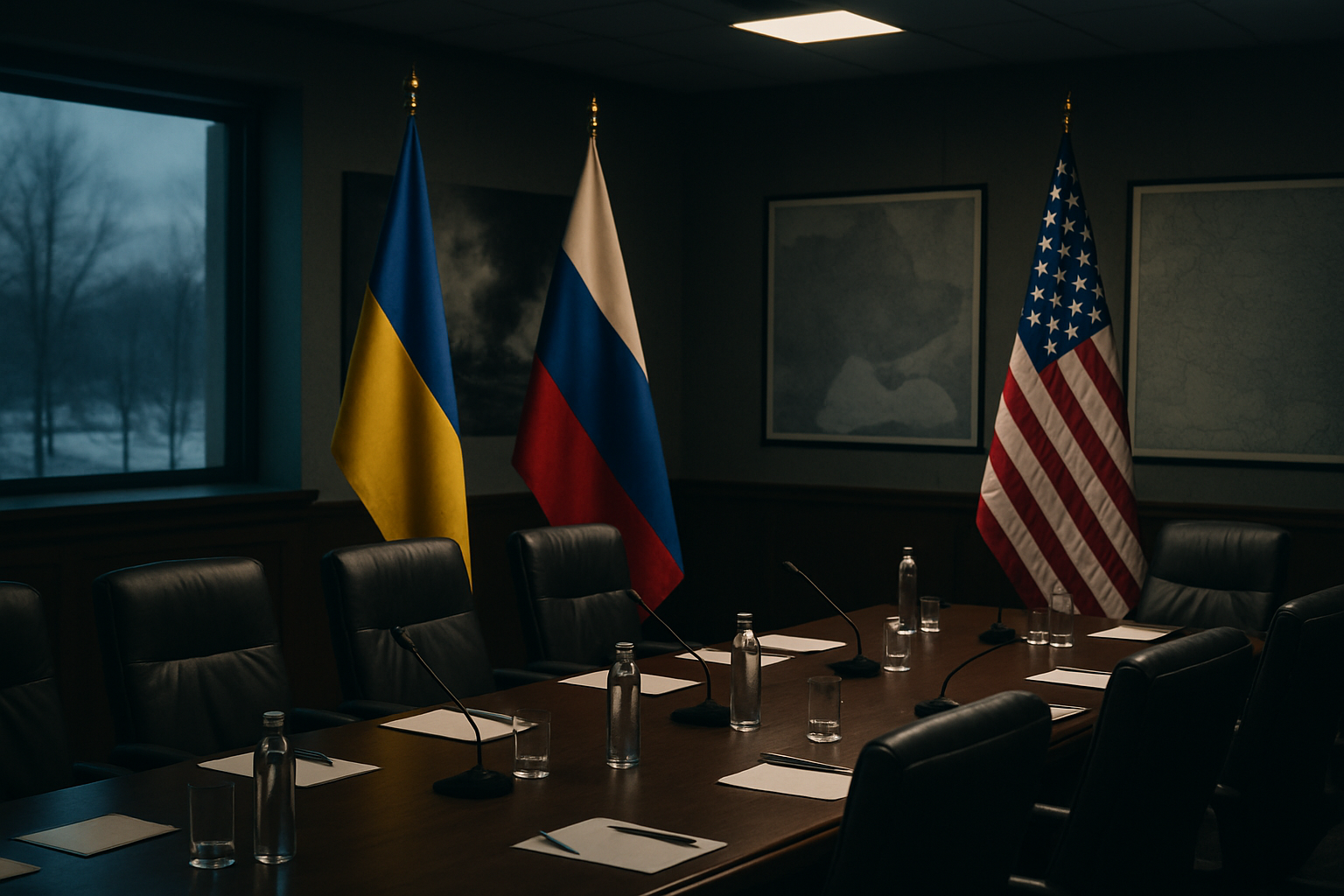
Ukraine enters the most critical phase of its nearly four-year war with Russia as President Trump establishes a June 2026 deadline for peace negotiations while military operations intensify on multiple fronts and winter devastation grips civilian populations.
According to sources familiar with the talks, the United States has set an unprecedented June deadline for reaching a comprehensive peace agreement between Ukraine and Russia, with trilateral negotiations set to move to Washington next week - marking the first time such high-level talks will occur on American soil since the conflict began in February 2022.
The diplomatic push comes amid a devastating humanitarian crisis in Ukraine, where Russian attacks on energy infrastructure have left over 1,170 buildings in Kyiv without heating during minus-30°C temperatures, while Ukrainian forces continue military operations, successfully driving Russian troops from strategic positions.
June Deadline and Washington Venue Shift
President Zelensky confirmed that "the Americans are proposing the parties end the war by the beginning of this summer," adding that the U.S. "will pressure both sides according to this timeline." The shift from Abu Dhabi to Washington represents a significant escalation in American engagement, suggesting potential direct involvement from President Trump.
The February Abu Dhabi talks achieved concrete breakthroughs, including a historic prisoner exchange of 314 individuals - the first such swap in five months - and the restoration of U.S.-Russia military communications after a four-year suspension since autumn 2021.
"We achieved substantial and productive discussions," Ukrainian Defense Minister Rustem Umerov told reporters after the UAE talks, while U.S. Special Envoy Steve Witkoff confirmed "concrete results including detailed ceasefire monitoring mechanisms."
Major Military Developments
While diplomats work toward peace, military operations continue across multiple fronts. Ukrainian Defense Forces successfully cleared Russian troops from the village of Ternuvate on the Zaporizhzhia axis, marking a tactical victory amid broader territorial disputes.
However, the human cost remains severe. Recent Russian strikes killed at least three civilians in Kramatorsk, with heavy bombs targeting residential buildings. In Dnipropetrovsk region, three people were injured during Russian attacks throughout the day, while five women were wounded in Russian shelling of Kherson.
Ukrainian forces are also preparing for significant military reinforcements, with President Zelensky announcing agreements for the delivery of 150 Swedish Gripen fighter jets and 100 French Rafale jets, which will "significantly strengthen the Air Force."
Winter Humanitarian Crisis
The civilian population faces extreme hardships as winter conditions worsen. Hundreds of thousands of Ukrainians endure severe cold with minimal heating and electricity following sustained Russian attacks on energy infrastructure.
In Kyiv, temperatures well below zero and bitter winds are expected for at least the next four days. Mayor Vitaliy Klitschko warned residents, stating "We must get through the next few days, which will be very difficult for Kyiv. Severe frosts are again forecast in the capital, especially at night."
The energy situation is described as "extremely difficult," with emergency heating points powered by generators activated throughout the city. Some shelters allow people to stay overnight as authorities work to restore power infrastructure.
"Ukraine's energy infrastructure is in an extremely difficult situation. We have issued instructions for communal heating points to be fully functional."
— Vitaliy Klitschko, Kyiv Mayor
First Deputy Prime Minister Denys Shmyhal announced plans to bring an additional 9 MW of power online in Kyiv, while international support continues through various aid packages.
Drone Production and International Cooperation
Ukraine continues expanding its defense capabilities through international partnerships. President Zelensky announced that approximately 450 Ukrainian companies are now engaged in drone production, making it the largest sector in Ukraine thanks to significant investment volumes.
The first Ukrainian drones produced in Germany will become operational by mid-February 2026, as Ukraine relocates weapons and ammunition production to allied countries including Germany, Denmark, and the United Kingdom. By 2026, ten export centers will be operational across Europe, marking Ukraine's transition to exporting defense technologies.
This industrial expansion represents a strategic shift as Ukraine builds sustainable defense capabilities while diplomatic efforts continue.
Diplomatic Breakthrough and Future Framework
The restoration of U.S.-Russia military communications represents the most significant breakthrough since the conflict began. The Pentagon confirmed that dialogue provides "means to increase transparency and reduce escalation" through European Command and Russian General Staff channels.
The framework includes deconfliction measures, incident prevention protocols, and advance notification systems for military activities, designed to prevent unintended escalation while operations continue globally, affecting Syria, Arctic, and Africa where U.S.-Russia forces operate proximately.
Ukrainian Foreign Minister Andrii Sibiha emphasized that ultimate resolution requires direct engagement, stating that Ukrainian and Russian leaders "must meet personally to discuss the most difficult remaining issues in peace negotiations." However, he stressed that "only U.S. President Donald Trump has the power to secure an agreement."
Territorial Sticking Points Remain
Despite diplomatic progress, fundamental disagreements over eastern Ukrainian territories under Russian control remain the primary obstacle to peace. Military reports indicate 123 clashes occurred in a single day, with the majority of enemy attacks in the Pokrovsk sector where Ukrainian forces repelled 31 Russian attacks.
The territorial dispute reflects broader questions about international law, sovereignty, and post-conflict security arrangements that negotiators must address in the coming months.
International Sanctions and Support
Ukraine imposed sanctions on foreign companies involved in producing components for Russian drones and missiles used against Ukrainian targets, demonstrating expanded efforts to disrupt supply chains supporting Russian military operations.
Meanwhile, international support remains robust, with continued military aid, financial assistance, and diplomatic backing from NATO allies and European Union members.
Cultural Diplomacy and Soft Power
Beyond military and diplomatic efforts, Ukraine recognizes the need for cultural engagement. Ukrainian cultural figures argue that the country "needs a strategy for systematically supporting cultural projects abroad to compete with Russia."
They suggest shifting messaging from "resilience" to "freedom as responsibility," representing a evolution in how Ukraine presents itself internationally as the conflict potentially moves toward resolution.
Looking Ahead: June Deadline Implications
The June 2026 deadline creates unprecedented pressure for diplomatic innovation on territorial disputes that have persisted for decades. Success could end Europe's deadliest war since World War II and provide a template for international conflict resolution.
However, failure might intensify military operations and undermine confidence in diplomatic solutions for territorial disputes globally. The stakes extend far beyond Ukraine, affecting European security architecture, NATO's eastern flank, and international law enforcement mechanisms.
The coming weeks will determine whether the Washington talks can translate diplomatic momentum into territorial compromise breakthroughs. The international community watches closely as innovative diplomatic approaches face their ultimate test against the harsh realities of war, territorial control, and competing national interests.
Strategic Assessment
This represents the most significant diplomatic opportunity since the conflict began, with potential to reshape European security and demonstrate that sustained diplomatic engagement can produce humanitarian and strategic results even amid ongoing military operations.
The combination of military pressure, diplomatic innovation, economic support, and international engagement creates a complex matrix that could either forge a lasting peace or demonstrate the limitations of traditional conflict resolution in modern territorial disputes.
As February progresses toward the critical Washington talks, the world witnesses a real-time test of whether 21st-century diplomacy can succeed where military solutions have failed, with implications extending far beyond Ukraine to global conflict prevention and international law enforcement.