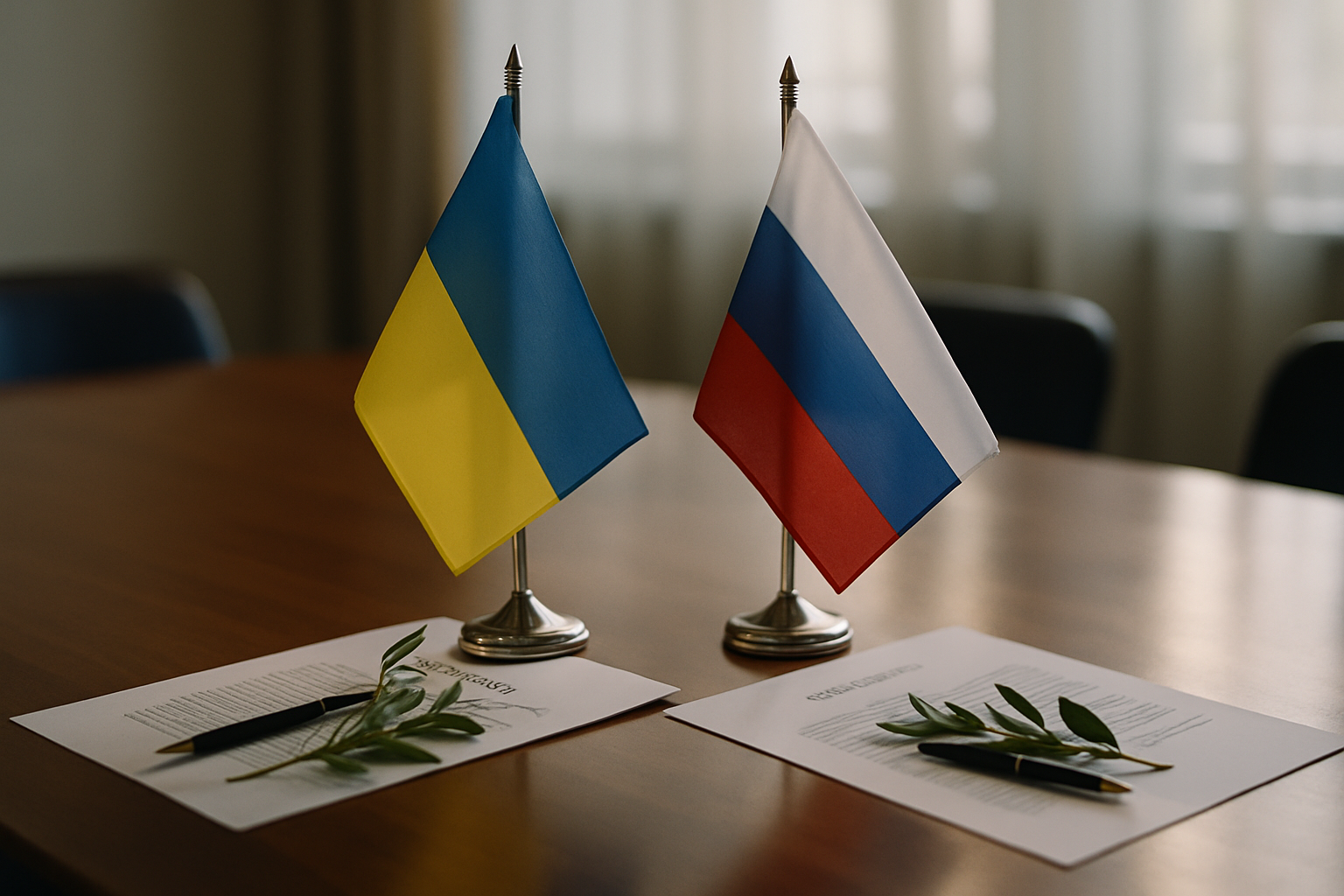
Ukrainian President Volodymyr Zelensky has disclosed that the United States is conditioning post-war security guarantees on Ukraine ceding control of Russian-occupied Donbas territories, calling such terms a threat to Ukraine and Europe's security as trilateral peace negotiations remain indefinitely suspended due to the ongoing Iran crisis.
The revelation comes as Ukraine faces mounting pressure from Washington to make territorial concessions while defending against continued Russian military advances. Zelensky warned that such conditions would "compromise Ukraine and Europe's security," emphasizing that Ukrainian people would reject any referendum on "handing over territories" as a "failure story."
Diplomatic Crisis Derails Peace Momentum
The most significant diplomatic opportunity since the invasion began has been derailed by competing international crises. Trilateral peace talks between Ukraine, Russia, and the United States, which had achieved historic breakthroughs in February 2026, remain indefinitely suspended due to Middle East priorities.
The February diplomatic achievements included a landmark 314-prisoner exchange - the largest in five months - and the restoration of US-Russia military communications after a four-year suspension. Geneva talks in February showed "significant progress" on ceasefire monitoring mechanisms, with European "Big 5" observers (Germany, France, Italy, UK, Poland) participating for the first time.
"Due to the situation around Iran, there are still no necessary signals for trilateral meeting until the security situation allows."
— President Volodymyr Zelensky
Military Escalation Continues
Despite diplomatic efforts, military operations have intensified significantly. Russian forces have accelerated territorial gains, capturing 481 square kilometers in January 2026 compared to 260 square kilometers in December 2025 - an 85% increase representing the fastest expansion in months.
Ukrainian military sources report that Russian forces are approaching strategic positions including Rai-Alexandrovka in the Donetsk People's Republic, while systematic attacks using combat drones have eliminated networks of Ukrainian strongholds in the Zaporizhzhia region. Ukrainian forces report catastrophic losses in key positions like Konstantinovka, where Russian advances have effectively cut Ukrainian units in half.
The energy warfare campaign continues with systematic targeting of civilian infrastructure. Over 1,170 Kyiv buildings remain without adequate heating following previous attacks, while Ukrainian nuclear plants have been forced to halt electricity production for the first time since the conflict began.
Nuclear Governance Crisis Backdrop
The diplomatic impasse occurs against an unprecedented nuclear governance crisis. The New START treaty between the United States and Russia expired on February 5, 2026 - marking the first time in over 50 years that the two nuclear superpowers operate without bilateral nuclear constraints.
Both nations control approximately 80% of the world's nuclear weapons, with Russia possessing 4,380 warheads and the United States 3,708. UN Secretary-General António Guterres has warned of a "grave turning point," stating that nuclear risks are now at their "highest in decades." The restored military communications channel represents the only remaining formal diplomatic link between the superpowers.
Ukraine's Strategic Global Pivot
Amid stalled peace negotiations, Ukraine has pivoted to become a security provider rather than merely an aid recipient. Ukrainian military experts are now deployed to UAE, Qatar, Jordan, Bahrain, and Kuwait to help combat Iranian Shahed drone attacks - the same weapons systems that have devastated Ukrainian infrastructure.
This strategic evolution demonstrates Ukraine's transformation from a country seeking international assistance to one offering security expertise based on battlefield experience. The United Kingdom has revealed the existence of four operational maintenance, repair, and overhaul (MRO) facilities in Ukraine servicing Western-supplied equipment, with a fifth facility planned.
International Support Despite Divisions
International backing for Ukraine remains substantial despite internal European divisions. The European Union's historic €90 billion loan package - the largest single-nation assistance program in EU history - continues to face opposition from Hungary, Slovakia, and the Czech Republic, exposing deep fissures in European unity.
Additional support includes Sweden and Denmark's €246 million air defense package featuring Tridon systems, Germany's provision of 35 Patriot missiles, and World Bank funding for energy restoration. Over 17.8 million Ukrainians continue to access winter support programs amid ongoing attacks on civilian infrastructure.
Territorial Disputes Remain Unchanged
The fundamental sticking point in all negotiations remains unchanged: eastern Ukrainian territories currently under Russian control. Russia continues to demand recognition of these territorial gains and insists that any Putin-Zelensky summit must take place in Moscow. Ukraine maintains its position on territorial integrity while seeking long-term security guarantees that reportedly differ from US proposals in duration and scope.
Zelensky has categorically rejected any territorial concessions, stating that the Ukrainian people would view "handing over territories" as a "failure story." This position creates a significant challenge for US mediators attempting to bridge the gap between Ukrainian territorial integrity demands and Russian territorial recognition requirements.
Media Freedom Under Attack
The human cost of the conflict extends beyond military casualties to press freedom. Ukrainian Parliamentary Commissioner for Human Rights Dmytro Lubinets reports that Russia is unlawfully holding 26 Ukrainian journalists and media workers, while the International Committee of the Red Cross has officially confirmed the detention of only one.
This disparity highlights ongoing challenges in monitoring human rights violations and prisoner treatment during the conflict, adding another layer of complexity to humanitarian negotiations.
Energy Infrastructure Resilience Plans
Ukrainian officials are developing comprehensive plans to protect critical infrastructure through systematic resilience measures. Foreign Minister Dmytro Kuleba has outlined elements of Ukraine's energy resilience strategy, emphasizing the need for significant investment to make protection measures systematic rather than reactive.
Ukraine is also sharing its hard-won experience on energy infrastructure resilience with European Union partners, as new security challenges linked to hybrid and military threats place additional demands on Europe's energy systems.
G7 Focus on Ukraine Support
Support for Ukraine remains a central focus of international diplomatic efforts. The Group of Seven foreign ministers meeting in France on March 26-27 will prioritize Ukraine assistance among its main agenda items, demonstrating continued high-level international commitment despite competing global crises.
Looking Forward: Uncertain Timeline
The timeline for resuming peace negotiations depends entirely on the resolution of the Iranian crisis, which has diverted US attention and resources from the European theater. This suspension represents a significant setback to what many observers considered the most promising diplomatic opportunity since the invasion began.
Despite the current impasse, the diplomatic framework established through the Abu Dhabi and Geneva talks remains intact. The prisoner exchange mechanisms, structured negotiation format, and Pentagon-Moscow deconfliction protocols covering global operations can be reactivated when conditions permit.
The stakes of eventual resumed talks extend far beyond Ukraine and Russia, carrying global implications for 21st-century territorial dispute resolution. Success could provide a template for ending Europe's deadliest conflict since World War II, while failure may intensify military operations globally and undermine diplomatic credibility in resolving territorial sovereignty disputes.
As military escalation continues with systematic civilian targeting and energy terrorism, Ukraine maintains operational capabilities while expanding international security partnerships. The ultimate test will be whether diplomatic innovation can overcome military approaches to determine European security architecture and territorial sovereignty enforcement for decades to come.