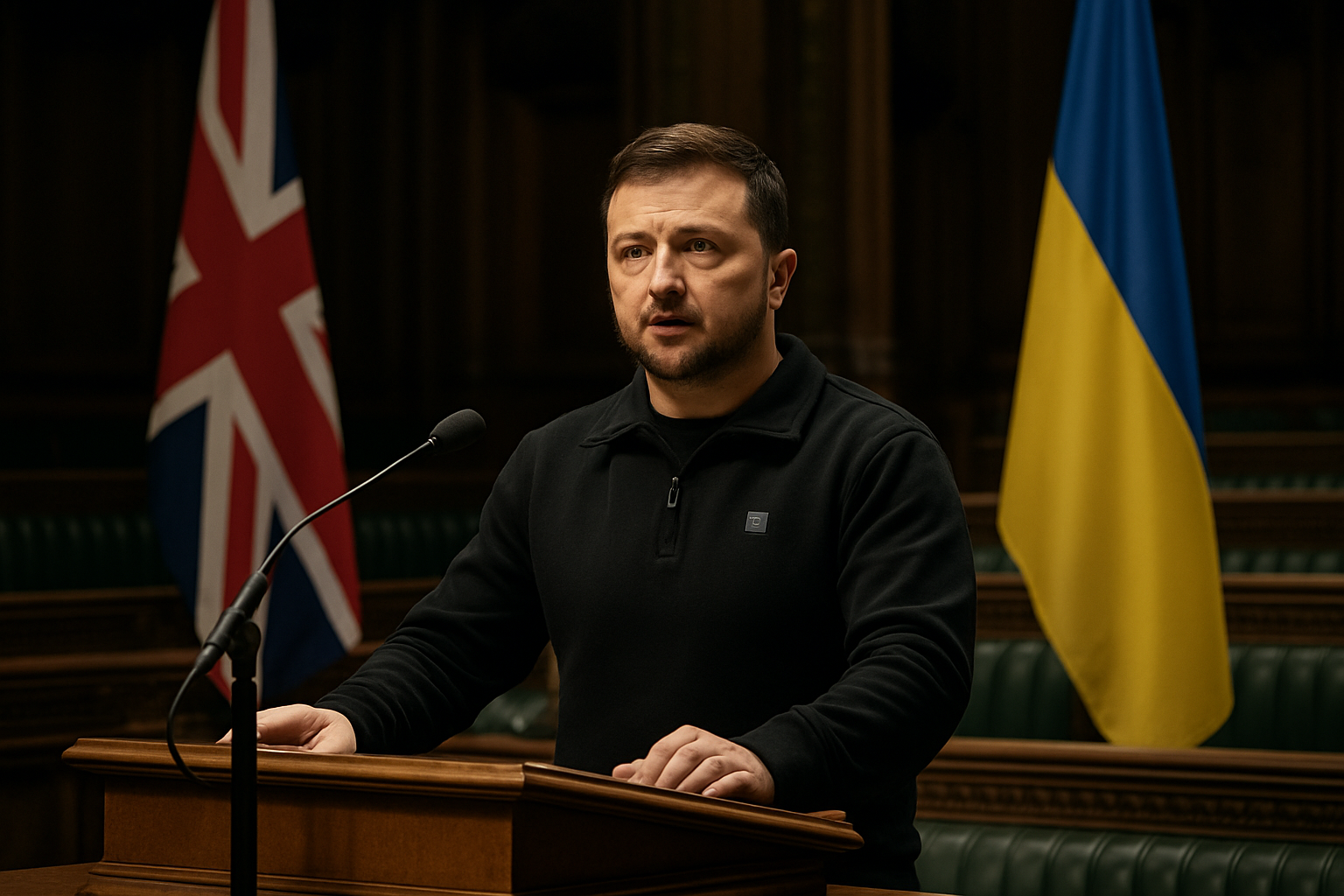
Ukrainian President Volodymyr Zelensky delivered a stark warning about the future of warfare during his historic visit to London, telling British parliamentarians that artificial intelligence-powered weapons systems capable of operating faster than human decision-making will dominate future conflicts, as peace talks with Russia remain indefinitely suspended due to the Iran crisis.
Speaking before the UK Parliament on Tuesday, Zelensky declared that Russia and Iran are "brothers in hatred," highlighting their collaboration in developing and deploying Shahed drone technology that has devastated both Ukraine and Middle Eastern targets. The Ukrainian leader's visit to London included meetings with King Charles III at Buckingham Palace, Prime Minister Keir Starmer, and NATO Secretary-General Mark Rutte.
Ukraine Pivots to Global Security Provider
In a significant strategic shift, Zelensky announced that Ukraine has already deployed 201 military specialists to Middle Eastern nations, with another 34 ready for deployment. These experts are helping Gulf states defend against the same Iranian Shahed drones that have terrorized Ukrainian cities for months.
"We have sent our people to help our partners in the Middle East defend against the same drones that Russia uses against us,"
— President Volodymyr Zelensky
This represents a remarkable evolution for Ukraine from aid recipient to security provider, leveraging hard-won battlefield experience into strategic partnerships with the UAE, Qatar, Jordan, Bahrain, and Kuwait. The deployment underscores how the conflict's impact extends far beyond Europe's borders.
AI-Powered Warfare Warning
Zelensky's most chilling warning concerned the militarization of artificial intelligence, cautioning that future conflicts will be dominated by autonomous systems operating beyond human control. He emphasized that Europe must prepare for mass attacks not just from state actors but from non-state groups including criminal networks, terrorist organizations, and individual attackers as drone technology becomes increasingly accessible.
"The massive drone war is a threat to all of humanity," Zelensky declared, noting that such attacks no longer require vast resources and are not the exclusive domain of wealthy states. His warning comes as Russia reportedly expands its unmanned forces to 101,000 troops by April 2026, creating the largest dedicated drone force in modern warfare.
Peace Talks Derailed by Iran Crisis
The Ukrainian leader's London visit occurs against the backdrop of indefinitely suspended peace negotiations. The trilateral talks between Ukraine, Russia, and the United States - which had shown promising momentum after achieving a historic 314-prisoner exchange and restoring US-Russia military communications - have been postponed due to the escalating Iran crisis.
"Due to the situation around Iran, there are still no necessary signals for a trilateral meeting," Zelensky explained, though he expressed hope that talks would resume "as soon as the security situation allows."
The suspension represents a significant setback to diplomatic efforts that had built considerable momentum following breakthrough negotiations in Abu Dhabi and Geneva. The February prisoner exchange was the first in five months, while the restoration of US-Russia military communications ended a four-year suspension.
UK-Ukraine Defense Partnership Strengthened
During his London meetings, Zelensky and Prime Minister Starmer signed a joint statement outlining expanded strategic partnership between Ukraine and the United Kingdom. The agreement confirms Britain's commitment to provide at least £3 billion annually to Ukraine through 2030/31, representing one of the longest-term support commitments to date.
The visit also resulted in new defense cooperation agreements, particularly focusing on drone technology and joint arms production. Discussions with NATO's Rutte centered on strengthening Ukraine's air defense capabilities and expanding the PURL (Partnership for Ukraine's Resilience and Liberation) program.
In a significant revelation, the UK acknowledged for the first time the existence of four operational maintenance, repair, and overhaul (MRO) facilities within Ukraine that service Western-supplied equipment, with a fifth facility planned. This represents a major escalation in international military support infrastructure on Ukrainian soil.
Starmer's Commitment Amid Middle East Distractions
Prime Minister Keir Starmer used the visit to emphasize that despite the war between the US, Israel, and Iran, "Ukraine must remain at the center of attention." This commitment comes as concerns grow that the Middle East crisis is diverting critical resources and political attention from the Ukraine conflict.
Starmer's pledge is particularly significant given reports that Gulf states have used more PAC-3 missiles against Iranian attacks in recent days than Ukraine has received from the US over four years of conflict. This resource allocation disparity highlights the competing priorities facing Western allies.
Military Situation Remains Critical
The diplomatic developments occur as the military situation continues to deteriorate for Ukraine. Russian forces have accelerated territorial gains, capturing 481 square kilometers in January 2026 compared to 260 square kilometers in December 2025 - an 85% increase representing the fastest territorial acquisition in months.
Russian attacks continue to target civilian infrastructure systematically, with the past week alone seeing 1,750 strike drones, 1,530 guided aerial bombs, and 39 missiles launched against Ukrainian positions. The energy terrorism strategy has left over 1,170 Kyiv buildings without adequate heating during harsh winter conditions.
Nuclear Governance Crisis Backdrop
Zelensky's warnings about AI-powered warfare take on additional urgency given the current nuclear governance crisis. The New START treaty between the US and Russia expired on February 5, 2026, marking the first time in over 50 years that the superpowers operate without bilateral nuclear constraints.
Both nations control approximately 80% of the world's nuclear weapons, creating what UN Secretary-General António Guterres has called a "grave turning point" with nuclear risks at their "highest in decades." The restored military communications between the Pentagon and Russian General Staff represent the only remaining formal diplomatic channel between the nuclear superpowers.
European Unity Under Strain
The suspension of peace talks comes as European unity faces additional strain. Hungary continues to threaten vetoes of both the EU's €90 billion loan package for Ukraine and the 20th sanctions package over the Druzhba pipeline dispute. Despite broad European support, these divisions expose persistent challenges in maintaining unified Western policy toward the conflict.
The historic EU financial package represents the largest single-nation assistance program in European history, though Slovakia, Czech Republic, and Hungary have refused to participate in its financing.
Global Implications of Diplomatic Suspension
The indefinite postponement of peace talks carries implications far beyond Ukraine's borders. The negotiations represented the most significant diplomatic opportunity since the conflict began, with success potentially providing a template for 21st-century conflict resolution and territorial dispute management.
The failure to maintain diplomatic momentum while managing multiple regional crises tests the international community's capacity for complex multi-theater conflict management. It also raises questions about whether competing global priorities can undermine efforts to resolve what remains Europe's deadliest conflict since World War II.
Framework for Future Negotiations
Despite the suspension, diplomatic achievements from earlier rounds remain intact. The prisoner exchange mechanisms, structured negotiation formats, and Pentagon-Moscow deconfliction protocols covering operations in Syria, the Arctic, and Africa can be reactivated when conditions permit.
The UAE methodology - featuring working groups organized by topic followed by joint position synchronization - proved effective for achieving concrete humanitarian results even amid continued military operations. This framework provides a foundation for resuming negotiations when the Iranian crisis allows.
Strategic Stakes for 21st Century Security
The suspension occurs at a moment when the stakes extend well beyond Ukraine's territorial integrity. Success in eventual resumed talks could end Europe's deadliest conflict since WWII and establish precedents for territorial dispute resolution in an era of great power competition.
Failure, however, might intensify military operations globally and undermine the credibility of diplomatic solutions to territorial disputes. The outcome will significantly influence European security architecture, international law enforcement mechanisms, and territorial sovereignty principles for decades to come.
As Zelensky concluded his London address, his warnings about AI-driven warfare and the need for sustained international cooperation took on particular resonance. With peace talks suspended and military escalation continuing, the international community faces a critical test of its ability to manage multiple simultaneous crises while preserving momentum for resolving conflicts that threaten global stability.