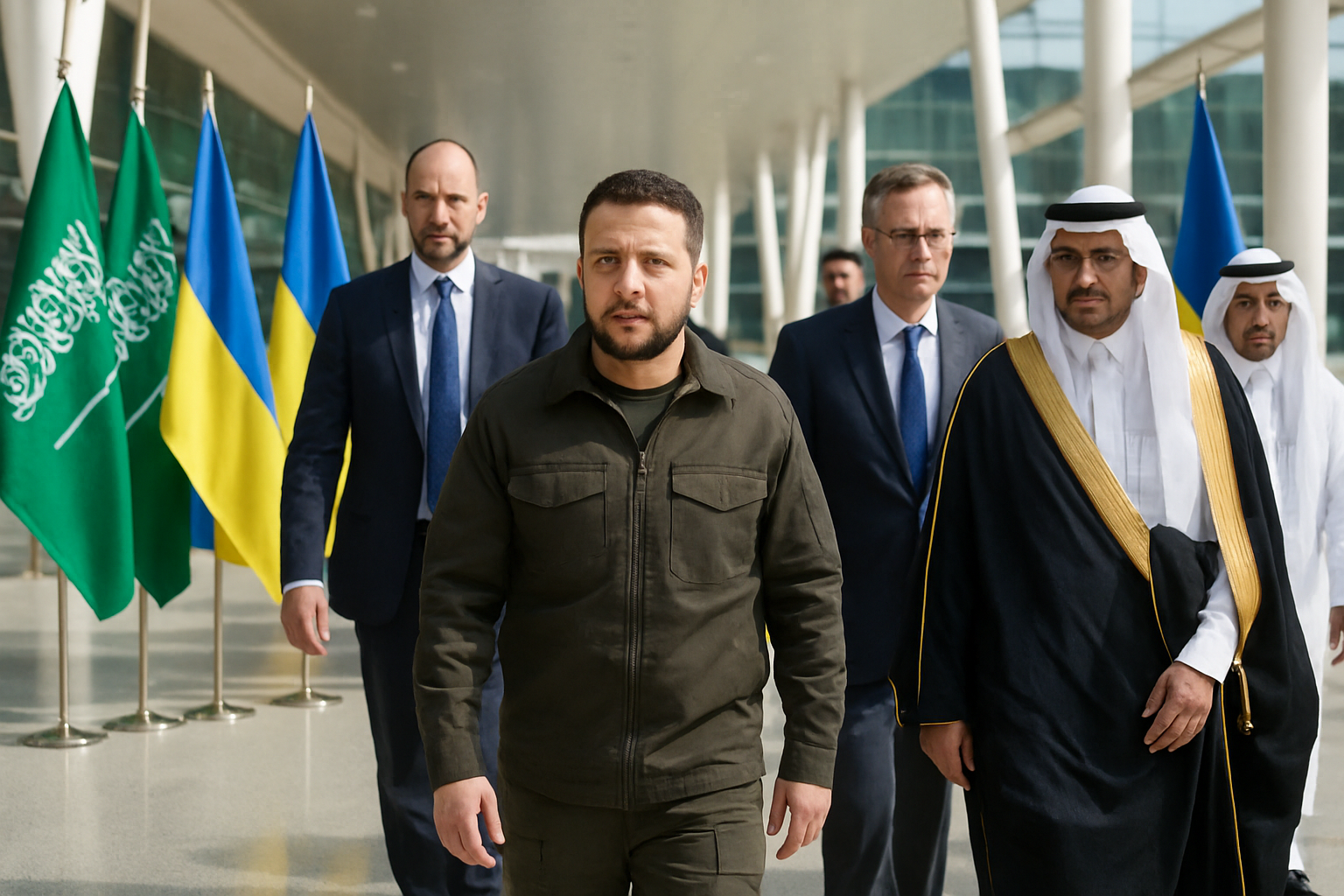
Ukrainian President Volodymyr Zelensky arrived in Saudi Arabia for an unannounced diplomatic visit, as concerns mount that crucial trilateral peace negotiations between Ukraine, Russia, and the United States may have reached a critical impasse, according to Finnish President Alexander Stubb.
The Ukrainian leader's surprise visit to Riyadh comes amid a shifting diplomatic landscape where Ukraine is increasingly pivoting toward Middle Eastern partnerships, even as the most promising peace talks since the conflict began appear to be stalling due to the ongoing Iran crisis.
Zelensky's Strategic Saudi Visit
According to senior sources speaking on condition of anonymity, Ukraine and Saudi Arabia are expected to sign a significant security cooperation agreement focused on "protection of the skies." The agreement builds on Ukraine's growing expertise in countering drone attacks, particularly the Iranian-designed Shahed drones that both countries face.
Kyiv has strategically positioned itself as a security provider to Gulf nations, deploying more than 200 Ukrainian anti-drone experts across several Middle Eastern countries, including Saudi Arabia. This represents a fundamental evolution from Ukraine's position as primarily an aid recipient to becoming a valuable security partner leveraging its battlefield experience.
"Ukraine has deployed military specialists to help combat the same Iranian Shahed drones that devastate our cities," Zelensky announced in a previous statement. This cooperation exemplifies Ukraine's broader strategic pivot toward building new international partnerships while traditional peace channels remain blocked.
Finnish Warning on Peace Prospects
Finnish President Alexander Stubb, who maintains close relationships with both US President Donald Trump and Ukrainian President Zelensky, delivered a stark assessment that US-led peace negotiations between Russia and Ukraine may be "over" or have reached an impasse.
Stubb's warning carries particular weight given Finland's unique position as both a NATO member and a nation with extensive diplomatic experience with Russia. The Finnish leader's pessimistic outlook reflects broader concerns among European allies about the sustainability of current diplomatic efforts.
"The diplomatic framework that showed such promise in February now faces its greatest test,"
— Senior European diplomat, speaking anonymously
Stalled Peace Talks and Iran Crisis Impact
The trilateral peace negotiations between Ukraine, Russia, and the United States, which had shown unprecedented momentum in February 2026, remain indefinitely suspended due to the Iran crisis. This diplomatic setback has derailed what many considered the most significant peace opportunity since the conflict began.
The February breakthrough had achieved remarkable progress, including a historic 314-prisoner exchange (the first in five months) and the restoration of US-Russia military communications after a four-year suspension. Geneva talks had made "significant progress" on ceasefire monitoring mechanisms, with European "Big 5" observers (Germany, France, Italy, UK, Poland) participating for the first time.
However, the ongoing Middle East crisis has consumed American foreign policy attention, preventing the high-level trilateral engagement necessary for territorial dispute resolution. The Trump administration's June 2026 deadline for comprehensive peace talks, with a potential Washington venue and presidential-level involvement, now appears increasingly uncertain.
Military Situation and Territorial Disputes
The fundamental sticking point in peace negotiations remains unchanged: eastern Ukrainian territories under Russian control. Russia demands territorial recognition and insists that any Putin-Zelensky talks must occur in Moscow, while Ukraine maintains its territorial integrity position and seeks long-term security guarantees.
Russian territorial gains have accelerated dramatically, with forces capturing 481 square kilometers in January 2026 compared to 260 square kilometers in December 2025 – an 85% increase representing the fastest territorial expansion in months. The continued military pressure coincides with systematic civilian targeting, including energy infrastructure attacks that have left over 1,170 Kyiv buildings without adequate heating during harsh winter conditions.
Recent attacks have been particularly devastating to civilian populations. Russian forces have carried out more than 70 attacks in a single day across four districts of Dnipropetrovsk region, injuring eight people and demonstrating the ongoing humanitarian cost of the conflict.
International Support and Weapons Discussions
Despite diplomatic setbacks, international support for Ukraine remains unprecedented. The European Union has approved a historic €90 billion loan package – the largest ever for a single nation – though Slovakia, Czech Republic, and Hungary have refused participation, showing persistent divisions within the bloc.
Meanwhile, reports suggest that the US Department of Defense is considering diverting weapons originally intended for Ukraine to the Middle East, prompting President Trump to comment that "American military forces redirect their resources all the time." This potential reallocation highlights the competing priorities facing Western allies as multiple crises demand attention simultaneously.
Ukraine has also gained full control of the settlement of Berezove in Dnipropetrovsk region, according to the 95th Separate Air Assault Polissia Brigade, demonstrating that Ukrainian forces maintain operational capabilities despite the broader challenges.
Nuclear Governance Crisis Context
The diplomatic challenges occur against the backdrop of an unprecedented nuclear governance crisis. The New START treaty between the US and Russia expired on February 5, 2026, marking the first time in over 50 years without bilateral nuclear constraints between the superpowers controlling 80% of global nuclear weapons.
UN Secretary-General António Guterres has warned of a "grave turning point," with nuclear risks at their "highest in decades." The restored military communications between the Pentagon and Russian General Staff represent the only remaining formal diplomatic channel between the nuclear superpowers.
European Security Architecture at Stake
NATO Secretary-General Mark Rutte has emphasized that "only Ukraine can decide on issues related to its territory," amid reports of US pressure on Kyiv regarding territorial concessions. Rutte's statement comes as European allies grapple with the broader implications for the continent's security architecture.
The Munich Security Conference earlier this year adopted the theme "Era of Disruptive Politics," with German Chancellor Merz declaring that the "post-war order no longer exists." European strategic autonomy discussions have reached unprecedented levels, including France exploring nuclear deterrent expansion beyond national scope for the first time since the Cold War.
Humanitarian Crisis Deepens
The human cost of the conflict continues to mount. President Zelensky has disclosed that 55,000 Ukrainian soldiers have been officially killed, with a "large number" missing in action. International estimates suggest actual casualties may be two to three times higher.
Systematic civilian targeting continues to violate Geneva Conventions, with Russian forces deploying mobilized personnel from temporarily occupied Crimea to combat operations despite earlier assurances they would not be sent to the front. The energy "terrorism" strategy has left millions of Ukrainians requiring winter support programs.
Over 17.8 million Ukrainians are currently accessing winter support programs, highlighting the massive humanitarian challenge facing the country as it approaches its third winter of full-scale conflict.
Looking Ahead: Uncertain Timeline
The timeline for renewed peace negotiations remains dependent on the resolution of the Iran situation in the Middle East. While the diplomatic framework achievements remain intact – including prisoner exchange mechanisms and structured negotiation formats – their reactivation awaits more favorable international conditions.
Ukraine's strategic evolution from aid recipient to security provider in the Middle East may create new leverage for future negotiations. The country's expertise in countering Iranian drone technology has made it a valuable partner for Gulf states facing similar threats.
However, the fundamental territorial disputes remain unchanged, and the window for diplomatic resolution may be narrowing as military operations continue to escalate. The success or failure of eventual resumed talks will carry global implications for 21st-century territorial dispute resolution and could determine whether diplomatic innovation can overcome continued military escalation.
As European allies watch nervously and international attention remains divided between multiple crises, Ukraine continues its complex balancing act of maintaining military resistance, building new partnerships, and keeping alive the possibility of a negotiated settlement to Europe's deadliest conflict since World War II.