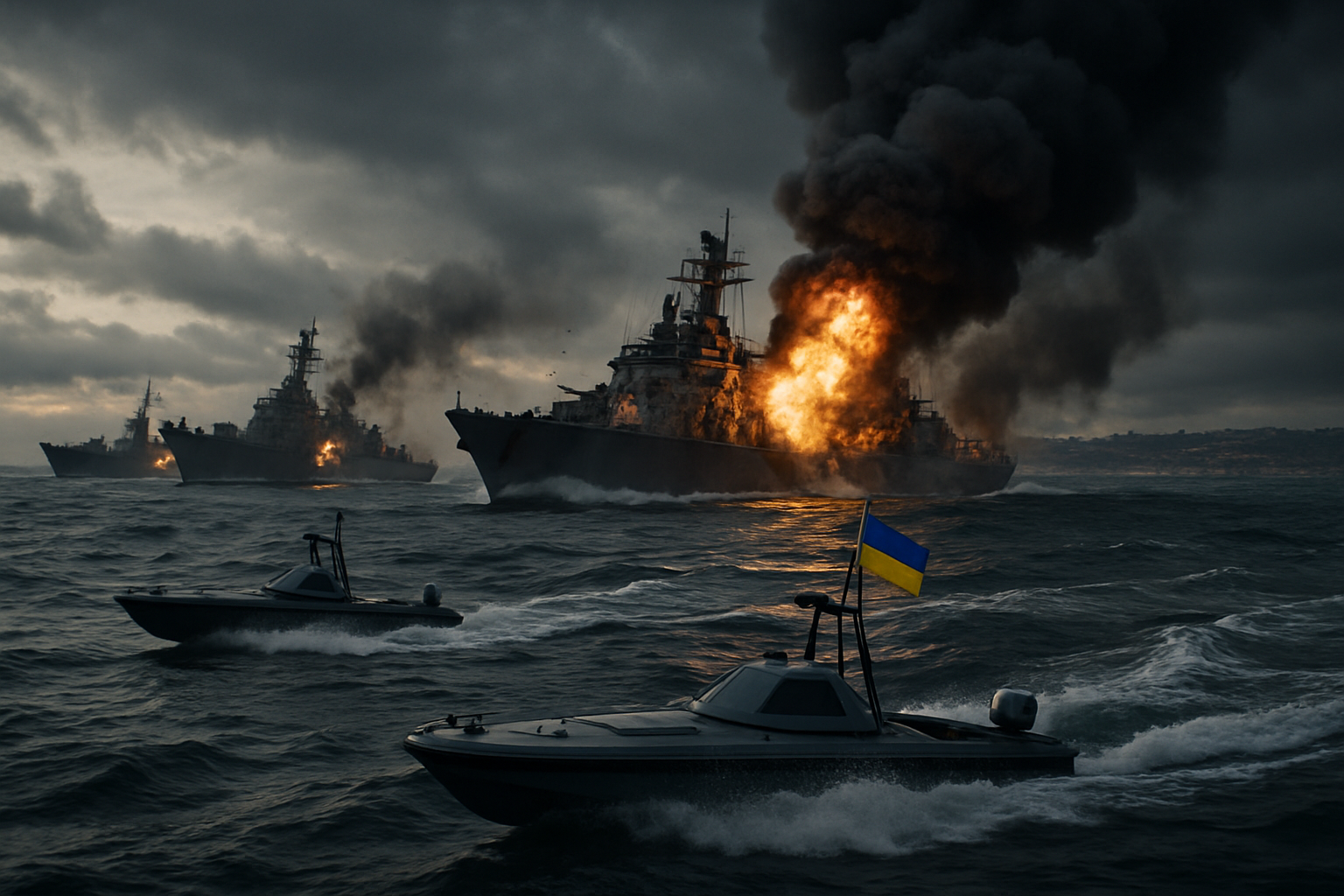
Ukrainian Defense Forces launched coordinated strikes against Russian naval vessels in occupied Crimea and targeted oil facilities in Russia, demonstrating enhanced maritime warfare capabilities as the conflict enters its fifth year.
Ukrainian military intelligence revealed successful attacks on two large Russian landing ships, the Yamal and Nikolai-Filchenkov, in Sevastopol Bay during overnight operations on April 18-19, 2026. The strikes, conducted by the specialized "Ghosts" unit of the Main Intelligence Directorate (GUR), utilized drone technology to target the vessels in occupied Crimean waters.
Coordinated Maritime and Infrastructure Attacks
The naval operations coincided with strikes on Russian territory, including an attack on the Tuapse port in Krasnodar region that killed at least one civilian and wounded another, according to regional governor Veniamin Kondratiev. The port facility, a strategic oil export hub, sustained significant damage and fires, marking the second such attack within a week.
Romanian intelligence sources confirmed that Ukrainian special forces "Ghosts" successfully engaged the Russian landing vessels in what represents one of the most significant naval operations in occupied Crimean waters since the conflict began. The attacks demonstrate Ukraine's continued ability to project force into Russian-controlled territories despite ongoing defensive pressures.
"Every dollar paid for Russian oil is money for war," Ukrainian President Volodymyr Zelensky stated, criticizing continued international sanctions relief that he argues directly funds Russian military operations.
— Volodymyr Zelensky, Ukrainian President
Sevastopol Under Extended Fire
The occupied city of Sevastopol has experienced sustained attacks over multiple days, with an oil depot in the Kozacha Bay area burning for three consecutive days following drone strikes on April 18. Ukrainian sources report that anti-aircraft fire and defensive systems were active near the Belbek airfield as Russian forces attempted to counter the aerial attacks.
The persistence of fires in Sevastopol's critical infrastructure highlights the strategic impact of Ukrainian operations on Russian logistics and fuel supplies. The Kozacha Bay facility serves as a crucial supply point for Russian naval operations in the Black Sea.
Broader Strategic Context
These operations occur against the backdrop of suspended trilateral peace negotiations between Ukraine, Russia, and the United States. The diplomatic talks, which achieved significant breakthroughs in February 2026 including a 314-prisoner exchange and restored US-Russia military communications, have been indefinitely postponed due to the ongoing Iran crisis consuming American foreign policy attention.
The attacks demonstrate Ukraine's evolution from aid recipient to security provider on the global stage. Ukrainian military specialists have been deployed to five Middle Eastern countries—UAE, Qatar, Jordan, Bahrain, and Kuwait—sharing expertise in defending against Iranian Shahed drones, the same weapon systems being used against Ukrainian infrastructure.
Enhanced Operational Capabilities
The successful targeting of Russian vessels in heavily defended Crimean waters showcases Ukrainian forces' enhanced deep-strike capabilities, with operations now routinely conducted at ranges exceeding 1,000 kilometers from Ukrainian territory. These capabilities have been developed through international cooperation, including the revelation of four operational maintenance, repair, and overhaul (MRO) facilities within Ukraine servicing Western-supplied equipment.
The UK's confirmation of these MRO facilities represents the first public acknowledgment of extensive military infrastructure on Ukrainian soil, demonstrating long-term international commitment to Ukrainian defense capabilities beyond current conflict resolution.
Nuclear Governance Crisis Backdrop
These military operations unfold under unprecedented circumstances, with the New START treaty having expired on February 5, 2026—marking the first time in over 50 years without US-Russia nuclear constraints. Both nations control approximately 80% of the world's nuclear weapons, with Russia possessing 4,380 warheads and the US maintaining 3,708.
UN Secretary-General António Guterres has described the current situation as a "grave turning point," warning that nuclear risks are at their highest level in decades. The Pentagon-Moscow deconfliction protocols represent the only remaining formal diplomatic channel between the superpowers.
Humanitarian and Military Toll
The conflict continues to exact a devastating human cost, with President Zelensky having disclosed that 55,000 Ukrainian soldiers have been officially killed, with a "large number" missing. International estimates suggest actual casualties may be two to three times higher than official figures.
Russian forces have systematically targeted civilian infrastructure in what Ukrainian officials describe as "energy terrorism," leaving over 1,170 Kyiv buildings without adequate heating during extreme winter conditions. This targeting of civilian infrastructure during harsh weather conditions has been documented as violations of the Geneva Conventions.
International Support Amid Divisions
Ukraine continues to receive historic levels of international support, including the European Union's €90 billion loan package—the largest single-nation assistance effort in history. However, European unity faces challenges, with Slovakia, Czech Republic, and Hungary refusing to participate in the financing, exposing persistent divisions within the bloc.
Sweden and Denmark have provided €246 million in air defense systems, while Germany has supplied 35 Patriot missiles. Over 17.8 million Ukrainians are accessing winter support programs as the international community maintains humanitarian assistance efforts.
Regional Energy Warfare
The Tuapse port attack represents part of Ukraine's systematic campaign targeting Russian energy infrastructure, which has disrupted approximately 40% of Russian oil export capacity through Baltic routes. These operations force Russia into more expensive alternative export routes and strand shadow fleet tankers, creating lasting economic pressure on Moscow's war financing mechanisms.
The targeting of energy infrastructure demonstrates the evolution of modern warfare, where civilian infrastructure with military relevance becomes part of the operational battlefield, raising complex questions about proportionality and civilian protection under international humanitarian law.
Looking Ahead
The successful naval operations in Crimea and continued strikes on Russian infrastructure signal Ukraine's sustained operational capabilities despite multi-front defensive pressures. With peace talks suspended indefinitely, military operations are likely to continue escalating as both sides seek to improve their positions for eventual negotiations.
The framework for diplomatic engagement remains intact, with prisoner exchange mechanisms and Pentagon-Moscow deconfliction protocols providing foundations for future diplomatic reactivation when international conditions permit. However, fundamental disagreements over territorial sovereignty in eastern Ukraine persist as the primary obstacle to comprehensive peace.
As the conflict enters its fifth year, these operations demonstrate how 21st-century warfare increasingly blurs traditional boundaries between military and civilian targets, while technological advancement enables precision strikes at unprecedented ranges, fundamentally altering the strategic landscape of modern conflict.