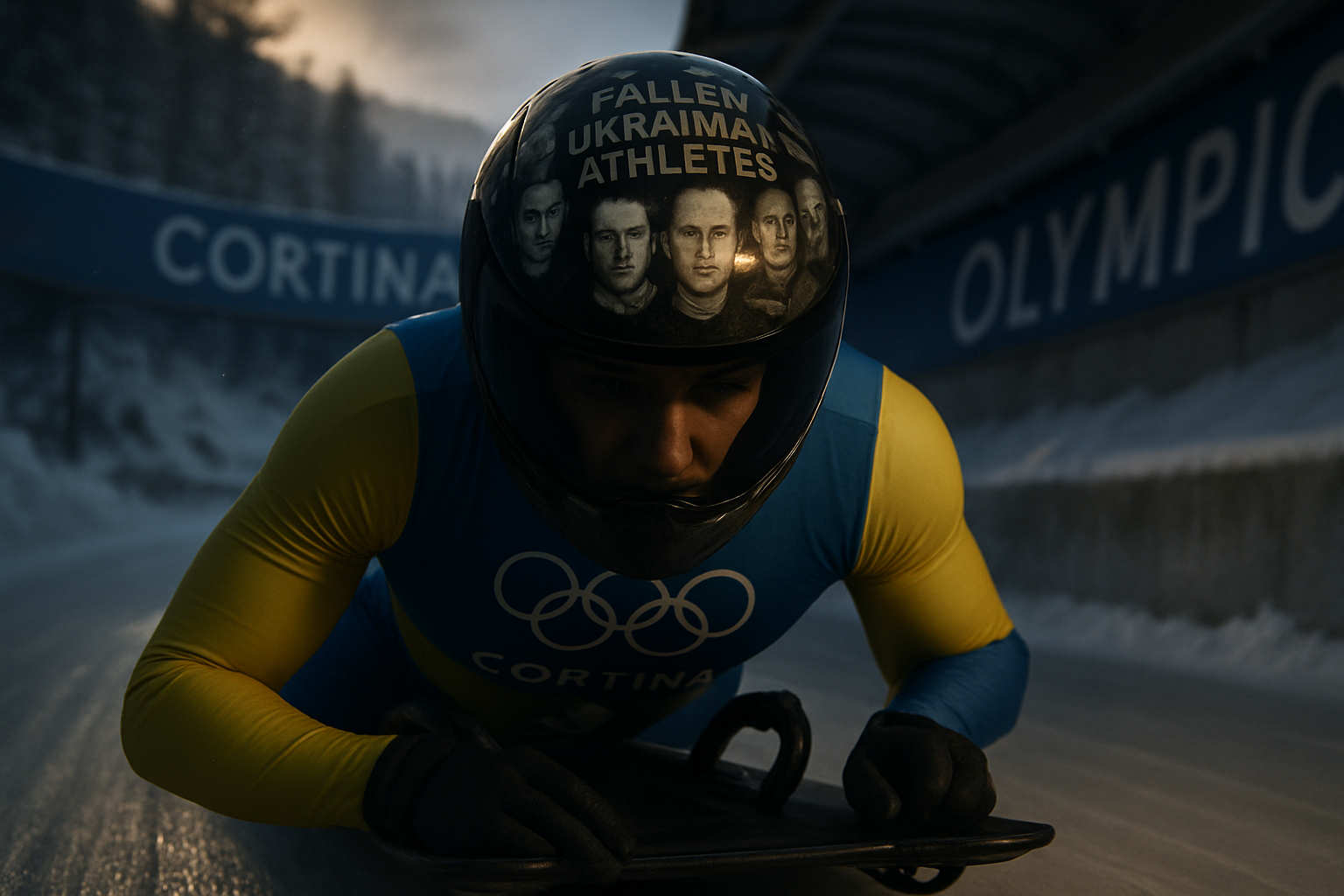
Ukrainian skeleton racer Vladyslav Heraskevych has been expelled from the Milano-Cortina 2026 Winter Olympics after refusing to compete with a regulation helmet, choosing instead to honor fallen Ukrainian athletes with a memorial design depicting over 20 athletes and coaches killed during Russia's war against Ukraine.
The International Olympic Committee announced Thursday that Heraskevych was disqualified from the Games "after refusing to adhere to the IOC athlete expression guidelines," withdrawing his accreditation just hours before his scheduled competition debut. The decision has sparked international controversy and drawn sharp criticism from Ukrainian officials, including President Volodymyr Zelensky.
The Memorial Helmet Controversy
Heraskevych's customized helmet featured the faces of more than 20 Ukrainian athletes and coaches who have been killed during the ongoing war that began shortly after the 2022 Beijing Olympics. The distinctive design was worn during training sessions at the Cortina d'Ampezzo sliding center, where the 2026 skeleton events are being held.
According to multiple sources, the IOC offered Heraskevych an alternative - wearing a black armband to honor the fallen athletes while competing with a regulation helmet. However, the Ukrainian athlete firmly rejected this compromise.
"Even if the IOC wants to betray the memory of these athletes, I will not betray them. This is the price of our dignity."
— Vladyslav Heraskevych, Ukrainian Skeleton Racer
The athlete took to social media to defend his decision, writing on X (formerly Twitter): "To je cena naší důstojnosti" (This is the price of our dignity), emphasizing that he would not compromise on honoring his fallen compatriots.
International Response and Support
The disqualification has generated widespread international reaction, with Ukrainian officials condemning the IOC's decision as playing into Russian propaganda. President Zelensky directly addressed the controversy, stating that the Olympic movement "should not play along with the aggressor" and describing the IOC's decision as contrary to Olympic principles of justice.
The National Olympic Committee of Ukraine has rallied behind Heraskevych, with officials arguing that his memorial helmet represented the values of remembrance and honor that should be celebrated rather than suppressed. Lithuanian media described the IOC's action as a "despicable step," reflecting broader Eastern European solidarity with Ukraine.
French media reported that the IOC's decision "aligns with Russian propaganda," highlighting the geopolitical dimensions of what might otherwise be seen as a simple rule enforcement. The controversy has exposed tensions between Olympic neutrality policies and athletes' desires to commemorate tragedy and loss.
Olympic Expression Guidelines Under Scrutiny
The disqualification raises fundamental questions about the IOC's athlete expression guidelines, which are designed to maintain political neutrality at the Olympic Games. These rules generally prohibit displays that could be interpreted as political statements, but critics argue that memorializing war victims transcends politics.
Heraskevych's case is particularly poignant given the timing - the Milano-Cortina Games are taking place while Ukraine continues to face ongoing Russian attacks. The IOC has faced similar challenges throughout these Olympics, including decisions about Russian athlete participation and various forms of expression by Ukrainian competitors.
The Human Cost Behind the Helmet
The faces depicted on Heraskevych's helmet represent a tragic toll on Ukraine's sporting community. Since Russia's full-scale invasion began in February 2022, numerous Ukrainian athletes and coaches have been killed, representing not only personal losses but also the destruction of Ukraine's sporting infrastructure and future.
The skeleton racer's gesture was meant to ensure that these individuals would not be forgotten, even in the context of international competition. For Heraskevych, competing without acknowledging their sacrifice would have been a betrayal of their memory.
Broader Olympic Context
The Milano-Cortina 2026 Olympics have been marked by various controversies and challenges, from infrastructure delays to geopolitical tensions. The Heraskevych case adds another layer to ongoing debates about the role of politics in sport and the limits of athlete expression at the Olympic Games.
This incident occurs against the backdrop of broader diplomatic efforts to end the war in Ukraine, including recent prisoner exchanges and trilateral talks. The contrast between diplomatic engagement and the silencing of memorial gestures at the Olympics highlights the complex intersection of sport, politics, and human rights.
"This decision is definitely not about Olympic principles based on justice and respect for human dignity."
— President Volodymyr Zelensky
The Price of Remembrance
Heraskevych's expulsion from the Olympics represents a choice between competing for Olympic glory and maintaining his principles of remembrance. The athlete has consistently stated that he has no regrets about his decision, viewing it as upholding the dignity of those who can no longer speak for themselves.
The controversy extends beyond a single athlete's protest to fundamental questions about how international sporting bodies should respond to ongoing conflicts and human suffering. While the IOC maintains its commitment to political neutrality, critics argue that such neutrality can become complicity when faced with clear cases of aggression and victimization.
As the Milano-Cortina Olympics continue, the empty space left by Heraskevych's absence serves as a powerful reminder of the human cost of war and the ongoing struggle to balance athletic competition with moral responsibility. The Ukrainian skeleton racer may have lost his chance to compete, but his message about remembering the fallen has resonated far beyond the sliding tracks of Cortina d'Ampezzo.
The incident underscores the continuing challenges facing Ukrainian athletes who seek to compete while their country remains under attack, and the difficult decisions international sporting bodies must make when athletic competition intersects with human tragedy and geopolitical conflict.