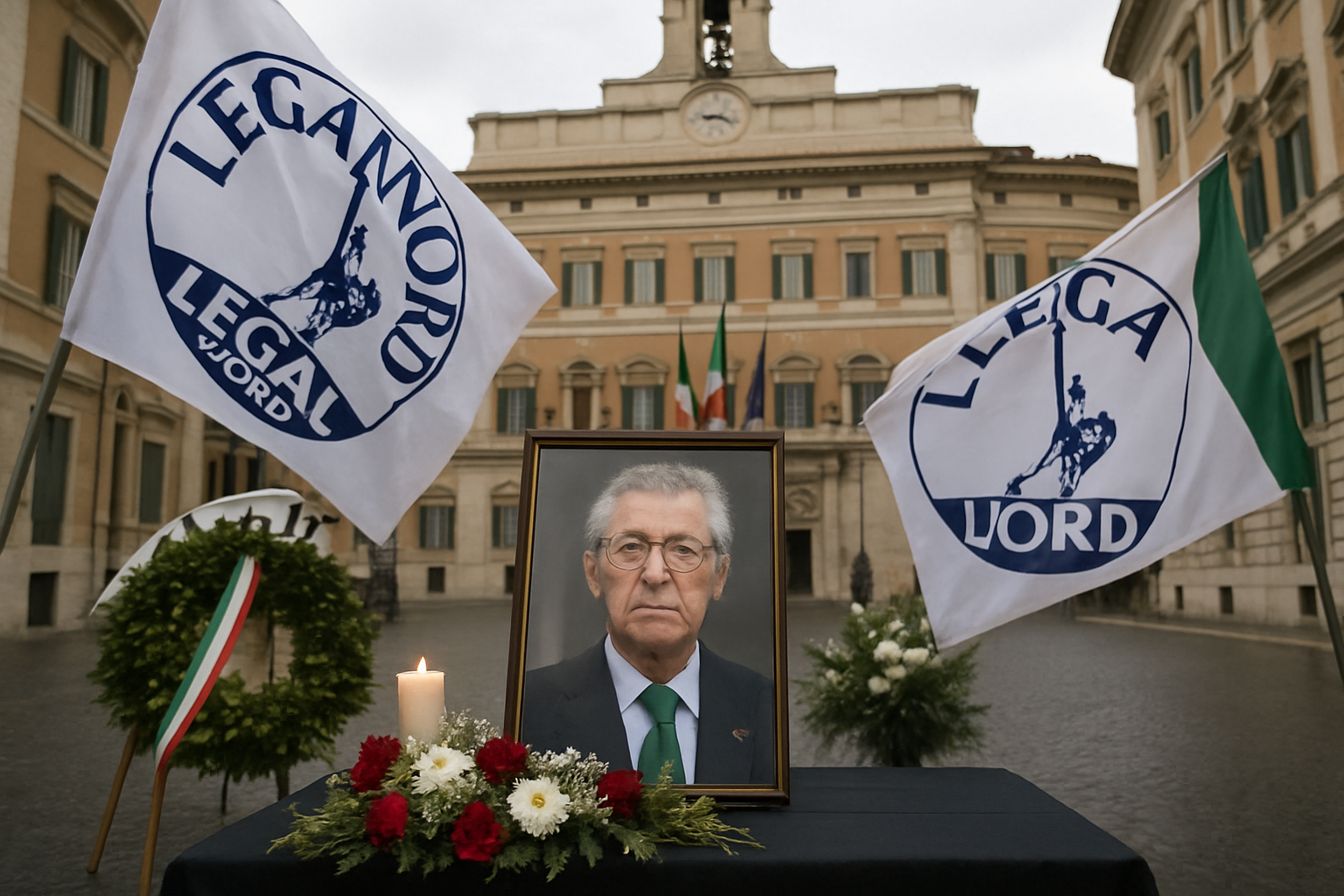
Umberto Bossi, the founder of Italy's Northern League party who revolutionized Italian politics with his separatist Padania movement and influenced the rise of populist nationalism across Europe, died at age 84 on March 20, 2026, at Circolo Hospital in Varese after being admitted to intensive care two days earlier.
Known throughout his political career as "Il Senatur" (The Senator), Bossi had been suffering from declining health since a severe stroke in 2004 that left him partially paralyzed and struggling with speech difficulties. His death marks the end of an era for a politician who fundamentally altered Italy's post-war political landscape and provided a template for right-wing populist movements that would later emerge across Europe.
"After a life lived to the last breath, he leaves us the strength to never give up," his son Renzo said in a statement, capturing the combative spirit that defined Bossi's five-decade political career.
The Revolutionary Vision of Padania
Bossi's most audacious political project was the creation of "Padania," an imagined independent northern Italian state that would separate the industrialized, prosperous north from what he characterized as the economically dependent south. Founded in 1991, Lega Nord became the political vehicle for this separatist vision, combining regional identity politics with anti-establishment rhetoric and early expressions of the immigration concerns that would later dominate European political discourse.
His movement pioneered strategies that became standard for populist parties across the continent: the cultivation of regional identity against national elites, the use of referendums as direct democratic tools, and the positioning of immigration as a threat to local communities. These innovations influenced movements from France's National Rally to Germany's Alternative for Deutschland, earning him recognition as what Austrian media described as the "pioneer of European right-wing populism."
The theatrical declaration of Padanian independence in 1996, complete with ceremonial river water from the Po collected in amphorae, demonstrated Bossi's understanding of political symbolism and media manipulation—tactics that would become hallmarks of 21st-century populist movements.
Kingmaker in Italian Politics
Despite—or perhaps because of—his separatist agenda, Bossi became an essential power broker in Italian national politics. His party's electoral strength in the wealthy northern regions made him an indispensable coalition partner for Silvio Berlusconi's center-right governments, providing Lega Nord with influence over immigration policy and federalism reforms far beyond what their vote share might suggest.
This pragmatic approach to power allowed Bossi to implement incremental steps toward greater regional autonomy while maintaining his ultimate separatist vision. His ability to extract concessions from national governments while positioning himself as an outsider challenging the Rome-based establishment became a model for populist parties seeking to work within democratic systems while claiming to oppose them.
The Scandals and Downfall
Bossi's political career ended in disgrace in 2012 when financial scandals forced his resignation as party leader. Investigations revealed the misuse of public funds, including the infamous purchase of a Ferrari for his son using party money intended for political activities. His 2017 conviction for embezzlement, though resulting in only a suspended sentence, symbolized the corruption that had infected the movement he founded.
These scandals created the opening for Matteo Salvini to assume leadership of Lega and transform it from a regional separatist movement into a national anti-immigration party. Under Salvini, the party abandoned Bossi's Padanian dream in favor of broader Italian nationalism, a shift that reportedly caused deep disappointment for the movement's founder.
A Complicated Legacy
The relationship between Bossi and Salvini had been strained for over a decade, with the old guard never fully accepting the transformation of their regional movement into what critics called a "national-populist" party. According to sources close to the party, the tension peaked during the 2024 European elections when rumors circulated—never denied—that Bossi had voted for Forza Italia rather than his own party.
Former Interior Minister Roberto Castelli, one of Bossi's longtime allies, defended his legacy: "We have never betrayed his Lega, the real one—not the nationalist and southern-leaning one of Salvini. A warrior. Frank, rough but humanly exceptional." This sentiment was echoed by other veterans of the original Northern League who felt that Salvini's transformation had betrayed Bossi's authentic regional vision.
Recognition Across the Political Spectrum
Despite decades of political conflict, tributes poured in from across Italy's political spectrum following news of Bossi's death. Current Lega leader Matteo Salvini, setting aside their differences, posted a simple "Ciao capo" (Goodbye chief) on social media, acknowledging his debt to the man who built the movement he now leads.
President Sergio Mattarella, representing the institutional establishment that Bossi spent his career opposing, described Italy as losing a "sincere democrat," recognizing his authentic commitment to his beliefs despite their controversial nature. Prime Minister Giorgia Meloni acknowledged his historical significance while maintaining her political differences with his methods.
Perhaps most tellingly, former Democratic Party leader Pier Luigi Bersani admitted: "Bossi was the adversary to whom I felt most attached in life. It's true that he had gone with Berlusconi, but he would never have gone with CasaPound"—a reference to Italy's neo-fascist movements that Bossi consistently opposed despite his right-wing politics.
European Influence and Modern Relevance
Bossi's political innovations extended far beyond Italy's borders, providing a template for populist movements that would reshape European politics in the 21st century. His combination of regional identity politics, anti-establishment rhetoric, and immigration concerns became the standard playbook for parties like France's National Rally, which has seen significant success in recent municipal elections, and movements in Germany, Austria, and across Eastern Europe.
The recent defection of General Roberto Vannacci from Salvini's Lega to form the "Futuro Nazionale" movement, with claims that other leaders would follow, demonstrates the continued relevance of debates Bossi initiated about the proper direction of Italian right-wing politics. These internal party tensions reflect broader questions about whether populist movements should remain regionally focused or expand to national and European levels.
Contemporary examples across Europe show the enduring influence of strategies Bossi developed in the 1990s. From Sweden's cooperation between liberal parties and the Sweden Democrats to local electoral successes by right-wing populist movements in France and Germany, the political innovations pioneered by "Il Senatur" continue to shape democratic politics across the continent.
The End of an Era
Umberto Bossi's death closes a chapter in European political history that began with the collapse of Italy's post-war political system in the 1990s and extends to today's continental debates over immigration, regional identity, and European integration. His life embodied the contradictions of modern populist politics: the authentic representation of genuine regional grievances combined with the exploitation of social divisions for political gain.
Whether viewed as a democratic innovator who gave voice to neglected regional concerns or as a divisive figure who pioneered the politics of resentment that continue to challenge European unity, Bossi's influence on Italian and European politics is undeniable. His funeral is expected to draw hundreds of supporters from across northern Italy who remember him not as the scandal-plagued figure of his final years, but as the charismatic leader who promised them a homeland called Padania.
As Europe continues to grapple with questions of national identity, regional autonomy, and democratic representation that Bossi first raised three decades ago, his passing marks not just the end of a political career, but the conclusion of a defining era in European political development. The movements he inspired continue to evolve, but they will do so without the guidance of the man who first showed them how to transform regional dissatisfaction into continental political influence.