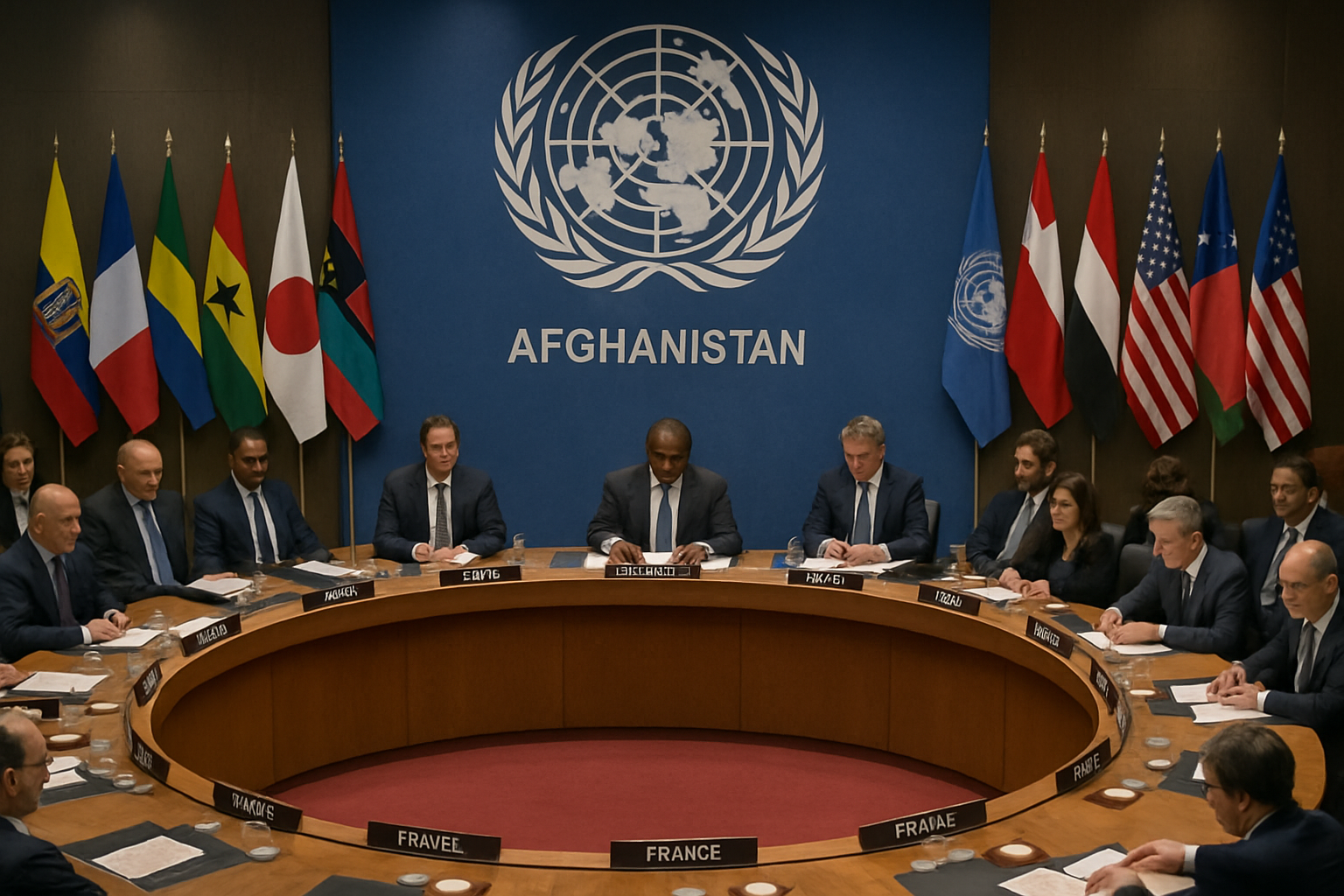
The United Nations Security Council has approved a three-month extension of the mandate for the UN Assistance Mission in Afghanistan (UNAMA), marking a significant departure from the mission's typical annual renewal cycle following calls by the United States for a comprehensive review of international engagement in the country.
The council voted on Monday to continue UNAMA's mandate temporarily, allowing additional time for crucial discussions among member states regarding the future role of the United Nations in Afghanistan. This decision represents the first time since 2021 that the mission has received such a limited extension, reflecting deep divisions within the international community over how to engage with Taliban authorities.
Historical Context and Mission Evolution
UNAMA was established in 2002 following the U.S.-led intervention that removed the Taliban from power. Throughout its two-decade history, the mission's mandate has typically been renewed annually, with only one previous exception in 2021 when the Security Council granted a six-month extension following the Taliban's return to power in August of that year.
China, which currently holds responsibility for drafting UN resolutions on Afghanistan, confirmed that the shorter extension was agreed upon to accommodate requests from several council members to review and potentially adjust UNAMA's mandate. The decision comes amid ongoing tensions between the international community and Taliban authorities over human rights issues, particularly concerning women's rights and governance practices.
Taliban Criticism of Sanctions Regime
The extension announcement coincided with intensified criticism from Taliban officials regarding the international sanctions regime. Zabihullah Mujahid, spokesperson for the Islamic Emirate of Afghanistan, has described the continued sanctions against Afghan officials as violations of human rights that should be lifted immediately.
"Imposing sanctions deprives individuals of their rights and has been done without cause. These sanctions have produced no results over the years and have not been a successful experience. Renewing the list again is simply repeating the same failed policy."
— Zabihullah Mujahid, Taliban Spokesperson
Mujahid argued that placing senior officials on sanctions lists restricts their ability to travel and engage internationally, which he maintains ultimately harms both the country and its people. The Taliban spokesperson emphasized that the sanctions have failed to achieve their intended objectives and represent a continuation of what he termed "ineffective policy."
U.S. Position and Review Process
The United States' request for a comprehensive review reflects growing concerns within the Biden administration about the effectiveness of current international engagement strategies with Afghanistan. The review is expected to examine UNAMA's operational capacity, humanitarian coordination role, and political engagement mechanisms with Taliban authorities.
American officials have consistently maintained that any long-term international recognition or normalized relations with the Taliban must be contingent on improvements in human rights, particularly regarding women's access to education and employment, as well as broader governance reforms.
Regional Security Implications
The UNAMA extension comes against the backdrop of significant regional security challenges. The mission operates in an increasingly complex environment, with ongoing concerns about terrorism threats from groups like ISIS-K, humanitarian crises affecting millions of Afghans, and persistent tensions over cross-border security issues.
Recent intelligence assessments have highlighted the continued presence of international terrorist organizations operating within Afghanistan, despite Taliban assurances that such groups have been eliminated. These security concerns factor heavily into international deliberations about the appropriate level and nature of engagement with Afghan authorities.
Humanitarian Crisis Context
Afghanistan continues to face one of the world's most severe humanitarian crises, with approximately 88% of female-headed households unable to meet minimum living requirements according to UN assessments. The World Health Organization has been forced to provide emergency medical oxygen to only 23 hospitals across the country, while hundreds of health centers have closed due to funding shortfalls.
UNAMA plays a crucial coordination role in humanitarian operations, working with international organizations to deliver aid to vulnerable populations. The mission's continued presence is considered essential by humanitarian agencies operating in the country, despite political tensions surrounding broader diplomatic engagement.
International Community Divisions
The three-month extension reflects deeper divisions within the international community about how to approach Afghanistan policy. While some nations advocate for increased engagement to address humanitarian needs and encourage gradual reforms, others maintain that any expansion of relations must be contingent on concrete improvements in governance and human rights practices.
European Union representatives have emphasized the importance of maintaining pressure on Taliban authorities regarding women's rights, while some regional powers, including China and Russia, have called for more pragmatic engagement approaches that prioritize stability and economic development.
Women's Rights as Central Issue
The extension discussions occur as Afghanistan ranks 181st out of 181 countries in the Georgetown Institute for Women, Peace and Security Index, marking the absolute lowest position globally. Taliban restrictions have systematically excluded women from most aspects of public life, creating what international legal experts describe as a system of "gender apartheid."
UN Special Rapporteur Richard Bennett has warned that these restrictions not only violate fundamental human rights but also contribute to the country's humanitarian and economic crises by removing approximately half of the potential workforce from productive economic activity.
Economic Dimensions
The sanctions regime and international isolation have contributed to Afghanistan's economic collapse, with bilateral trade relationships severely impacted. The country's banking system remains largely cut off from international financial networks, complicating even humanitarian operations and basic commercial activities.
Taliban officials argue that economic sanctions harm ordinary Afghans more than government officials, and they have called for the unfreezing of Afghan assets held abroad to address humanitarian needs. However, international authorities maintain that any significant sanctions relief must be linked to measurable improvements in governance and human rights practices.
Looking Ahead
The three-month extension period will be crucial for determining the future trajectory of international engagement with Afghanistan. UNAMA officials will continue their humanitarian coordination work while the broader international community conducts its policy review.
Key issues that will likely influence future decisions include the Taliban's approach to women's rights, cooperation on counter-terrorism efforts, governance reforms, and willingness to engage constructively with international humanitarian operations. The outcome of this review period could significantly impact not only UNAMA's future mandate but also the broader international approach to Afghanistan for years to come.
As the international community grapples with these complex challenges, the extension represents both a continuation of existing engagement mechanisms and an acknowledgment that current approaches may require substantial recalibration to address Afghanistan's evolving situation effectively.