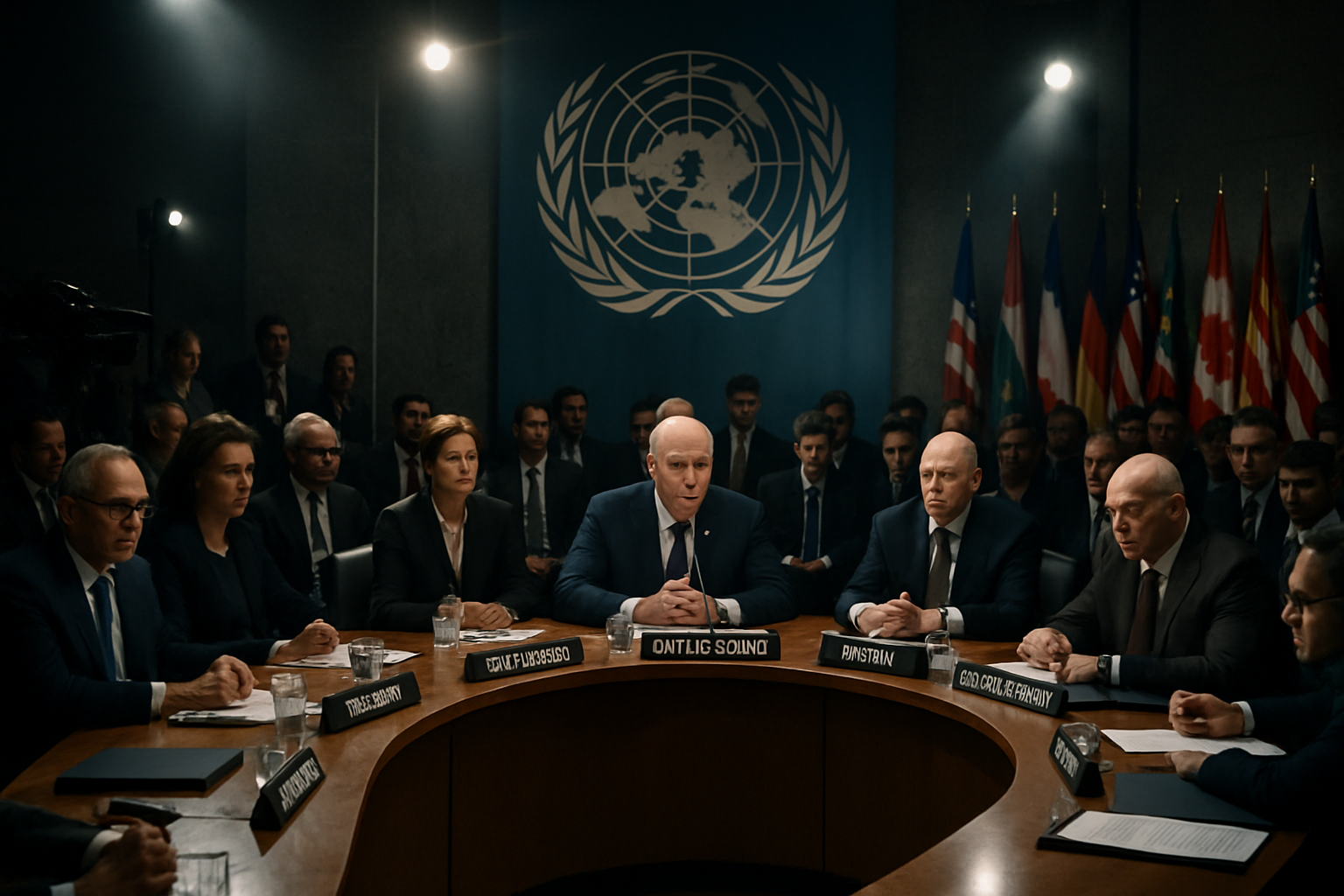
The United Nations Security Council passed a sweeping resolution on March 12, 2026, condemning Iran's ongoing attacks against Gulf states and demanding an immediate cessation of hostilities amid the most dangerous international crisis since the Cold War.
The resolution, co-sponsored by 135 countries, represents a remarkable diplomatic achievement given the complex geopolitical dynamics at play. Most significantly, Iran's traditional allies Russia and China abstained from voting rather than exercising their veto power, allowing the measure to pass with broad international support.
Historic Security Council Action
The Security Council resolution specifically condemns Iran's Revolutionary Guard for "interfering with international navigation through the Strait of Hormuz" and demands the Islamic Republic halt all attacks on regional shipping. The measure comes as Iran has effectively blockaded the strategic waterway, which handles 40% of global seaborne oil transit.
According to multiple diplomatic sources, the resolution's passage required intensive behind-the-scenes negotiations. Germany's representative to the UN played a crucial role in building consensus, while Greek diplomats coordinated with regional partners to ensure unified support from affected Gulf states.
Iran immediately rejected the resolution as what officials called a "political maneuver orchestrated by the United States and Israel." Iranian Foreign Minister Abbas Araghchi dismissed the measure as "meaningless interference in our sovereign right to defend against unprovoked aggression."
Escalating Maritime Crisis
The UN action comes against the backdrop of Iran's systematic closure of the Strait of Hormuz following the March 1 death of Supreme Leader Ali Khamenei in the US-Israeli "Operation Epic Fury" strikes. Iran's Revolutionary Guard has deployed an estimated 2,000-6,000 naval mines using small vessels, with US forces having destroyed 16 Iranian mine-laying ships in response.
Over 150 oil and LNG tankers remain stranded in the Persian Gulf, representing billions in cargo value. Major shipping companies Maersk and MSC have suspended all operations in the region, while Qatar has halted LNG production at its Ras Laffan and Mesaid facilities, affecting approximately 20% of global LNG exports.
"The situation threatens the foundations of international maritime law and global energy security. We cannot allow one nation to hold the world economy hostage through illegal blockades of international waters."
— UN Secretary-General António Guterres
The crisis has triggered the largest emergency oil reserve release in the International Energy Agency's 50-year history, with 32 member countries deploying 400 million barrels to stabilize global markets. Oil prices have surged to over $100 per barrel for the first time since 2022, with Brent crude reaching a peak of $119.50.
Regional Coalition Under Strain
The Security Council resolution reflects growing international concern about Iran's systematic targeting of Gulf states during its "Operation True Promise 4" retaliation campaign. The Iranian strikes have caused casualties across the region:
- UAE: 1 civilian killed in Abu Dhabi, Dubai International Airport completely shut down
- Kuwait: 32 foreign nationals injured in airport drone strikes
- Qatar: 8 people wounded despite Patriot missile systems intercepting 65 missiles and 12 drones
- Cyprus: RAF Akrotiri base struck in the first attack on European territory since WWII
Egyptian President Abdel Fattah Al-Sisi condemned the Iranian attacks on "sisterly Arab countries," warning of "comprehensive chaos" spreading across the region. The unprecedented Saudi Arabia-UAE-Qatar-Egypt coalition that had previously supported diplomatic solutions is now severely strained by Iran's direct targeting of member territories.
Global Economic Impact
The maritime crisis has triggered the most severe global energy emergency in decades. Natural gas prices have exploded by 24% in Europe and 78% in the United States, reaching €47.32 per MWh—the highest level since February 2025.
Consumer impacts are spreading worldwide: Sweden faces electricity increases of 10-20 öre and gasoline price rises of 1-2 kronor, while Ireland confronts heating oil prices approaching €2 per liter. Pakistan has implemented fuel rationing for 170 million people, and Bangladesh faces its most severe energy shortage in years.

Financial markets have crashed globally, with Pakistan's KSE-100 index recording its largest single-day decline in history at -8.97%. South Korea's KOSPI fell 12%, triggering circuit breakers, while the Korean won hit a 17-year low. The crisis has forced PayPal to postpone its $1.1 billion IPO indefinitely.
Diplomatic Breakdown Context
The current crisis stems from the complete collapse of US-Iran nuclear negotiations despite what had been hailed as a breakthrough. The Geneva framework talks achieved "broad agreement on guiding principles"—the most progress since the 2018 JCPOA collapse—but ultimately foundered on fundamental scope disagreements.
Iran excluded ballistic missiles and proxy forces as "red lines" while insisting on nuclear-only negotiations. The United States demanded comprehensive agreements covering missiles, armed groups, and human rights issues. This impasse led directly to Operation Epic Fury, the largest coordinated US-Israeli military operation since the 2003 Iraq invasion.
Iran continues enriching uranium to 60% purity with over 400 kilograms of weapons-grade material—sufficient for multiple nuclear weapons if weaponized. The crisis occurs against the broader backdrop of nuclear governance breakdown, with the New START Treaty having expired on February 5, marking the first time in over 50 years without US-Russia nuclear constraints.
European Security Implications
The Iranian drone strike on Cyprus's RAF Akrotiri base represents a watershed moment for European security, marking the first attack on European territory since World War II. This unprecedented escalation has prompted an extraordinary naval coalition response, with Britain's HMS Dragon, Spanish frigates, and vessels from Italy, France, Netherlands, and Greece deploying to protect European interests.
Cyprus activated its national ESTIA evacuation plan for the first time, evacuating the Akrotiri village and closing schools in surrounding areas. The attack exposed critical gaps in European civil defense capabilities, with only 2,200 shelters available for 30% of the population.
Aviation Crisis Reaches Global Scale
The conflict has triggered an unprecedented aviation crisis, with over 18,000 flights cancelled worldwide—the most extensive disruption since COVID-19. Eight Middle Eastern countries have simultaneously closed their airspace: Iran, Iraq, Israel, UAE, Qatar, Syria, Kuwait, and Bahrain.
Dubai International Airport, the world's busiest with 86 million passengers annually, remains completely shut down due to missile damage. Emirates, Air France-KLM, Wizz Air, and Bulgaria Air have suspended operations indefinitely, affecting hundreds of thousands of passengers globally and severing the critical Europe-Asia aviation hub.
International Response and Implications
The Security Council resolution represents the largest diplomatic mobilization since the Cold War, with emergency sessions convened following formal requests from France, China, Russia, Colombia, and Bahrain. UN Secretary-General Guterres has called the situation the "greatest test of multilateral cooperation and crisis management in the modern era."
Russia's decision to abstain rather than veto the resolution—despite condemning what it calls "reckless actions by Washington and West Jerusalem"—reflects the gravity of the global economic implications. China similarly abstained while issuing its strongest condemnation of US actions in years, calling the strikes a "serious violation of Iran's sovereignty and security."
"This crisis exposes the dangerous over-dependence on strategic chokepoints that affects not just energy markets but the entire foundation of global trade. We need fundamental restructuring of international supply chains."
— Energy Analyst Samuel Ciszuk
Template-Setting Moment for 21st Century
The current crisis represents a template-setting moment for 21st-century conflict resolution, demonstrating both the fragility of modern crisis management in a multipolar era and the critical importance of international cooperation. The rapid transition from diplomatic breakthrough to military confrontation within weeks highlights fundamental challenges in contemporary governance.
Recovery timelines remain uncertain and dependent on military operations resolution rather than diplomatic normalization—unlike weather-related disruptions with predictable patterns. Aviation industries cannot maintain long-term scheduling with multiple airspaces closed, while energy markets remain volatile with critical transit routes blocked.
Traditional monetary policy has proven limited in effectiveness against structural geopolitical disruptions, forcing central banks to coordinate emergency liquidity measures across multiple economies simultaneously.
Looking Ahead: Stakes and Implications
The stakes of this crisis extend far beyond the immediate Middle Eastern context. Success in containing the escalation could provide a framework for future nuclear crisis resolution while strengthening diplomatic precedents. However, failure may accelerate military solutions to international disputes, potentially reshaping Middle Eastern geopolitics for decades while encouraging nuclear proliferation globally and undermining diplomatic credibility worldwide.
The crisis simultaneously tests regional war prevention, global energy security, nuclear governance credibility, and international law enforcement mechanisms that underpin the post-World War II order. The Persian Gulf's role as a critical trade hub extends beyond energy, affecting consumer goods and industrial materials worldwide, while exposing the fundamental vulnerability of global systems to geopolitical shocks.
As the UN Security Council's resolution takes effect, the international community faces its most consequential challenge in determining whether diplomatic solutions can prevail over military confrontation in the modern era. The decisions made in the coming days and weeks will reverberate through international relations for decades, establishing precedents for how territorial disputes, nuclear crises, and energy security challenges are managed in an increasingly interconnected but fragmented world order.