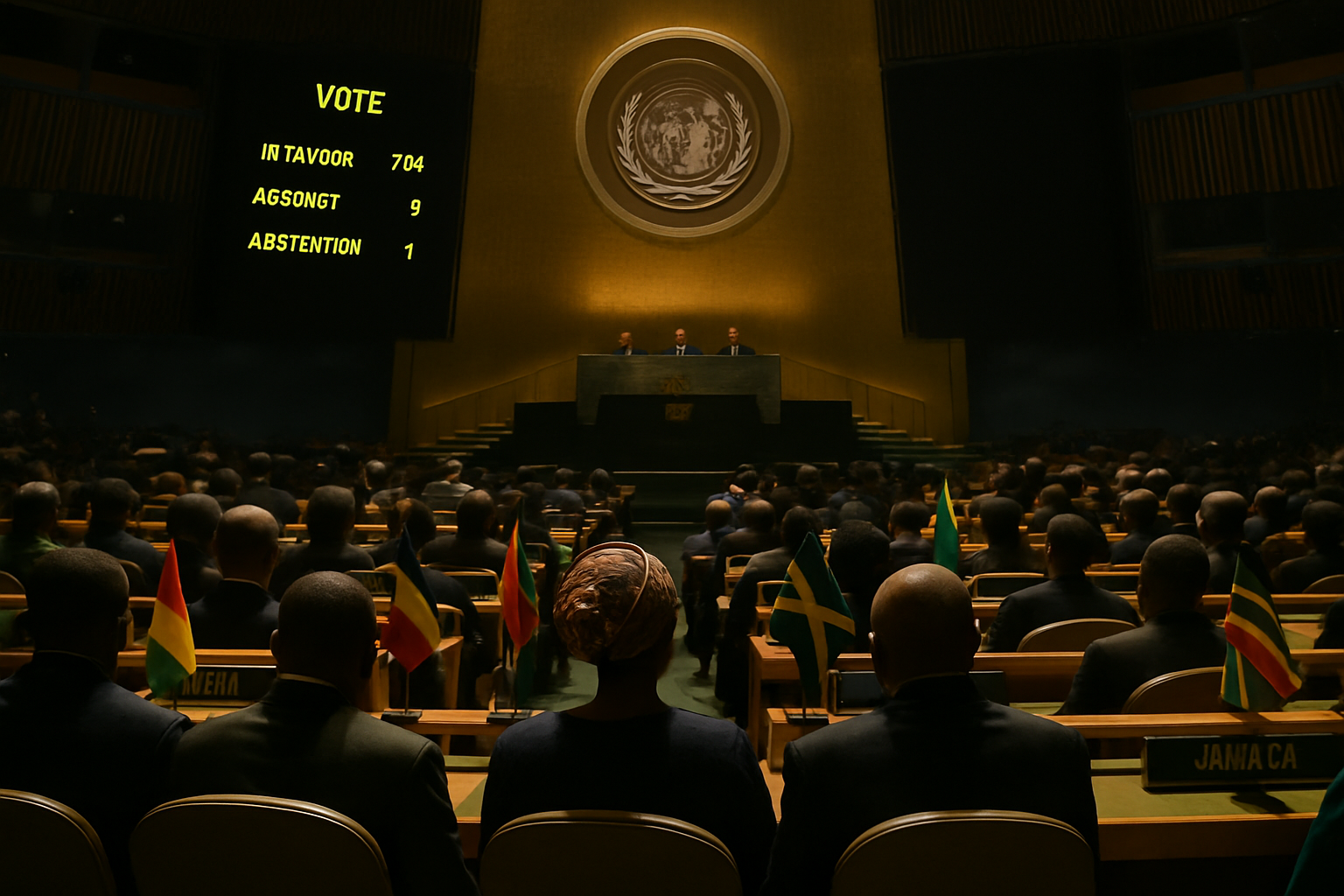
In a watershed moment for international justice, the United Nations General Assembly has adopted a historic resolution declaring the transatlantic slave trade the "gravest crime against humanity," marking the most significant diplomatic victory for African and Caribbean nations in their decades-long struggle for formal recognition of slavery's devastating impact.
The landmark resolution passed on Wednesday, March 25, 2026, with 123 member states voting in favor, three countries opposing—the United States, Israel, and Argentina—and 52 abstentions, including the United Kingdom and European Union member states. The vote took place on the International Day of Remembrance of the Victims of Slavery and the Transatlantic Slave Trade, adding symbolic weight to this unprecedented diplomatic achievement.
Ghana's Leadership and the African Coalition
The resolution was championed by Ghana on behalf of the African Group of States, with President John Dramani Mahama delivering the proposal that has fundamentally altered the international discourse on historical justice. In his address to the General Assembly, President Mahama declared: "Let it be recorded that when history beckoned, we did what was right for the memory of millions who suffered the indignity of slavery."
The initiative received unprecedented backing from the African Union and the Caribbean Community (CARICOM), representing nations most directly affected by the centuries-long transatlantic slave trade. This coordinated approach demonstrated the power of small and medium-sized nations to achieve significant diplomatic victories through strategic coalition-building around shared historical experiences.
Saint Lucia and São Tomé and Príncipe were among the nations that emphasized the profound importance of this diplomatic breakthrough, viewing it as a template for how smaller countries can drive meaningful change in international relations when unified by common purpose and moral clarity.
The Resolution's Call for Reparations
Beyond its symbolic designation, the resolution explicitly calls for reparations as "a concrete step toward remedying historical wrongs," demanding "political recognition at the highest level" of the lasting damage caused by the transatlantic slave trade. This represents the strongest international endorsement of reparative justice for slavery in the United Nations' history.
The formal designation creates potential new legal pathways for reparations claims in international courts and strengthens diplomatic negotiations between affected communities and nations with historical involvement in the slave trade. Legal experts suggest the resolution could bolster existing movements, including the HR 40 legislation in the United States studying reparations for African Americans, and cases before the European Court of Human Rights.
"This formal recognition creates moral authority and international legitimacy for reparations advocates worldwide, providing a framework that transcends individual national contexts."
— International Legal Observer
Opposition and International Divisions
The United States' opposition to the resolution reflects deep concerns about potential legal and financial implications for domestic reparations debates. The Biden administration had previously shown interest in addressing historical injustices, but the current political climate has created resistance to any international framework that could strengthen legal arguments for domestic reparations claims.
Israel's position sparked particular controversy given the nation's emphasis on Holocaust remembrance and the importance of formal international recognition of historical atrocities. Critics argued this represented an inconsistent approach to addressing crimes against humanity, though Israeli officials maintained that each historical tragedy requires unique consideration.
The United Kingdom's abstention demonstrates the ongoing tensions over colonial legacy amid growing domestic pressure for reparations to former colonies. Britain has consistently rejected calls to pay reparations, arguing that contemporary institutions cannot be held responsible for historical wrongs, but the resolution adds new diplomatic pressure to this position.
European Union's Divided Response
The abstention by European Union member states revealed internal disagreements about how to address colonial histories and their lasting consequences. While the EU has made significant strides in acknowledging historical injustices, member states remain divided on the practical implications of formal reparations frameworks.
France, Belgium, the Netherlands, and other former colonial powers have faced increasing pressure from civil society organizations and descendant communities to address their historical involvement in the slave trade. The UN resolution intensifies these domestic debates by providing international legitimacy to reparations advocacy.
Regional Reactions and Support
Mauritania welcomed the resolution through its human rights commission, stating that this formal declaration "represents a great moral victory for collective memory and a decisive step toward comprehensive international justice." The commission emphasized that slavery in all its forms remains "a flagrant violation of human conscience requiring firm international condemnation."
Nigeria joined Ghana and 121 other UN member states in supporting the resolution, with the Nigerian delegation viewing it as essential for addressing "historical wrongs" through concrete reparative measures. The collaboration between West African nations demonstrated the strategic coordination that made this diplomatic breakthrough possible.
The Democratic Republic of Congo, through Radio Okapi, reported extensively on the vote, emphasizing how the resolution passed "despite opposition from certain states, including the USA." This coverage highlighted African perspectives on the international dimensions of reparations advocacy.
Historical Context and Precedent
The resolution builds upon decades of advocacy by African and Caribbean nations for international recognition of slavery's impact. Previous efforts had achieved partial recognition through UNESCO programs and national reconciliation initiatives, but this represents the first formal designation of the transatlantic slave trade as the "gravest crime against humanity" in UN history.
The timing coincides with growing global movements for racial justice and increased scrutiny of institutions with historical connections to slavery. Universities, museums, corporations, and governments worldwide have faced pressure to acknowledge their roles in perpetuating systems of exploitation and to provide meaningful redress.
Implementation Challenges and Next Steps
While the resolution provides crucial moral and political authority, significant challenges remain in translating this symbolic victory into meaningful reparative justice. Complex questions persist about which institutions and nations bear responsibility, how to identify and compensate descendant communities, and what forms reparations should take beyond financial transfers.
The African Union has announced plans to use the resolution as a foundation for renewed negotiations with former colonial powers, while Caribbean nations view it as strengthening their position in ongoing discussions with European countries about reparations for slavery and colonialism.
Practical implementation will require innovative approaches to addressing questions of descendant identification, compensation methods, and the roles of various responsible institutions. Some experts advocate for educational initiatives, cultural preservation programs, and development aid as components of comprehensive reparative frameworks.
Legal and Diplomatic Implications
Unlike UN Security Council resolutions, General Assembly resolutions are not legally binding under international law. However, they carry significant moral and political weight, particularly when supported by such a substantial majority of member states. The resolution establishes new diplomatic precedents and creates frameworks for future accountability mechanisms.
The formal designation could influence judicial decisions in domestic and international courts addressing slavery-related claims. It provides advocates with United Nations authority when arguing for institutional accountability and governmental action on reparations.
Legal scholars note that the resolution's language about "political recognition at the highest level" creates expectations for governmental responses, potentially influencing electoral politics in countries with significant descendant populations.
Global Context and Future Trajectory
The resolution's passage occurs within a broader context of international engagement with historical injustices and human rights accountability. It demonstrates how sustained advocacy, strategic coalition-building, and moral clarity can achieve diplomatic breakthroughs even when traditional power structures resist change.
The success provides a template for other historical justice movements seeking international recognition and support. Indigenous rights advocates, genocide survivors, and other communities affected by systematic historical oppression may draw inspiration from the African-Caribbean approach to UN engagement.
"This is not an ending but a beginning of renewed international engagement with historical injustice that requires sustained implementation efforts worldwide."
— UN Diplomatic Observer
Criticism and Counterarguments
Critics of the resolution argue that it oversimplifies complex historical processes involving multiple actors and contexts over several centuries. Some scholars contend that ranking historical crimes could diminish attention to other atrocities, including contemporary forms of human trafficking and forced labor.
Opposition voices also raise concerns about the precedential implications for international law and diplomacy. They worry that formal rankings of historical crimes could create problematic hierarchies that serve political rather than humanitarian purposes.
Additionally, some analysts question whether symbolic resolutions can achieve meaningful change without concrete implementation mechanisms and adequate resources for reparative programs.
Economic and Development Dimensions
The resolution's call for reparations occurs amid growing recognition of the economic dimensions of historical injustice. Recent scholarship has documented the massive wealth transfers involved in the transatlantic slave trade and their lasting effects on both African societies and European/American development.
Development economists increasingly view reparative justice as essential for addressing contemporary inequalities rooted in historical exploitation. This perspective influences discussions about international development aid, trade relationships, and economic cooperation between former colonies and colonial powers.
The resolution may influence multilateral development bank policies, bilateral trade agreements, and other economic relationships between affected regions. Some advocates hope it will reshape development cooperation from charity-based to justice-based approaches.
Looking Forward: A New Era of Reparative Justice
March 25, 2026, represents a watershed moment in the international recognition of slavery's impact, opening new possibilities for sustained engagement with historical injustice. The resolution transforms reparations advocacy from marginalized activism to internationally legitimized diplomacy.
The African Union and CARICOM are already developing frameworks to translate this diplomatic victory into concrete negotiations with relevant governments and institutions. Success will depend on maintaining the coalition unity that achieved this breakthrough while adapting to the practical challenges of implementation.
As the world grapples with rising authoritarianism, climate change, and economic inequality, the resolution provides hope that international cooperation and moral leadership can still achieve transformative change. The coalition of African and Caribbean nations demonstrated that even relatively small countries can drive global conversations when united by shared values and strategic vision.
The coming years will determine whether this historic recognition translates into meaningful reparative justice for the millions of descendants of enslaved Africans worldwide. The resolution creates possibilities; sustained advocacy and implementation will determine whether those possibilities become reality for communities still experiencing the legacy of humanity's "gravest crime."