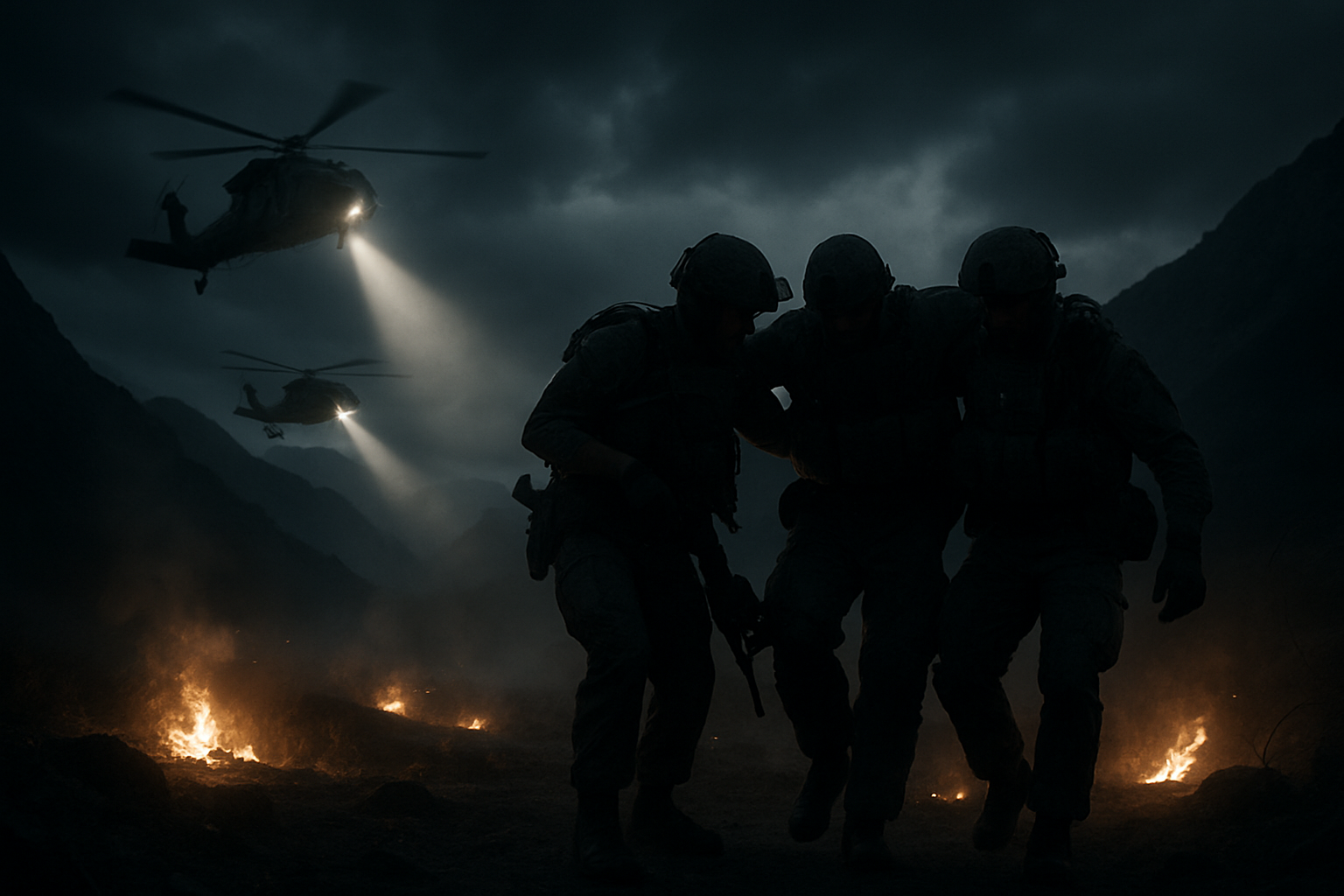
US special forces successfully rescued an injured airman from a downed F-15E Strike Eagle fighter jet deep inside Iranian territory on Sunday, concluding what President Donald Trump called "one of the most daring search and rescue operations in US history."
The weapons systems officer, identified as a colonel, had been missing since Friday when his F-15E was shot down by Iranian air defenses over southwestern Iran - marking the first confirmed US aircraft loss during the six-week Operation Epic Fury. The rescue operation involved hundreds of military personnel, dozens of aircraft, and extensive coordination between US and Israeli forces.
High-Stakes Rescue Mission
According to multiple sources, the injured airman evaded capture for more than 24 hours in Iran's treacherous mountainous terrain before being extracted by US commandos under heavy fire. The colonel, described as a weapons systems officer, sustained injuries during ejection but remained mobile enough to hide in mountain crevasses while Iranian Revolutionary Guards conducted intensive search operations.
"This brave Warrior was behind enemy lines in the treacherous mountains of Iran, being hunted down by our enemies, who were getting closer and closer by the hour," Trump stated on Truth Social.
— President Donald Trump
The rescue operation reportedly required replacing designated aircraft that became stuck in mud at a temporary forward operating base, forcing US forces to destroy their own C-130 Hercules transport planes to prevent Iranian capture. Intelligence sources confirmed that Israel provided crucial targeting intelligence for the mission.
Iranian Response and Reward Offer
Iranian authorities had placed a substantial bounty on the missing pilot's capture, offering up to 57,000 euros for information leading to his apprehension. The Revolutionary Guards conducted what they termed "comprehensive field operations" across the region, utilizing civilian rewards and systematic searches to locate the American airman.
The successful rescue dealt a significant blow to Iranian propaganda efforts, as Tehran had been actively promoting the search and potential capture of US personnel as a psychological warfare tactic against American operations in the region.
Context of Ongoing Conflict
The F-15E shootdown occurred during the latest escalation of Operation Epic Fury, the largest US-Israeli coordinated military campaign since the 2003 Iraq invasion. The six-week conflict has involved unprecedented dual-carrier deployment with USS Gerald R. Ford and USS Abraham Lincoln representing approximately one-third of the active US Navy fleet.
This marks the first confirmed loss of US aircraft during the conflict, which began following the complete breakdown of nuclear negotiations with Iran despite initial diplomatic progress in Geneva. The diplomatic collapse occurred after Iran maintained that ballistic missiles and regional proxy activities were "red lines" excluded from nuclear-only talks, while the US demanded comprehensive agreements addressing missiles, armed groups, and human rights.
Global Crisis Implications
The rescue operation took place against the backdrop of an unprecedented global crisis affecting multiple sectors:
- Over 18,000 flights cancelled worldwide due to Middle Eastern airspace closures
- Oil prices surging past $100 per barrel following Iran's mining of the Strait of Hormuz
- Natural gas prices increasing 24% in Europe and 78% in the United States
- Eight countries maintaining simultaneous airspace closures affecting international aviation
Military Casualties and Costs
Operation Epic Fury has resulted in the first US casualties from a major Middle East operation since 2003, with three confirmed American deaths and over 150 wounded personnel. The financial cost has reached $27 billion, with operations running approximately $1 billion daily - making it one of the most expensive military campaigns in recent history.
The conflict expanded beyond traditional Middle Eastern boundaries when a US submarine sank an Iranian frigate near Sri Lanka, marking the first enemy vessel destroyed by American submarine forces since World War II.
Regional and International Response
The rescue operation has strained regional coalitions, with traditional US allies in the Gulf caught between American military demands and Iranian retaliation threats. Iranian forces have systematically targeted coalition partner territories, including strikes in the UAE, Kuwait, and Qatar, severely testing the unprecedented diplomatic consensus that had supported earlier negotiation efforts.
European allies have shown historic resistance to Trump's demands for naval coalition support in securing the Strait of Hormuz, with German Defense Minister Pistorius questioning what "handful of frigates" could accomplish that the powerful US Navy cannot.
Nuclear Governance Crisis
The military escalation occurred amid a broader nuclear governance crisis, with the New START treaty having expired in February 2026 - marking the first time in over 50 years without US-Russia nuclear constraints. Iran continues uranium enrichment at 60% purity, approaching the 90% threshold needed for weapons-grade material.
Congressional Scrutiny
The rescue success comes as bipartisan lawmakers demand comprehensive briefings on strategy, costs, and potential ground troop deployment. Senator Richard Blumenthal expressed being "more concerned than ever" about boots on the ground, with conflict support at historically low 25% among Americans.
Pentagon officials have prepared operations extending through September, well beyond the initial 4-6 week timeline projected by the White House, raising questions about long-term strategic objectives and exit strategies.
Looking Forward
The successful rescue represents a significant tactical victory for US forces but occurs within the context of what UN Secretary-General António Guterres has called "the greatest test of multilateral cooperation in the modern era." The crisis affects regional war prevention, global energy security, nuclear governance credibility, and international law enforcement mechanisms simultaneously.
As the conflict enters its seventh week, the template-setting nature of this crisis will likely influence diplomatic versus military approaches to international disputes for decades. The rapid transition from promising diplomatic engagement to military confrontation demonstrates what experts describe as "multipolar era crisis management fragility."
The rescued airman's safe return provides a moment of success amid an increasingly complex conflict that continues to reshape Middle Eastern geopolitics and test the resilience of post-World War II international order principles.