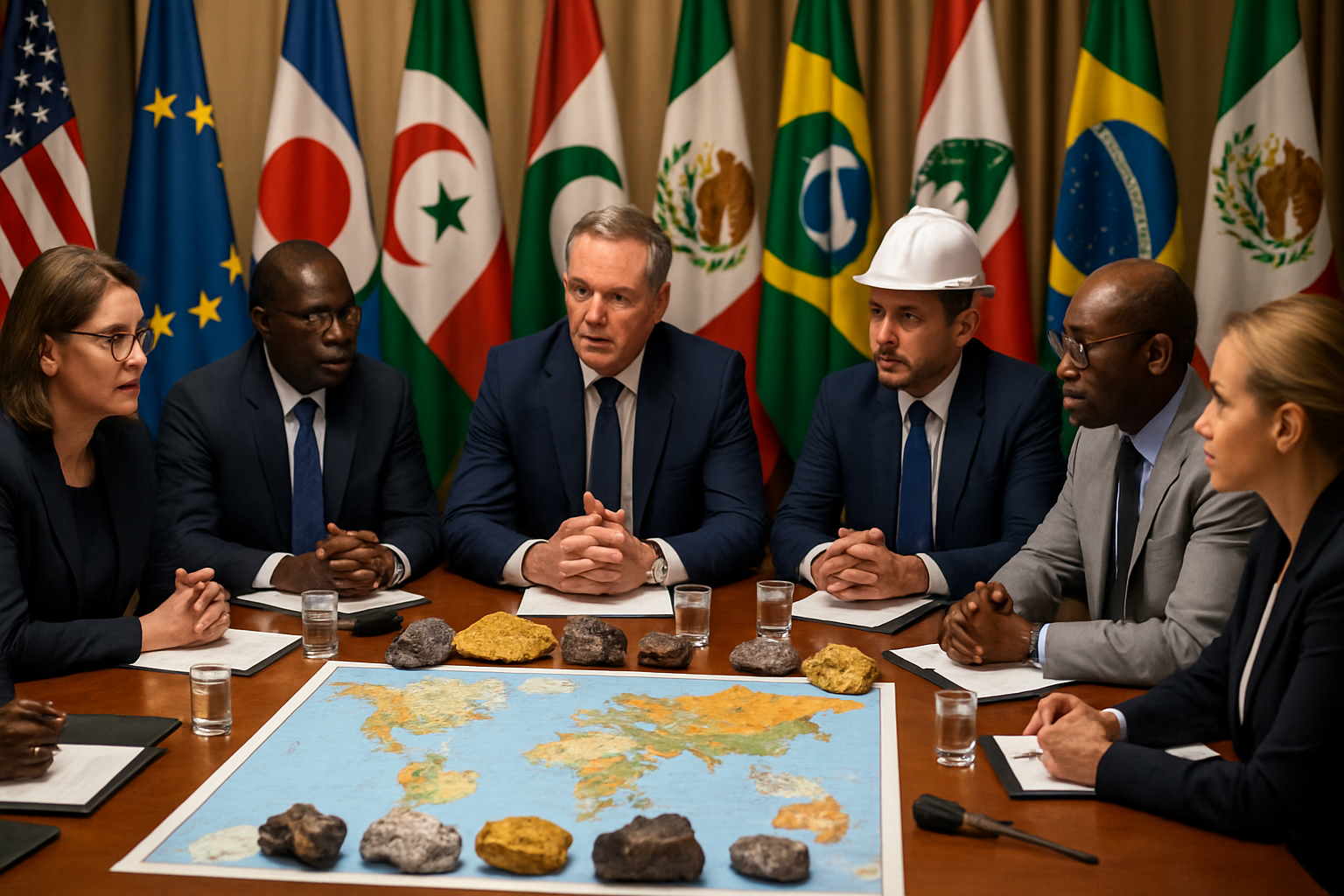
The United States and its allies launched the most comprehensive critical minerals partnership initiative to date, signing multiple bilateral agreements with African and Latin American countries in a coordinated effort to break China's stranglehold on global supply chains essential for renewable energy and advanced technology.
The 2026 Critical Minerals Ministerial, held in Washington D.C. on February 5, brought together seven African nations and multiple Latin American partners in what Secretary of State Marco Rubio described as an "invitation-only summit" designed to forge new strategic alliances. The African participants included Angola, the Democratic Republic of the Congo, Guinea, Kenya, Morocco, Sierra Leone, and Zambia, while significant agreements were also reached with Argentina and Brazil.
Historic Bilateral Agreements Signed
The United States signed new bilateral critical minerals frameworks and Memoranda of Understanding (MOUs) with Guinea and Morocco during the ministerial, according to State Department documentation. These agreements represent the culmination of months of diplomatic preparation following the landmark US-EU-Japan Critical Minerals Strategic Partnership announced just days earlier on February 4.
Argentina emerged as a key partner, with the country signing what experts describe as Washington's "biggest move yet" to challenge Chinese control over lithium supply chains. The South American nation, whose mining exports hit a record $6 billion in 2025, possesses vast untapped lithium reserves crucial for electric vehicle batteries and renewable energy storage systems.
"Every lithium battery in your phone, laptop, and electric car depends on minerals that China controls at every stage — from mine to magnet — and Argentina just signed a deal with the United States to change that."
— Source: Rio Times analysis
Romania's Strategic Role in European Integration
Romania's participation underscored the European dimension of the partnerships. Foreign Minister Oana Țoiu attended the ministerial at Rubio's invitation, with Romania's embassy in Washington announcing that the country "represents a strategic ally in securing the future of critical minerals."
Romania's involvement reflects broader European Union concerns about supply chain vulnerabilities. EU auditors have repeatedly warned that climate goals are at serious risk due to dangerous dependence on China, which controls 60% of global critical mineral production and an overwhelming 90% of global refining capacity.
Building on Previous Momentum
The February 5 ministerial builds directly on the US-EU-Japan alliance announced February 4 by Vice President J.D. Vance, which brought together 55 countries in Washington D.C. That trilateral partnership established minimum pricing mechanisms, alternative supply chains, and strategic stockpiling coordination with a 30-day timeline for formal implementation.
The timing proves crucial as Western nations face mounting pressure to secure reliable supplies of lithium, cobalt, rare earth elements, and other materials essential for the clean energy transition. Recent breakthroughs, including Japan's world-first successful deep-sea rare earth mining trial at Minamitorishima island, demonstrate the urgency driving technological innovation in the sector.
Addressing China's Market Dominance
China's overwhelming control over critical mineral supply chains has become a major strategic vulnerability for Western economies. The Asian giant not only produces 60% of the world's critical minerals but processes an even more dominant 90% of raw materials into refined products ready for manufacturing.
This concentration has created what officials describe as "chokepoint vulnerabilities" that could threaten everything from electric vehicle production to wind turbine manufacturing. The partnerships announced this week represent the most coordinated Western response to date.
African Mining Potential
The African countries participating in the ministerial control significant portions of global critical mineral reserves. The Democratic Republic of the Congo alone produces approximately 70% of the world's cobalt, while Guinea possesses substantial bauxite reserves essential for aluminum production.
However, most African countries currently export raw materials to China for processing, limiting their economic benefits and creating supply chain dependencies. The new partnerships aim to develop in-country processing capabilities and direct export relationships with Western markets.
Implementation Challenges and Opportunities
Despite the strategic importance of these partnerships, significant implementation challenges remain. Developing new mining operations and processing facilities requires billions of dollars in investment and years of development time. Environmental regulations and community acceptance add additional complexity to project timelines.
The partnerships must also compete with Chinese cost advantages and economies of scale built over decades of market dominance. Chinese companies have established extensive relationships with mining operations worldwide, often offering infrastructure investment packages that combine resource extraction with broader development projects.
Technological Innovation Drive
Success will likely depend on technological innovation that can make Western operations more competitive. Japan's recent deep-sea mining breakthrough, which extracted rare earth-bearing mud from 6,000 meters depth with concentrations up to 20 times higher than terrestrial mines, offers one potential pathway.
The partnerships also emphasize recycling technologies and alternative material development that could reduce overall dependency on newly extracted minerals. Advanced processing techniques and automation may help offset higher labor costs in Western-aligned countries.
Broader Strategic Implications
The critical minerals initiatives represent a fundamental shift in how Western nations approach supply chain security. Rather than relying purely on market mechanisms, governments are now actively coordinating strategic resources allocation and diplomatic engagement.
This shift extends beyond minerals to other strategic sectors, including semiconductors, pharmaceuticals, and defense technologies. The partnerships demonstrate growing recognition that economic security and national security have become inseparable in an era of great power competition.
"This represents the most significant challenge to China's dominance in critical materials since the market developed. The coordination between the US, EU, and partner countries creates real alternatives for the first time."
— Industry Analysis
Long-term Success Factors
The ultimate success of these partnerships will depend on sustained political commitment across multiple electoral cycles, substantial investment coordination, and effective implementation of complex international agreements. Environmental stewardship and community engagement in partner countries will prove equally crucial for long-term viability.
The partnerships remain open to additional members, with potential expansion to other resource-rich nations in Africa, Latin America, and Asia. Success in the initial phase could attract additional countries seeking alternatives to Chinese-dominated supply chains.
As the clean energy transition accelerates and demand for critical minerals continues rising, these partnerships represent a critical test of Western nations' ability to coordinate strategic economic policy. The stakes extend far beyond mining to encompass energy security, technological leadership, and geopolitical influence in the 21st century.