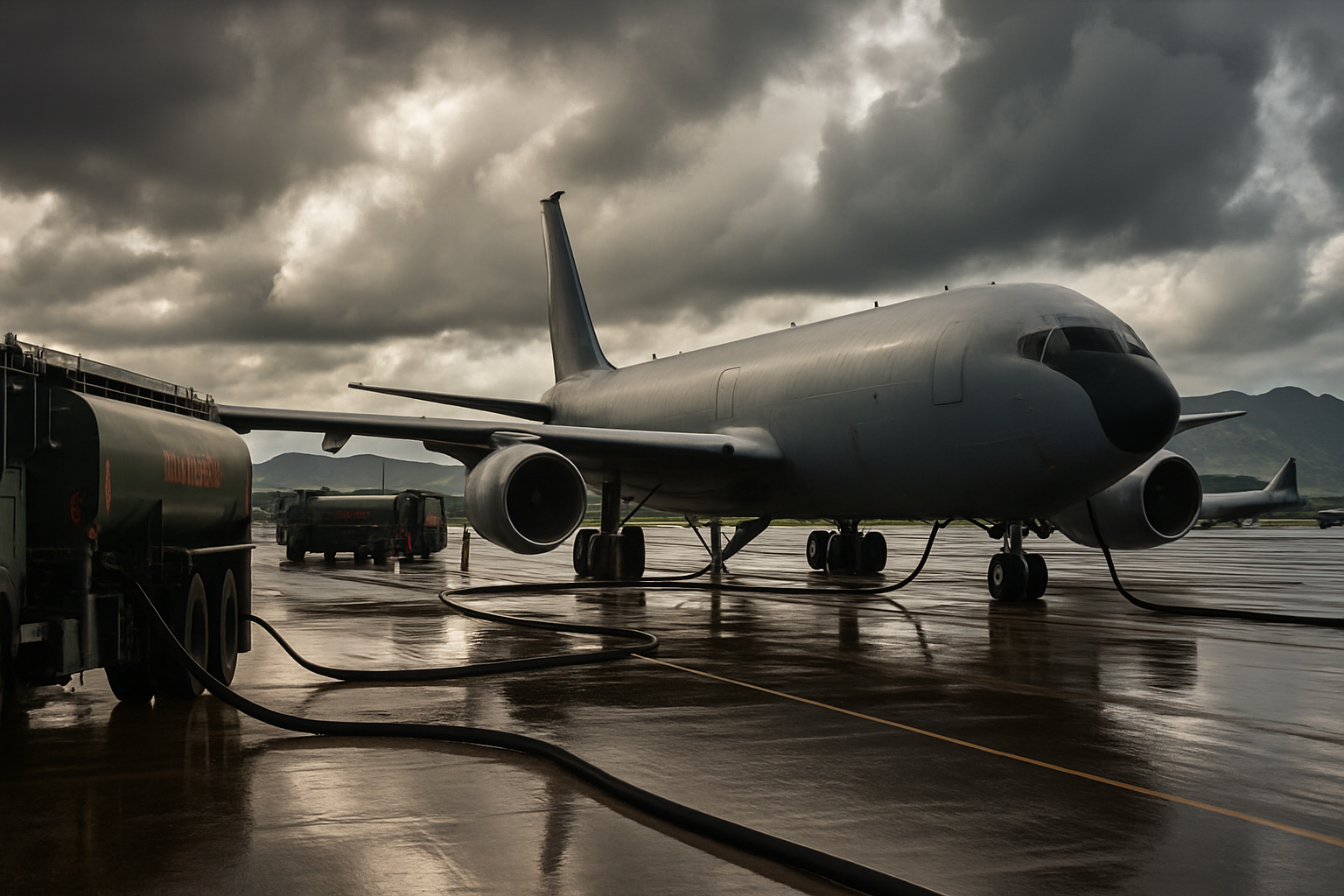
The United States has launched extraordinary aviation fuel rerouting operations to strategic Asian bases as the global aviation industry confronts its most severe crisis since the COVID-19 pandemic, with European authorities warning of systematic flight cancellations within six weeks due to critical jet fuel shortages.
A request for offers to ship 235,000 barrels of military-grade jet fuel from Cherry Point in Blaine, Washington, where BP operates a refinery, to Subic Bay in the Philippines—a strategic access point for US naval operations—illustrates the dramatic measures being taken to maintain aviation operations across the Pacific as Iran's Revolutionary Guard continues blocking 40% of global oil transit through the Strait of Hormuz.
Aviation Industry Faces Unprecedented Disruption
The crisis has already resulted in over 18,000 flight cancellations worldwide since March 2026, representing the most extensive aviation disruption since the COVID-19 pandemic. Eight Middle Eastern countries maintain simultaneous airspace closures, creating what industry experts call an "aviation black hole" that has severed critical Europe-Asia corridors.
Dubai International Airport, the world's busiest with 86 million passengers annually, remains completely shut down due to missile damage, while major carriers including Emirates, Air France-KLM, and Wizz Air have suspended operations indefinitely.
International Energy Agency Director Fatih Birol issued an unprecedented warning that Europe has "perhaps six weeks of jet fuel" remaining before widespread flight cancellations become inevitable by early June, potentially paralyzing the continent's summer travel season.
Emergency Fuel Rerouting Operations
The unusual Pacific fuel shipment request represents just one element of a broader US strategy to maintain aviation operations in the Asia-Pacific region. Military-grade jet fuel, typically reserved for defense operations, is being diverted to civilian aviation networks as traditional supply chains collapse under geopolitical pressure.
The Cherry Point refinery route to Subic Bay demonstrates the strategic importance of maintaining fuel supplies to bases that serve as critical logistics hubs for both military and civilian aviation operations across the region. Subic Bay's location provides essential access for fuel distribution throughout the Philippines and broader Southeast Asian aviation networks.
"This represents the most severe aviation threat to European operations since COVID-19, with systematic shutdowns possible by June without immediate resolution."
— European aviation industry source
Irish Airlines Face Existential Threat
Irish aviation officials have confirmed that domestic carriers "will be hurt" by the ongoing Strait of Hormuz closure, though some analysts believe suggestions of existential threat may be overstated. The crisis has forced airlines to implement emergency protocols that were previously unthinkable in peacetime operations.
Meanwhile, Air New Zealand has been dealing with separate operational challenges, including a flight delayed after air conditioning issues left passengers trapped on board in uncomfortable conditions for over 90 minutes, and another flight diverted for safety checks due to hydraulic concerns—incidents that highlight how the broader fuel crisis is compounding routine operational pressures.
Global Context of Energy Crisis
The aviation fuel shortage stems from Iran's Revolutionary Guard closure of the Strait of Hormuz following the collapse of US-Iran nuclear negotiations despite initial progress in Geneva. The waterway closure has blocked 40% of global seaborne oil transit through the critical 21-mile chokepoint, with no realistic alternative routes available.
Oil prices have surged to historic levels, with Brent crude peaking at $119.50 and West Texas Intermediate hitting a record 18.98% single-day jump to $108.15—the first time prices have exceeded $100 per barrel since 2022. Jet fuel costs have exploded 122% from $85-90 to $150-200 per barrel, forcing airlines to implement emergency fare surcharges across their networks.
The International Energy Agency has deployed the largest strategic petroleum reserve release in its 50-year history—400 million barrels from 32 countries, more than double the 2022 Ukraine crisis response. Japan is contributing 80 million barrels, marking the first such release since the 2011 Fukushima disaster.
Industry Transformation Accelerating
The crisis has fundamentally altered aviation operations, with airlines implementing enhanced security screening, mandatory conflict insurance, and pre-approval requirements for high-risk destinations as standard operating procedures. Route diversification has become an urgent priority to reduce dependence on Middle Eastern hub airports.
Ryanair CEO Michael O'Leary is conducting daily emergency calls with European fuel suppliers, while Lufthansa has announced the cancellation of 20,000 flights through October 2026 and permanently closed its CityLine subsidiary, citing unsustainable fuel costs.
Financial Market Devastation
The crisis has triggered severe financial market disruptions, with Pakistan's KSE-100 index suffering its largest single-day decline in history at -8.97%, while South Korea's KOSPI dropped 12%, triggering circuit breakers as the Korean won hit 17-year lows. PayPal postponed its $1.1 billion IPO indefinitely due to market volatility.
Central banks including the European Central Bank and Bank of Japan are coordinating emergency liquidity measures, though traditional monetary policy has proven limited in effectiveness against structural geopolitical disruptions of this magnitude.
Consumer Impact Worldwide
The aviation fuel crisis is part of a broader global energy emergency affecting consumers worldwide. Bangladesh has implemented fuel rationing for 170 million people, while Pakistan has imposed wartime austerity measures with four-day government work weeks as fuel prices reach the highest levels in South Asia.
European consumers face severe impacts, with Swedish electricity and gasoline prices rising significantly, Irish heating oil approaching €2 per liter amid accusations of "brazen rip-offs," and multiple governments abandoning free-market principles to implement emergency price controls and consumer protections.
Nuclear Diplomacy Breakdown
The crisis originates from the complete breakdown of US-Iran nuclear negotiations despite what was described as "broad agreement on guiding principles"—the most progress since the 2018 JCPOA collapse. The subsequent Operation Epic Fury, the largest US-Israeli operation since 2003, led to Iranian retaliation through True Promise 4 operations and the Strait of Hormuz closure.
The situation has been further complicated by the February 2026 expiration of the New START treaty, marking the first time in over 50 years without US-Russia nuclear constraints. Iran continues uranium enrichment at 60% purity with over 400kg of weapons-grade material—sufficient for multiple nuclear weapons.
Energy Security Transformation Needed
Energy security expert Samuel Ciszuk describes this as "the most severe energy security crisis in decades, with single-chokepoint vulnerabilities completely exposed." The 21-mile Strait of Hormuz has proven to be a dangerous single-point failure for modern logistics, affecting not just energy but consumer goods and industrial materials worldwide.
UN Secretary-General António Guterres has called the situation "the greatest test of multilateral cooperation in the modern era," with nuclear risks at "the highest levels in decades." Qatar's Energy Minister Saad Al Kaabi has warned that Gulf states may declare force majeure "within weeks" if oil approaches $150 per barrel, threatening to "bring down the economies of the world."
Recovery Timeline Uncertain
Unlike weather-related disruptions with predictable recovery patterns, the aviation crisis timeline depends entirely on military and diplomatic developments in the Middle East. Airlines are conducting daily operational reviews but cannot maintain long-term scheduling with volatile security conditions and blocked transit routes.
The crisis represents a template-setting moment for 21st-century aviation, determining whether the industry emerges with strengthened global connectivity systems despite security challenges, or fragments into regionalized networks prioritizing security over comprehensive international mobility.
Success in containing the crisis could provide frameworks for future nuclear crisis resolution and strengthen diplomatic precedents. Failure could accelerate military solutions, reshape Middle Eastern geopolitics for decades, encourage nuclear proliferation globally, and undermine diplomatic credibility worldwide.
April 2026 represents a watershed moment in international aviation, with implications extending far beyond immediate operational challenges to fundamentally reshape energy security paradigms, crisis management frameworks, and international cooperation mechanisms for the volatile, interconnected world of the 21st century.