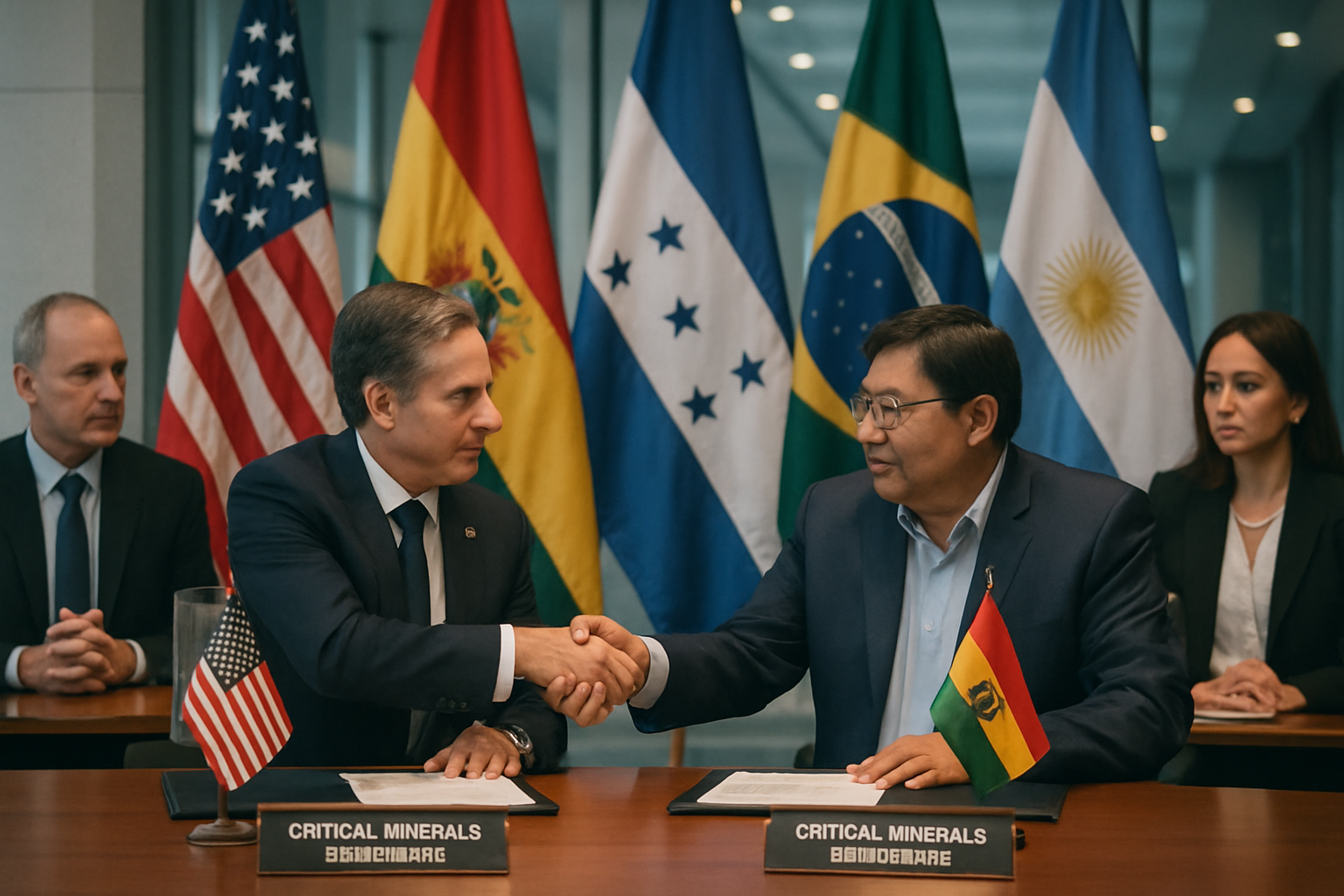
The United States formalized 11 bilateral critical minerals agreements during the inaugural Critical Minerals Ministerial Summit in Washington D.C., marking a historic shift in global supply chain strategy with Bolivia joining Argentina, Ecuador, and other strategic partners in challenging Chinese market dominance.
During the groundbreaking summit, Secretary of State Marco Rubio and Vice President J.D. Vance hosted delegations from over 50 countries and the European Union to establish new frameworks for critical minerals cooperation. The agreements, signed with Argentina, Cook Islands, Ecuador, Guinea, Morocco, Paraguay, Peru, Philippines, United Arab Emirates, United Kingdom, and Uzbekistan, represent the most significant U.S. effort to diversify mineral supply chains since the Cold War.
Bolivia's Strategic Inclusion
Bolivia's participation marked a significant diplomatic development, with Foreign Minister Fernando Aramayo and Mining Minister Marco Antonio Calderón representing President Rodrigo Paz's government at the high-level talks. The inclusion signals Bolivia's growing importance in the global transition to renewable energy, given the country's substantial lithium reserves essential for battery production.
"Bolivia has been inserted into the dialogue to diversify the supply of rare earths and other critical minerals for energy transition and advanced technologies," the Bolivian delegation confirmed following the summit. The country's participation comes as global demand for lithium has surged, with Bolivia possessing some of the world's largest known reserves in its salt flats.
Breaking China's Market Control
The agreements directly challenge China's overwhelming dominance in critical minerals markets, where Beijing controls approximately 60% of global production and 90% of refining capacity for materials essential to renewable energy infrastructure, electric vehicles, and advanced manufacturing.
The memorandums of understanding establish frameworks for collaboration on pricing challenges, mining development, market equity, supply chain gap closure, and expanded financing access. The initiative aims to reduce vulnerability to highly concentrated markets susceptible to political pressures and supply disruptions.
"Together, we want members to form a trading bloc among allies and partners that ensures U.S. access to critical materials while reducing dependence on potentially hostile suppliers."
— Senior U.S. State Department Official
Multilateral Architecture and FORGE Initiative
The summit launched the FORGE Forum to coordinate investments and policies across participating nations. This represents a departure from previous bilateral approaches, creating a "variable geometry partnership" where different countries sign individual commitments while participating in broader coordinated strategies.
Seven African countries participated as key alternative suppliers: Angola, Democratic Republic of the Congo, Guinea, Kenya, Morocco, Sierra Leone, and Zambia. Their involvement reflects the administration's recognition that effective supply chain diversification requires engaging resource-rich developing nations as strategic partners rather than merely extraction zones.
Economic and Strategic Implications
The agreements build on recent U.S. bilateral trade successes, including the historic Argentina partnership that eliminated over 1,600 U.S. tariffs and the India framework potentially worth $500 billion in trade expansion. Argentina's lithium cooperation agreement alone generated an estimated $6 billion in mining exports during 2025.
Industry analysts project the partnerships could unlock billions in investment for new mining and processing facilities, though development timelines extend years rather than months. Environmental regulations in Western nations create cost disadvantages compared to Chinese operations, requiring sustained political commitment across electoral cycles for success.
Implementation Challenges
Despite the diplomatic breakthrough, significant obstacles remain. Developing alternative supply chains requires massive capital investment, advanced technological capabilities, and years of infrastructure development. China's established relationships, lower costs, and economies of scale provide formidable competitive advantages that new partnerships must overcome.
Environmental and social governance standards demanded by Western investors and governments add complexity and costs compared to traditional extractive models. Success depends on balancing responsible development with economic competitiveness while maintaining community support in resource-rich regions.
Regional Context and Future Prospects
The critical minerals initiative occurs within broader Trump administration efforts to reshape trade relationships through bilateral agreements rather than multilateral frameworks. Recent successes with India and Argentina demonstrate the administration's preference for direct partnerships that can be implemented through executive authority while seeking Congressional approval for comprehensive aspects.
Bolivia's inclusion reflects evolving regional dynamics, with the country positioned between traditional relationships and new partnership opportunities. The government's participation suggests pragmatic engagement with U.S. initiatives while maintaining sovereign decision-making over natural resource development.
Regional organizations and neighboring countries are closely monitoring these developments, as successful diversification could accelerate similar partnerships across Latin America and Africa. The economic multiplier effects extend beyond mining to manufacturing, technology transfer, and infrastructure development crucial for sustainable economic growth.
Global Supply Chain Transformation
The agreements represent a fundamental shift from market-driven to security-based supply chain coordination, reflecting growing recognition that critical materials access constitutes national security infrastructure comparable to energy or defense systems. Success could provide templates for other strategic sectors while failure might accelerate military tensions over resource access.
International cooperation mechanisms include regular high-level consultations, technical working groups, joint investment committees, and monitoring frameworks to ensure implementation effectiveness. The partnerships remain open to additional members, potentially expanding to other resource-rich nations seeking alternatives to Chinese-dominated markets.
As climate neutrality targets approach 2030-2050 deadlines, these partnerships test whether Western democratic governments can successfully compete with authoritarian approaches to resource development while maintaining higher labor, environmental, and governance standards. The coming years will determine whether this diplomatic initiative translates into operational supply chain alternatives capable of supporting the global energy transition.