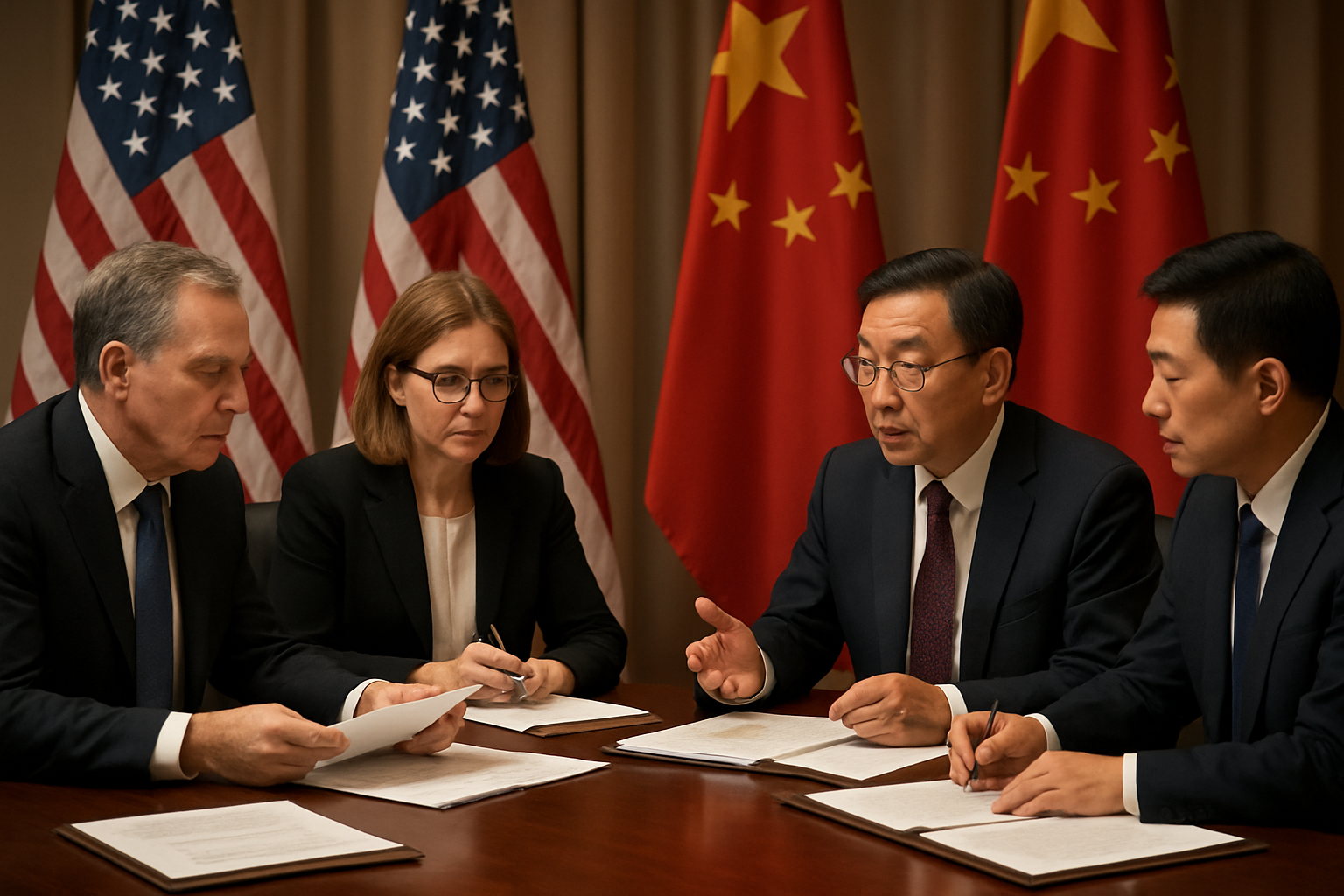
Washington and Beijing are exploring the establishment of a new "Board of Trade" mechanism to formalize trade relations between the world's two largest economies, offering potential diplomatic progress while raising concerns among market experts about government intervention in commercial activities.
US Trade Representative Jamieson Greer confirmed that both nations are "mulling a new mechanism to formalize and identify what kinds of goods the United States should be exporting to and importing from China," marking a potential shift toward structured bilateral trade management after years of tension and uncertainty.
Diplomatic Framework for Economic Relations
The proposed Board of Trade represents an attempt to institutionalize US-China economic cooperation through formal channels, potentially providing a framework for managing the complex relationship between nations whose annual trade volume exceeds $700 billion despite ongoing political tensions.
The initiative builds on recent diplomatic engagement, including the February 4, 2026 phone call between President Trump and Chinese President Xi Jinping that both leaders described positively. That conversation covered trade relations, Taiwan tensions, and broader strategic cooperation, with Xi calling for 2026 to be a "year of peaceful coexistence and cooperation."
However, the proposed mechanism comes amid dramatically altered circumstances following the Supreme Court's February 21 ruling that struck down Trump's global tariff authority under the International Emergency Economic Powers Act. The 6-3 decision, authored by Chief Justice John Roberts, declared that such sweeping trade measures require clear congressional authorization for actions of "vast economic and political significance."
Market Forces Versus Government Direction
The Board of Trade proposal has generated divided expert opinion on its potential effectiveness and market impact. Some analysts view the mechanism as a constructive step toward reducing trade uncertainty and providing predictable frameworks for business planning between the two economic superpowers.
"A formal trade board could create transparency and reduce the kind of sudden policy shifts that have disrupted supply chains," said one trade expert familiar with bilateral negotiations.
— Industry Source, Speaking on Background
However, other experts express concerns that government-directed trade identification could interfere with market mechanisms that naturally determine optimal trade flows based on comparative advantage, consumer demand, and business efficiency.
The debate reflects broader questions about the role of state intervention in international commerce, particularly between nations whose economic systems operate on different principles. China's state-led development model contrasts sharply with traditional American free-market approaches, though both countries have increasingly embraced strategic trade policies in recent years.
Constitutional and Political Context
The Board of Trade discussions occur against a backdrop of constitutional constraints on presidential trade authority that have fundamentally altered the negotiating landscape. The Supreme Court's landmark ruling eliminated a key tool that President Trump had used to impose economic pressure on China, potentially creating space for more conventional diplomatic approaches.
Congressional resistance to unilateral trade measures has also grown, evidenced by the House's 219-211 vote to end Canada tariffs with six Republican defections—the first significant bipartisan rebuke of Trump's trade policies in his second term. This suggests that any substantial trade agreement with China would likely require legislative approval, adding democratic oversight to the process.
China has welcomed these constitutional developments, viewing them as validation of its position that trade disputes should be resolved through multilateral frameworks rather than unilateral pressure. Beijing has simultaneously demonstrated its own approach to selective trade liberalization, announcing zero-tariff access for 53 African countries starting May 1, 2026, and reducing EU dairy tariffs significantly.
Strategic Competition Amid Cooperation
The Board of Trade proposal emerges as both nations navigate complex strategic competition alongside economic interdependence. China controls 60% of global critical minerals production and 90% of refining capacity, providing significant leverage in discussions. Meanwhile, the US-EU-Japan Critical Minerals Partnership, involving 55 countries, represents efforts to diversify supply chains away from Chinese dominance.
Recent developments illustrate this dual dynamic. Germany's Chancellor Friedrich Merz successfully concluded his Beijing visit in February with a 120-aircraft Airbus deal worth billions, while simultaneously acknowledging that China has evolved from a "lucrative market to competitive threat" in high-tech manufacturing.
Taiwan remains the most sensitive issue in US-China relations, with Chinese military pressure increasing 23% in 2025 around the island. The Trump administration's historic US-Taiwan trade agreement, eliminating tariffs up to 26% on agricultural imports, adds complexity to any broader US-China trade arrangement.
Implementation Challenges and Opportunities
Establishing an effective Board of Trade would require addressing fundamental differences in economic philosophy and trade practices between the two nations. The mechanism would need to balance government oversight with market flexibility, ensuring that formal structures enhance rather than constrain beneficial commercial relationships.
Success would depend on several factors: clear mandates and authority for board representatives, transparency in decision-making processes, regular review mechanisms to adapt to changing circumstances, and alignment with broader economic and security objectives of both nations.
The initiative faces skepticism from various quarters. Free-market advocates worry about bureaucratic interference in commercial decisions, while security-focused critics question whether closer trade integration serves national interests given strategic competition concerns.
Global Implications and Precedents
A US-China Board of Trade could establish precedents for managing economic relationships between major powers in an era of strategic competition. The success or failure of such institutional approaches may influence how other nations structure their own bilateral trade relationships.
The proposal occurs as global trade governance faces multiple challenges, including the breakdown of traditional multilateral frameworks, rising economic nationalism, and the intersection of commercial and security considerations. How Washington and Beijing navigate these challenges through formal mechanisms could provide templates for 21st-century economic diplomacy.
International observers are closely monitoring developments, particularly given the global economic implications of US-China trade stability. Any framework that reduces uncertainty and provides predictable rules for the world's most important bilateral trade relationship would likely have positive spillover effects for global economic confidence.
Looking Ahead: Diplomatic Windows and Market Realities
The Board of Trade discussions represent a test of whether institutional approaches can manage economic competition while preserving beneficial cooperation. Both nations face domestic pressures that could complicate negotiations: American concerns about trade deficits and job losses, and Chinese priorities for technological advancement and economic security.
The timing may prove crucial, as both leaders face political calculations about the benefits of economic cooperation versus the risks of appearing weak to domestic audiences. President Trump's postponed Beijing summit, originally scheduled for March 31-April 2 but delayed due to Iran crisis management, may provide additional time for developing concrete proposals.
Ultimately, the Board of Trade proposal reflects recognition that the US-China economic relationship requires active management rather than reliance on either pure market forces or government coercion. Whether such institutional innovation can successfully balance cooperation with competition remains an open question with significant implications for global economic stability.
As analysts continue to debate the merits of formal trade structures versus market mechanisms, the practical outcome may depend less on theoretical considerations than on the political will of both nations to prioritize economic stability over tactical advantage in their broader strategic competition.