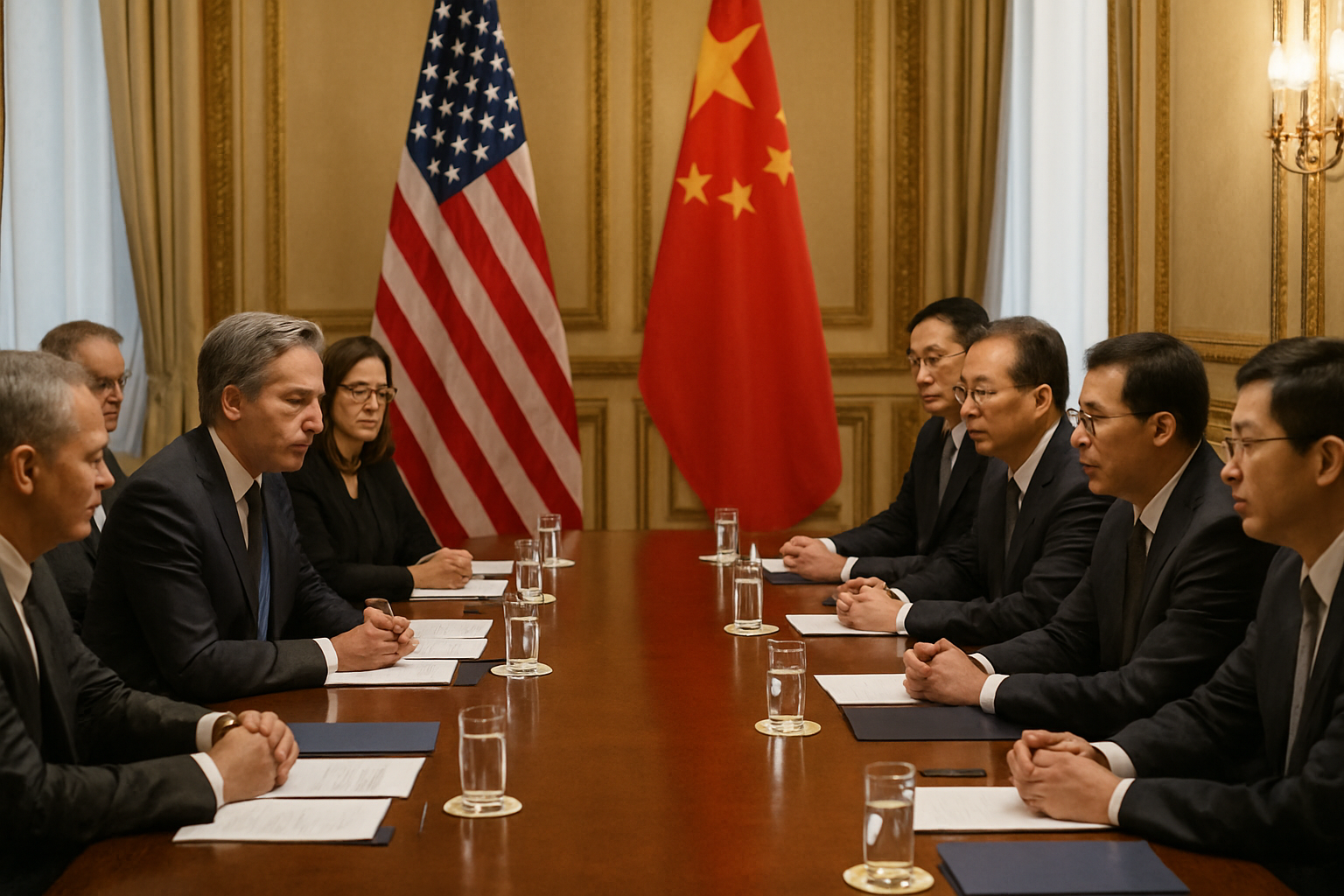
Top US and Chinese economic officials launched critical trade negotiations in Paris on Sunday, seeking to iron out persistent trade disputes and prepare for President Donald Trump's historic trip to Beijing at the end of March, as constitutional constraints reshape the dynamics of US-China economic relations.
The discussions, led by US Treasury Secretary Scott Bessent and Chinese Vice Premier He Lifeng, commenced at the Paris headquarters of the Organisation for Economic Cooperation and Development (OECD), marking a significant diplomatic venue choice for the world's two largest economies. The talks are expected to focus on reshaping US tariff structures, managing the flow of Chinese-produced rare earth minerals and magnets to American buyers, addressing high-tech export controls, and securing Chinese purchases of US agricultural products.
Constitutional Crisis Reshapes Trade Dynamics
The Paris negotiations occur against the backdrop of a dramatic shift in American trade policy authority following the Supreme Court's historic 6-3 ruling in February 2026 that struck down Trump's global tariff program under the International Emergency Economic Powers Act (IEEPA). Chief Justice John Roberts authored the majority opinion applying the "major questions doctrine," declaring that IEEPA "does not authorize president to impose tariffs" without explicit congressional authorization.
This constitutional ruling has fundamentally altered the negotiating landscape, removing a key leverage tool Trump previously wielded in imposing 34% tariffs on China as part of his maximum pressure campaign. In response, Trump immediately implemented alternative 15% global tariffs using Section 122 of the Trade Act, though this authority faces a strict 150-day limit and potential congressional override.
"The Supreme Court decision paradoxically may create space for substantive arrangements by forcing both sides to seek sustainable, congressionally-backed agreements rather than relying on executive emergency powers."
— Senior Trade Analyst
Chinese Position Strengthened
Beijing welcomed the Supreme Court ruling as vindication of its position that unilateral American tariffs violated international trade norms. The Chinese government has used this period to strengthen its global economic position, announcing zero-tariff access for 53 African countries starting May 1, 2026 – the most comprehensive China-Africa trade expansion in history.
China's strategic position has been further reinforced by its control of 60% of global critical minerals production and 90% of refining capacity, providing significant leverage in negotiations over rare earth materials essential to American technology and defense industries. Recent agreements with the EU to reduce dairy tariffs from 21.9%-42.7% to 7.4%-11.7%, affecting over $500 million in trade, demonstrate China's sophisticated economic diplomacy while America grapples with constitutional constraints.
Taiwan Tensions Loom Large
The economic discussions cannot be separated from escalating tensions over Taiwan, which Chinese President Xi Jinping has called "the most important issue" in US-China relations. Chinese military pressure around Taiwan increased 23% in 2025, with daily deployments designed to "exhaust" the Taiwanese population through constant threat presence.
Despite these tensions, or perhaps because of them, both leaders demonstrated diplomatic engagement through their February 4 "lengthy and detailed" phone call, which Trump described as "excellent." The conversation covered Taiwan tensions, trade relations, Iran's nuclear situation, and the Ukraine war, with Xi calling for 2026 to be a "year of peaceful coexistence and cooperation."
Economic Reality Checks
The persistence of structural trade imbalances provides sobering context for the Paris negotiations. The US trade deficit reached $901.5 billion annually as of December 2025, essentially unchanged despite extensive tariff policies, demonstrating that trade imbalances reflect deeper structural economic factors beyond tariff solutions.
Congressional resistance to Trump's trade approach has also grown significantly, with the House passing 219-211 legislation to end Canada tariffs with six Republican defections – the first significant bipartisan rebuke of Trump's trade authority in his second term. Speaker Johnson's unsuccessful attempt to prevent the vote highlighted growing party concerns about unpredictable trade policies.
Preparing for the Beijing Summit
The Paris talks serve as essential groundwork for Trump's planned March 31-April 2 visit to Beijing, which will mark his first official trip to China during his second term. The summit builds on the diplomatic foundation established in their February phone call and represents a critical test of whether engagement backed by constitutional constraints rather than aggressive economic threats can produce sustainable frameworks for managing the defining geopolitical relationship of the 21st century.
Success in Paris and Beijing could establish a template for major power economic competition management in an increasingly multipolar world. The talks will likely focus on agricultural purchases, technology cooperation arrangements, financial services access, and critical minerals partnerships rather than the aggressive tariff threats that previously characterized US-China relations.
Global Implications
The outcome of the Paris negotiations extends far beyond bilateral US-China relations. Regional allies are closely monitoring whether the engagement produces concrete progress on global challenges or whether escalating competition will continue to dominate the relationship.
The talks occur amid broader global uncertainties, including the expiration of the New START treaty on February 5 (marking the first time in over 50 years without US-Russia nuclear constraints), ongoing Iran nuclear negotiations, and Venezuela energy cooperation. The success or failure of the Paris framework will influence international approaches to diplomatic engagement versus economic coercion for years to come.
As the two economic superpowers navigate constitutional constraints and geopolitical competition, the Paris talks represent a crucial opportunity to demonstrate that sustained diplomatic engagement can produce innovative frameworks for economic cooperation even amid strategic rivalry. The world watches as the US and China attempt to balance competition with cooperation in an era of unprecedented global challenges.