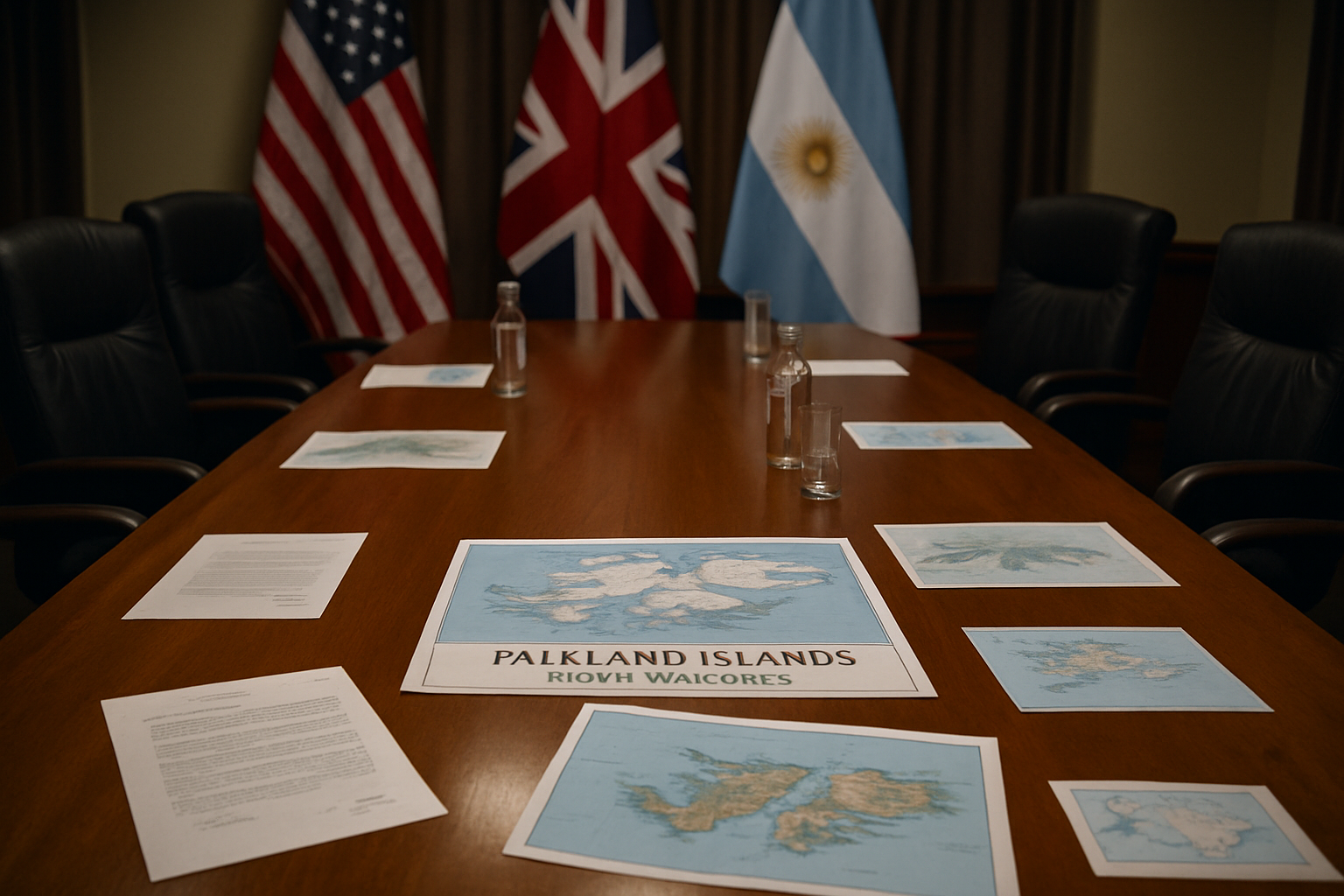
The United States has officially confirmed its neutral position on the Falkland Islands sovereignty dispute after a leaked Pentagon memorandum suggested potential policy shifts, creating the most significant diplomatic crisis over the South Atlantic territory since the 1982 war.
In a carefully worded statement, US officials acknowledged "competing sovereignty claims between Argentina and the United Kingdom" over the islands, known as Las Malvinas in Argentina. The clarification comes amid unprecedented strain in US-UK relations and growing Argentine diplomatic assertiveness over the disputed territory.
Pentagon Memo Controversy Emerges
The diplomatic crisis erupted following revelations of a leaked Pentagon email that allegedly proposed withdrawing American backing for British claims to the Falkland Islands. According to multiple diplomatic sources, the memo was framed as potential retaliation for the UK's refusal to support "Operation Epic Fury" - the US military campaign against Iran.
The timing of the leak has proven particularly sensitive, occurring just days before King Charles III's state visit to Washington on April 27-28, marking the 250th anniversary of American independence and the first visit by a British monarch since Queen Elizabeth II in 2007.
Simon Weston, a Falklands War veteran, expressed outrage at reports suggesting the US might review its support for UK territorial claims, saying such a move would make his wartime sacrifice feel "irrelevant." The veteran's comments underscore the deep emotional significance the islands hold for many Britons who served in the 1982 conflict.
Argentina Seizes Diplomatic Opportunity
Argentine Foreign Minister Pablo Quirno has rejected recent statements by British Prime Minister Keir Starmer regarding UK sovereignty over the islands, calling instead for the resumption of bilateral negotiations. Argentina's position explicitly rejects the principle of self-determination while emphasizing what it calls "historical rights" to Las Malvinas.
The Argentine government has signaled renewed diplomatic assertiveness, calculating that current US-UK tensions create a rare opportunity for territorial negotiations. Chancellor Quirno's stance represents a departure from previous diplomatic approaches, stating "negotiations with London, no self-determination and yes historical rights."
This diplomatic offensive comes as Buenos Aires has observed the worst breakdown in US-UK relations since the Iraq War, with President Trump publicly criticizing the Starmer government for refusing to support Iran military operations.
Historical Context and Legal Framework
The Falkland Islands have been under continuous British administration since 1833, with a current population of approximately 3,500 people who are overwhelmingly British in identity and allegiance. A 2013 referendum demonstrated 99.8% support for remaining a British Overseas Territory, a result that Argentina has never recognized.
Argentina has never accepted British sovereignty over the islands, leading to the 1982 Falklands War when Argentine forces briefly occupied the territory before being expelled by British military forces. The conflict resulted in 649 Argentine and 255 British military deaths, making it the deadliest confrontation between the two nations.
Under international law, British claims are typically supported by principles of continuous administration, population consent, and peaceful dispute resolution. Argentina's position relies primarily on geographic proximity arguments and claims of historical inheritance from Spanish colonial administration.
US-UK Relations Under Strain
The Falklands controversy emerges against a backdrop of severe strain in the "special relationship" between Washington and London. President Trump has openly criticized Prime Minister Starmer's government for declining to provide military support for Operation Epic Fury, describing the relationship as "obviously not what it was."
The UK's refusal to allow US forces to use British bases for Iran operations was justified by the Starmer government's emphasis on "Iraq lessons" and its belief that Britain "does not believe in regime change from the skies." This position has frustrated the Trump administration, which had sought broader allied support for its Middle Eastern military campaign.
European allies have delivered what analysts describe as the most comprehensive rejection of American military leadership since the 2003 Iraq War, with countries including Germany, France, and Spain declining to provide naval support for Strait of Hormuz operations.
Regional and International Implications
The Falklands dispute carries implications far beyond the South Atlantic, serving as a test case for how alliance relationships should influence territorial sovereignty claims. The situation presents a precedent with global ramifications, as other territorial disputes worldwide are closely watching whether the US might subordinate alliance principles to strategic objectives.
Falkland Islanders themselves have condemned what they perceive as American "bullying," with war veterans expressing particular outrage. The timing of the controversy, coinciding with King Charles's state visit, suggests calculated pressure designed to maximize leverage during a critical diplomatic moment.
Regional powers across Latin America are observing whether Argentina's diplomatic approach during the US-UK crisis yields territorial concessions, potentially encouraging similar strategies in other disputed territories worldwide.
Looking Ahead
The coming weeks will prove critical in determining whether the Pentagon memo represents tactical pressure or a fundamental shift in US policy toward the Falklands dispute. The success or failure of King Charles's state visit may significantly influence how this territorial controversy evolves.
This represents the most significant challenge to British sovereignty over the islands since 1982, demonstrating how contemporary geopolitical pressures can resurrect seemingly settled territorial disputes. The situation serves as a template for understanding how alliance relationships may be tested against territorial sovereignty principles in an era of multipolar competition.
For Argentina, the current moment represents the best opportunity in decades to advance its territorial claims through diplomatic rather than military means. For Britain, it constitutes a fundamental test of whether alliance relationships can withstand disagreements over military policy while preserving long-standing territorial arrangements.
The resolution of this diplomatic crisis will likely establish important precedents for international territorial disputes, alliance obligations, and the balance between strategic partnerships and sovereignty principles in 21st-century international relations.