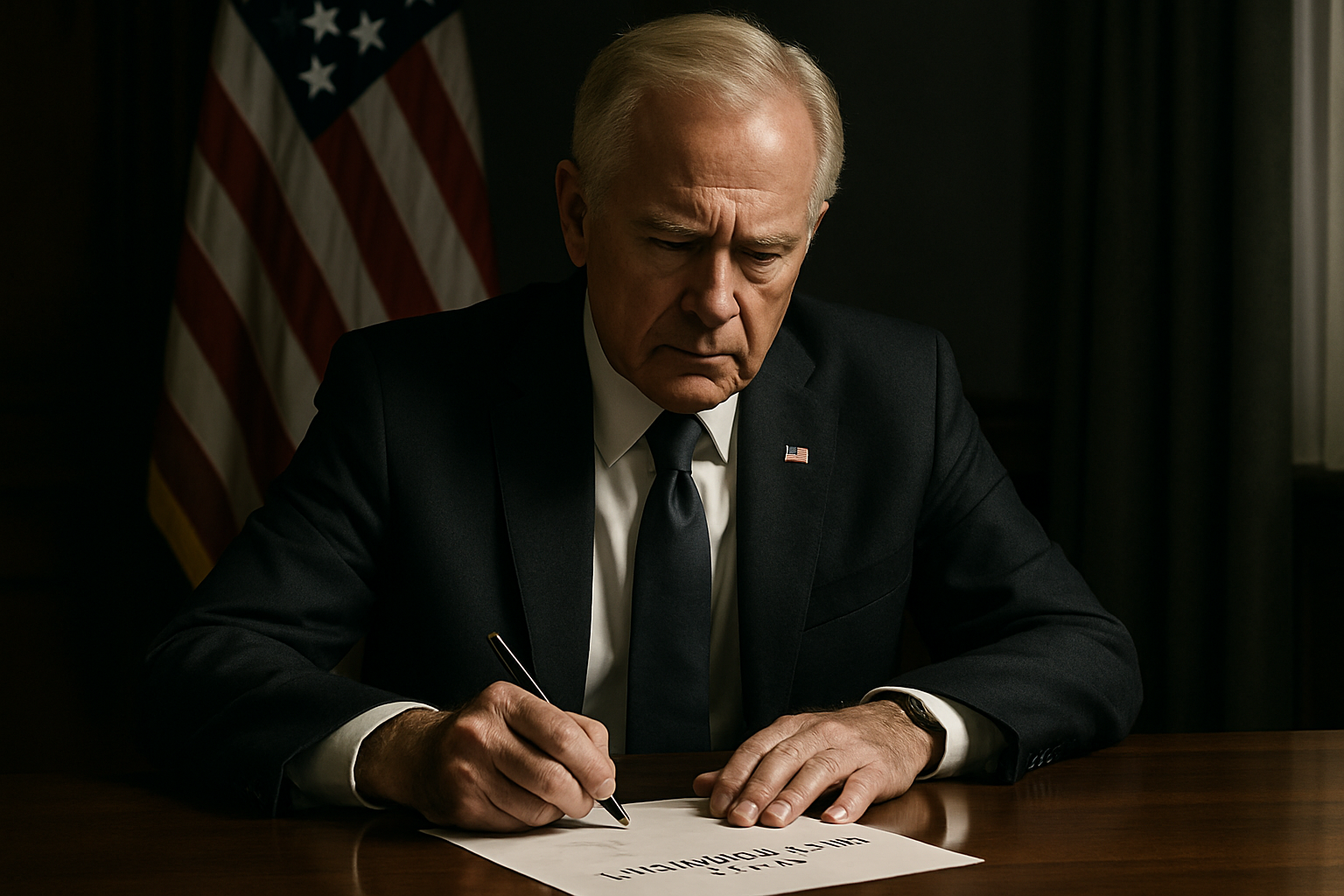
Joseph Kent, the director of the National Counterterrorism Center, announced his resignation on Tuesday, becoming the first senior Trump administration official to quit in opposition to the ongoing US-Israeli military campaign against Iran, declaring he "cannot in good conscience" support the war.
In his resignation letter to President Donald Trump, Kent stated unequivocally that "Iran posed no imminent threat to our nation" and argued that the United States initiated the conflict due to pressure from Israel and its influential American lobby. The resignation represents a dramatic break within the highest levels of the US national security establishment over Operation Epic Fury, the largest American-Israeli military operation since the 2003 Iraq invasion.
Unprecedented High-Level Dissent
Kent's departure marks the first significant internal opposition to Trump's Iran policy from within his own administration. The former Green Beret special forces member, who served multiple combat tours, delivered a scathing assessment of the military campaign that has now entered its third week with devastating global consequences.
"I cannot in good conscience support the ongoing war in Iran," Kent wrote in his letter, which was later posted on social media. "Iran posed no imminent threat to our nation, and it is clear that we started this war due to pressure from Israel and its powerful American lobby."
The resignation comes as Operation Epic Fury has struck over 2,000 targets across Iran, with costs reaching $5.6 billion in just the first two days alone. The campaign has resulted in the death of Iran's Supreme Leader Ali Khamenei and triggered a massive Iranian retaliation known as "Operation True Promise 4."
Global Crisis Unprecedented in Scale
The war has precipitated one of the most severe international crises since the Cold War, with cascading effects across multiple sectors. Iran has effectively closed the Strait of Hormuz, which handles 40% of global seaborne oil transit, stranding over 150 oil tankers worth billions of dollars in the Persian Gulf.
The aviation industry faces its worst disruption since COVID-19, with over 18,000 flights cancelled worldwide as eight Middle Eastern countries maintain simultaneous airspace closures. Dubai International Airport, the world's busiest, remains shuttered due to missile damage.
Oil prices have surged past $100 per barrel at their peak, while natural gas prices have increased by 24% in Europe and 78% in the United States. Major shipping companies including Maersk and MSC have suspended operations in the region indefinitely.
Diplomatic Collapse Context
Kent's resignation is particularly significant given the collapse of what appeared to be promising diplomatic progress. Just weeks before the military campaign began, US-Iran negotiations in Geneva had achieved what officials described as "broad agreement on guiding principles" - the most substantial progress since the 2018 collapse of the Joint Comprehensive Plan of Action (JCPOA).
However, fundamental disagreements over scope proved insurmountable. Iran maintained that ballistic missiles and regional proxy relationships were "red lines" that should be excluded from nuclear-only talks. The US, led by Secretary of State Marco Rubio, demanded a comprehensive agreement covering missiles, armed groups, and human rights issues.
The breakdown led directly to Operation Epic Fury, launched on March 1, 2026, following the confirmed death of Supreme Leader Khamenei in the initial strikes.
Congressional Scrutiny Intensifies
Kent's resignation comes as bipartisan lawmakers intensify their scrutiny of the Trump administration's Iran war strategy. Senator Richard Blumenthal has expressed being "more concerned than ever" about the potential deployment of ground troops, while multiple senators have demanded detailed briefings on strategy, costs, and exit plans.
The conflict faces unprecedented unpopularity for early-stage military operations, with only 25% of Americans supporting the Iran strikes according to recent polling. Even among Trump's Republican base, support has proven surprisingly limited, raising questions about the sustainability of the military campaign.
The Senate recently voted 53-47 to block a bipartisan resolution that would have limited Trump's presidential war powers against Iran, largely along party lines, but the vote highlighted growing concern about executive authority in military matters.
Regional and International Implications
The war has severely strained the unprecedented regional coalition that had supported diplomatic solutions. Saudi Arabia, the UAE, Qatar, and Egypt had formed a remarkable Middle Eastern consensus backing negotiations over military confrontation. However, Iranian retaliation targeting their territories has created new pressures on these relationships.
The conflict has also created the first attack on European territory since World War II, with Iranian drones striking RAF Akrotiri in Cyprus. This prompted an unprecedented naval coalition response involving British, Spanish, Italian, French, Dutch, and Greek vessels to protect European interests.
International evacuations have reached the scale not seen since the Arab Spring in 2011, with Australia reporting 115,000 nationals trapped in the region and Germany scrambling to evacuate 30,000 tourists.
"This is clearly the greatest test of multilateral cooperation and crisis management in the modern era."
— UN Secretary-General António Guterres
Nuclear Governance Crisis
The Iran crisis unfolds against the backdrop of a broader nuclear governance breakdown. The New START treaty between the United States and Russia expired on February 5, 2026, marking the first time in over 50 years without nuclear constraints between the superpowers. Combined with China's nuclear expansion, UN Secretary-General António Guterres has warned that nuclear risks are at their "highest in decades."
Iran continues uranium enrichment at 60% purity, with an estimated 400+ kilograms of material that could be weaponized to 90% weapons-grade levels sufficient for multiple nuclear weapons.
Trump's Evolving Position
President Trump's statements on the conflict have shown remarkable evolution and internal contradiction. Initially suggesting the war could end "pretty quickly," he has also threatened Iran would be hit "twenty times harder" if oil supplies are disrupted. Most significantly, Trump has explicitly called for Iran's "unconditional surrender" and claimed the right to personally choose Iran's next Supreme Leader.
This represents the most direct assertion of American control over Iranian internal affairs since the 1979 revolution and effectively eliminates diplomatic solution possibilities while the military campaign continues.
Economic and Energy Implications
The closure of the Strait of Hormuz has exposed the vulnerability of global energy infrastructure to regional conflicts. The 21-mile waterway serves as a single point of failure for modern logistics, with no realistic alternatives capable of handling the diverted shipping volume.
Airlines have implemented emergency fuel surcharges as jet fuel prices have skyrocketed from $85-90 per barrel to $150-200. Major carriers including Qantas, Air New Zealand, and SAS have announced fare increases to offset unsustainable fuel costs.
The broader supply chain disruptions extend far beyond energy, affecting automotive, electronics, and textile manufacturing that depends on Gulf trade networks.
Constitutional and Alliance Questions
Kent's resignation has raised broader questions about the constitutional balance of war powers and alliance obligations. The conflict has created the most serious NATO diplomatic crisis in decades, with Spain refusing to allow US use of military bases for Iran operations, leading Trump to threaten cutting off trade relations with Madrid.
European leaders have expressed growing concern about American policy predictability, accelerating discussions about strategic autonomy and independent defense capabilities. The crisis has intensified talks between Germany and France about nuclear deterrence cooperation for the first time since the Cold War ended.
Looking Ahead
As Operation Epic Fury enters its third week, the costs continue mounting across multiple dimensions. The Pentagon has prepared for operations potentially lasting through September, far beyond Trump's initial 4-6 week timeline. First American casualties have been confirmed, with 3 service members killed and 5 wounded.
Kent's resignation represents more than individual conscience - it symbolizes the broader challenges facing American foreign policy in an increasingly multipolar world where traditional alliance structures and diplomatic norms are under severe strain.
The template being set by the rapid transition from diplomacy to military confrontation will likely influence international approaches to conflict resolution for decades to come. Whether the current crisis leads to successful containment or broader regional war will determine not just Middle Eastern stability, but the credibility of diplomatic solutions for future territorial and nuclear disputes worldwide.
As the international community grapples with what UN Secretary-General Guterres has called the "greatest test of multilateral cooperation and crisis management in the modern era," Kent's principled stand serves as a reminder that even in times of crisis, individual conscience and professional integrity retain their power to challenge the momentum toward conflict.