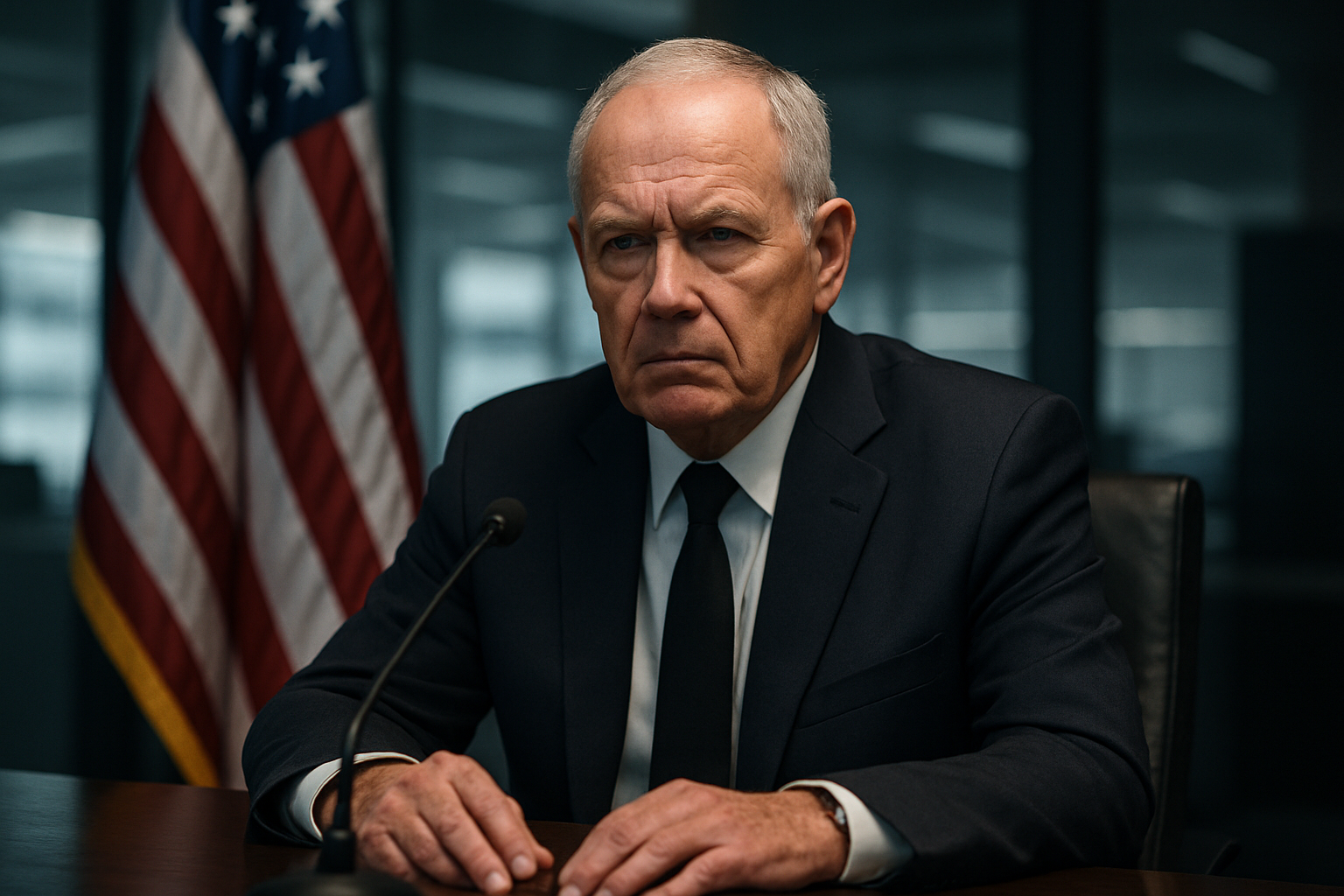
In a stunning blow to the Trump administration's war strategy, Joe Kent, director of the U.S. National Counterterrorism Center, resigned Tuesday in protest over the ongoing military campaign against Iran, becoming the first senior official to publicly break with President Trump's Operation Epic Fury.
Kent's resignation letter, published on social media platform X, delivered a scathing critique of the Iran war, declaring that "Iran posed no imminent threat to our nation" and accusing the administration of launching the conflict under pressure from Israel and powerful lobbying forces in Washington. The resignation marks the most significant internal dissent since the war began March 1, exposing deep divisions within the Trump administration over what has become the most dangerous international crisis since the Cold War.
Direct Challenge to War Justification
In his blunt resignation letter, Kent directly contradicted the administration's core justification for Operation Epic Fury, the largest U.S.-Israeli coordinated military campaign since the 2003 Iraq invasion. "I cannot in good conscience support the ongoing war on Iran," Kent wrote, arguing that the conflict was initiated under pressure from Israeli officials and American media rather than genuine national security threats.
Kent, a former special forces warrant officer with extensive combat experience, warned that the same tactics that drew the United States into the Iraq War were being repeated. He accused "high-ranking Israeli officials and powerful members of the American media" of developing a "disinformation campaign that completely undermined your 'America First' platform and sowed pro-war sentiment."
The timing of Kent's resignation is particularly significant, coming as the war enters its third week with mounting casualties and global economic disruption. Iran's Red Crescent has reported 787 civilian deaths from U.S.-Israeli strikes, while the conflict has triggered the worst global aviation crisis since COVID-19, with over 18,000 flights cancelled worldwide.
White House Fires Back
The White House responded immediately to Kent's explosive claims, with President Trump dismissing his former counterterrorism chief as "weak on security" during remarks from the Oval Office. Speaking to reporters, Trump insisted he had "strong and compelling evidence" that Iran was preparing an attack on the United States, directly refuting Kent's assessment.
The president's defensive posture suggests Kent's resignation has struck a particularly sensitive nerve within the administration. Kent's credentials as a former Green Beret with multiple combat tours and his role overseeing America's counterterrorism efforts give significant weight to his criticism of the war's justification.
Historical Context and Personal Stakes
Kent's opposition to the Iran war carries additional resonance given his personal history. His wife, a military officer and intelligence agent, was killed in Syria in 2019 – a tragedy that has shaped his views on military intervention. Despite this loss, or perhaps because of it, Kent praised Trump's earlier foreign military actions while drawing a sharp distinction with the current Iran campaign.
The resignation comes against the backdrop of unprecedented military escalation. Operation Epic Fury has cost the Pentagon $11.3 billion in its first week alone, with oil prices surging past $80 per barrel as Iran has effectively closed the Strait of Hormuz, threatening 40% of global oil transit. The conflict has expanded beyond the Middle East, with the first U.S. submarine attack on an enemy vessel since World War II when the USS Charlotte sank an Iranian frigate off Sri Lanka.
Congressional Scrutiny Intensifies
Kent's resignation amplifies growing congressional opposition to the war, with bipartisan lawmakers demanding answers about strategy, costs, and the potential for ground troop deployment. Senator Richard Blumenthal told reporters he is "more concerned than ever" about the prospect of American boots on the ground, while the conflict's unpopularity has reached "almost unprecedented" levels for an early-stage military operation, with only 25% of Americans supporting the strikes.
The administration faces particular scrutiny over the dramatic escalation from diplomatic engagement to military action. Just weeks before Operation Epic Fury began, Geneva talks had achieved what Iranian Foreign Minister Abbas Araghchi called "broad agreement on guiding principles" – described as the most significant progress since the collapse of the 2018 nuclear deal.
Regional Consequences and Global Impact
Kent's warnings about Israeli influence appear to reference the broader regional coalition that had supported diplomatic engagement. An unprecedented consensus among Saudi Arabia, the UAE, Qatar, and Egypt backing negotiations has been severely strained as Iranian retaliation has targeted their territories. Egyptian President Abdel Fattah el-Sisi condemned attacks on "sisterly Arab countries," warning of "comprehensive chaos" spreading across the region.
The war has also triggered the first attack on European territory since World War II, with Iranian drones striking RAF Akrotiri in Cyprus, prompting an unprecedented naval coalition response involving British, Spanish, Italian, French, Dutch, and Greek vessels. The EU activated its ESTIA evacuation plan for Cyprus for the first time in the bloc's history.
Intelligence Community Divisions
Kent's resignation reveals broader intelligence community skepticism about the war's necessity. According to British media reports, Jonathan Powell, Britain's national security adviser who participated in U.S.-Iran nuclear talks, assessed that the parties could have reached an agreement before military action began. This assessment contradicts the administration's narrative that diplomatic options had been exhausted.
The nuclear diplomacy collapsed despite what negotiators described as the most promising opening in years, with fundamental disagreement over scope: Iran insisted on nuclear-only talks while the U.S. demanded comprehensive agreements covering ballistic missiles, regional proxies, and human rights.
Personal and Professional Isolation
Kent's decision to go public with his opposition comes as the administration faces mounting isolation both domestically and internationally. Pakistan's stock market suffered its largest single-day decline in history, falling 8.97%, while major shipping companies Maersk and MSC have suspended operations in the Persian Gulf, stranding over 150 oil tankers worth billions in cargo.
The resignation also highlights the administration's preference for unilateral action over traditional alliance structures. Trump has rejected offers of assistance from British naval forces, telling reporters "We don't need people that join Wars after we've already won!" – a departure from decades of U.S.-UK military cooperation that mirrors Kent's criticism of the administration's approach.
Looking Ahead: Template for Opposition
Kent's resignation may serve as a template for other administration officials uncomfortable with the war's trajectory. His carefully crafted letter, which praised Trump's earlier foreign policy successes while targeting specific decisions about Iran, provides a blueprint for principled dissent that could encourage similar actions from other officials.
The broader implications extend far beyond the Trump administration. As the UN Secretary-General António Guterres noted, the crisis represents "the greatest test of multilateral cooperation in crisis management in the modern era." The rapid transition from diplomatic breakthrough to military escalation demonstrates what experts describe as the fragility of crisis management in the multipolar era.
With Iran's Supreme Leader Ali Khamenei confirmed killed in the opening days of Operation Epic Fury, and his son Mojtaba appointed as successor in an unprecedented hereditary transition, the stakes of Kent's warnings about mission scope continue to escalate. As the administration prepares operations through September – far beyond Trump's initial 4-6 week timeline – Kent's resignation stands as a prescient warning about the dangers of military solutions over diplomatic engagement in an increasingly complex international environment.