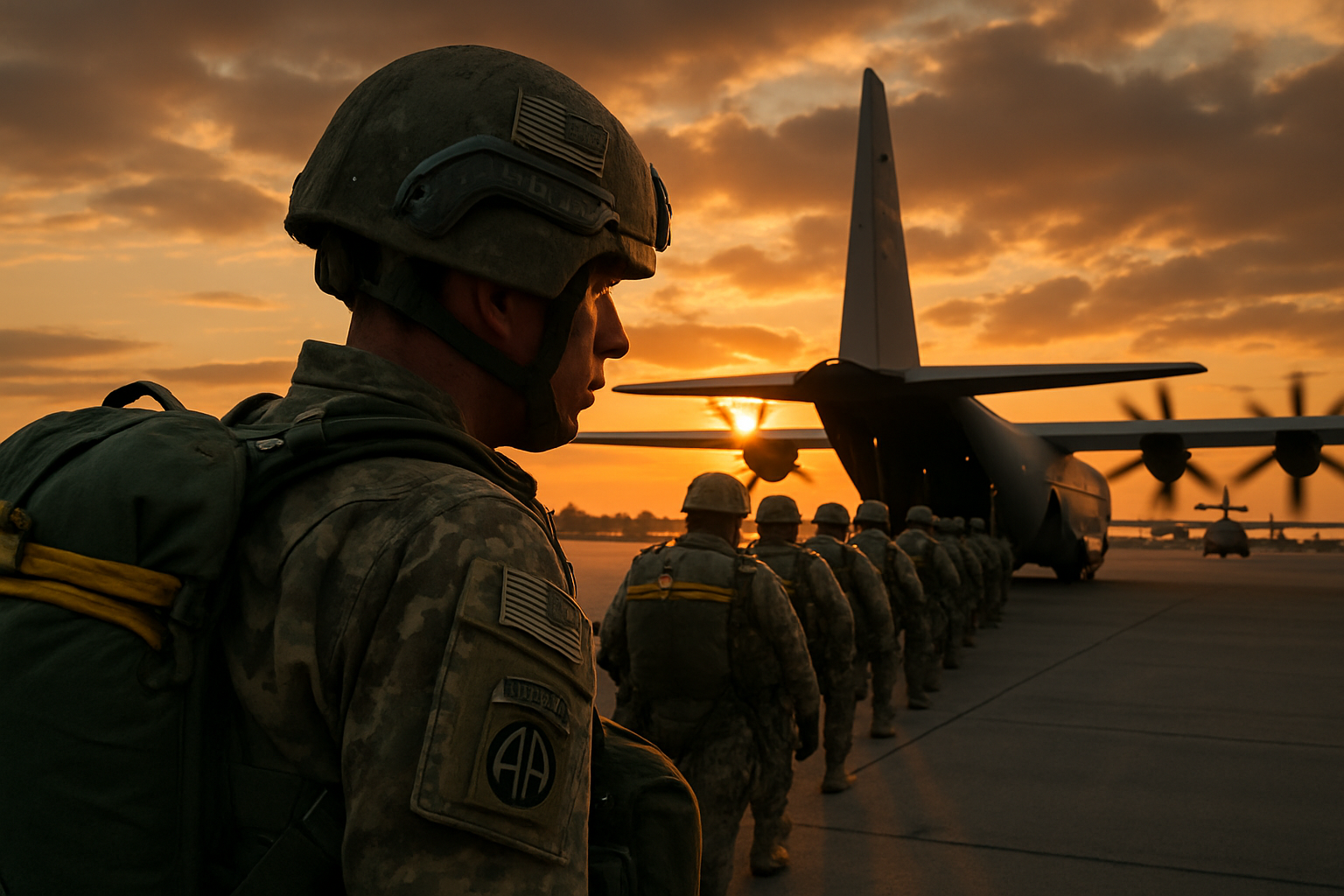
The United States is preparing to deploy approximately 3,000 elite paratroopers from the 82nd Airborne Division to the Middle East in what military sources describe as the most significant troop buildup since the March 2026 Iran crisis began.
According to multiple international sources, including reports from the Wall Street Journal and confirmed by defense officials, orders for the deployment are expected within hours. The move represents a dramatic escalation in the ongoing conflict that has already seen unprecedented global consequences.
Elite Forces Target Strategic Operations
The deployment will include not only ground combat forces but also a specialized command element responsible for operational planning and logistics. Military analysts suggest the primary targets may include Iran's critical Kharg Island oil export terminal, which processes approximately 90% of Iran's crude oil exports.
This strategic facility has been described by Portuguese military sources as potentially representing "the occupation of Kharg Island, from where 90 percent of Iran's oil comes out." Such an operation would constitute the most direct assault on Iran's economic lifeline in the Persian Gulf.
"This war has been won. We really have regime change... because the leaders are all very different from the ones we started with."
— President Trump, White House Statement
Escalating Regional Crisis Context
The paratroopers deployment comes as the Iran crisis enters its most dangerous phase since Cold War-era tensions. The conflict began following the death of Supreme Leader Ali Khamenei on March 1, 2026, triggering Operation Epic Fury - the largest US-Israeli coordinated military campaign since the 2003 Iraq invasion.
Already, 5,000 US Marines and sailors, alongside an amphibious assault ship, have been dispatched to the region. The addition of 3,000 paratroopers from the elite 82nd Airborne Division signals a potential shift from naval and air operations to significant ground force deployment.
Global Economic and Aviation Impact
The crisis has created unprecedented global disruption. Over 18,000 flights have been cancelled worldwide - the most extensive aviation crisis since COVID-19. Eight Middle Eastern countries have simultaneously closed their airspace, effectively severing Asia-Europe air corridors.
Energy markets are experiencing severe volatility, with oil prices surging past $100 per barrel and heading toward $200, according to market warnings. Iran's mining operations in the Strait of Hormuz - affecting 40% of global oil transit - have stranded over 150 tankers worth billions in cargo.
European Territory Under Attack
In a historic escalation, Iranian forces have struck European territory for the first time since World War II. Drone attacks on RAF Akrotiri in Cyprus prompted an unprecedented naval coalition response, with HMS Dragon, Spanish frigates, and vessels from Italy, France, the Netherlands, and Greece deploying to protect European interests.
The European Union activated its ESTIA evacuation plan for Cyprus for the first time in the bloc's history, marking the conflict's expansion beyond traditional Middle Eastern boundaries.
Congressional Opposition Growing
Despite the military escalation, the deployment faces significant domestic opposition. Senator Richard Blumenthal expressed being "more concerned than ever" about the possibility of "boots on the ground," while the conflict maintains historically low public support at just 25% among Americans.
Operation Epic Fury has already cost $11.3 billion in its first week alone, with Pentagon operations expected to continue through September - far beyond the initially projected 4-6 week timeline.
Nuclear Diplomacy Breakdown
The military escalation follows the complete collapse of nuclear negotiations despite February's Geneva framework achieving "broad agreement on guiding principles" - the most significant diplomatic progress since the 2018 JCPOA collapse.
The fundamental scope disagreement proved insurmountable: Iran demanded nuclear-only discussions excluding ballistic missiles and proxy forces as "red lines," while the US insisted on comprehensive agreements addressing missiles, armed groups, and human rights issues.
Revolutionary Leadership Change
Iran now faces its first hereditary succession in Islamic Republic history, with Mojtaba Khamenei (son of the deceased Supreme Leader) appointed to the position. CIA assessments suggest Revolutionary Guards have consolidated unprecedented military control, representing a shift from clerical to military governance during wartime conditions.
Regional Coalition Under Strain
The previously unprecedented regional coalition of Saudi Arabia, UAE, Qatar, and Egypt supporting diplomacy has come under severe strain as Iranian retaliation systematically targets member territories. Egypt's President Sisi condemned attacks on "sisterly countries," warning of "comprehensive chaos" throughout the region.
Casualties from Iranian Operation True Promise 4 include: one civilian killed in Abu Dhabi with Dubai International Airport shut down, 32 injured in Kuwait airport strikes, and eight wounded in Qatar despite Patriots intercepting 65 missiles and 12 drones.
Historical Template-Setting Crisis
UN Secretary-General António Guterres has called this "the greatest test of multilateral cooperation and crisis management in the modern era." The rapid transition from diplomatic framework to military escalation demonstrates the fragility of crisis management in the multipolar era.
The stakes include regional war prevention, global energy security, nuclear governance credibility, and international law enforcement - all being tested simultaneously in what experts describe as the most consequential international crisis since the end of the Cold War.
Looking Ahead
The deployment of 3,000 elite paratroopers represents a potential point of no return in the Iran crisis. Success in containing the conflict could provide a framework for future nuclear dispute resolution, while failure may accelerate military solutions for decades, encouraging proliferation globally and undermining diplomatic credibility worldwide.
As the international community watches these developments unfold, the coming days will be critical in determining whether this crisis can be contained or whether it will fundamentally reshape 21st-century conflict resolution approaches with implications extending far beyond current events.