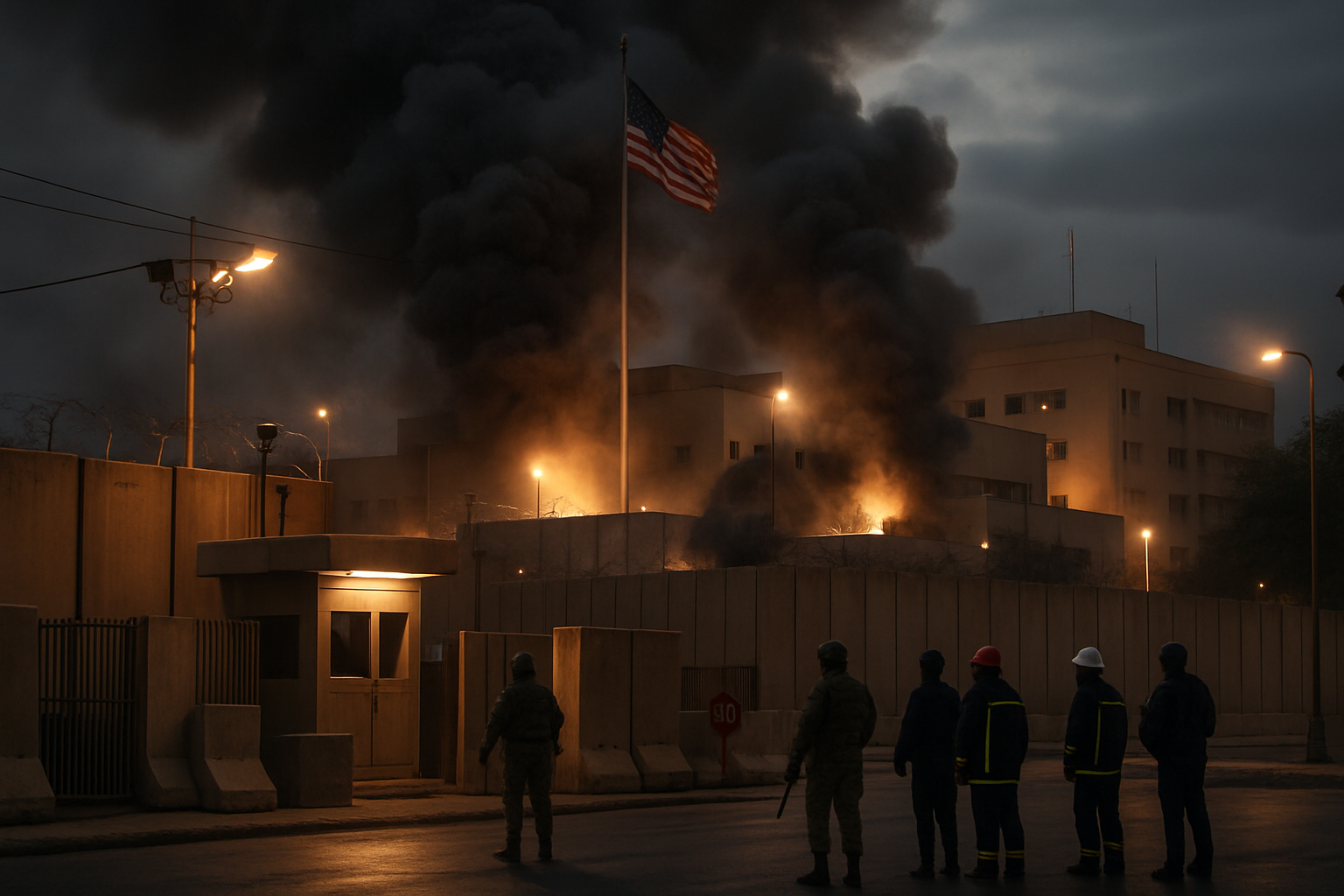
Multiple rockets and missiles struck the United States Embassy compound in Baghdad on Saturday, according to Iraqi security officials, marking the latest escalation in a widening Middle East conflict that has seen Iranian forces systematically target American diplomatic facilities across the region.
At least one rocket landed inside the heavily fortified embassy complex in Baghdad's Green Zone, with additional projectiles hitting the helipad area according to two Iraqi security officials who spoke on condition of anonymity. Video obtained by international news agencies showed smoke billowing from within the embassy compound, while local residents reported hearing loud explosions in the early morning hours.
Context of Escalating Regional Crisis
The Baghdad embassy attack occurs against the backdrop of the most serious Middle East crisis since the Cold War, triggered by the complete breakdown of US-Iran nuclear negotiations and subsequent military confrontation. The crisis reached a critical turning point on March 1, 2026, when Iran's Supreme Leader Ayatollah Ali Khamenei was killed during Operation Epic Fury, the largest coordinated US-Israeli military operation since the 2003 Iraq invasion.
Iranian Revolutionary Guard forces have declared "no red lines remain" in their retaliation campaign, known as Operation True Promise 4, systematically targeting US and Israeli assets across the Gulf states and beyond. The embassy attack represents part of this broader Iranian strategy to pressure American interests throughout the region.
Details of the Baghdad Attack
Iraqi officials confirmed that the projectiles struck the embassy compound during the early morning hours, landing within the perimeter of one of the world's most heavily fortified diplomatic facilities. The Green Zone, which houses Iraqi government institutions and foreign embassies, has experienced increased security measures since the regional crisis began in late February.
While initial reports suggested limited material damage and no immediate casualties among embassy personnel, the successful penetration of the embassy's defensive systems represents a significant security breach. The facility, which cost over $750 million to construct, features multiple layers of security including high concrete barriers, armed checkpoints, and advanced missile defense systems.
"Images circulating online showed a column of smoke rising from the embassy area inside the Green Zone,"
— Associated Press report
The attack comes as diplomatic tensions have reached unprecedented levels following the collapse of Geneva nuclear negotiations in late February. Despite achieving what Iranian Foreign Minister Abbas Araghchi described as "broad agreement on guiding principles" – the most significant progress since the 2018 JCPOA collapse – fundamental disagreements over scope proved insurmountable.
Regional Pattern of Attacks
The Baghdad embassy strike is part of a systematic Iranian campaign targeting US diplomatic facilities across the Middle East. In recent days, Iranian drone attacks have struck:
- US Embassy Riyadh in Saudi Arabia, causing fire and material damage
- US Consulate Dubai, with drones hitting the parking area
- Kuwait International Airport, injuring multiple employees
- RAF Akrotiri base in Cyprus, marking the first attack on European territory since World War II
These coordinated strikes represent a dramatic escalation from Iran's traditional proxy warfare tactics to direct confrontation with US diplomatic infrastructure, crossing fundamental red lines in international relations.
Nuclear Diplomacy Breakdown
The current crisis stems from the complete collapse of US-Iran nuclear negotiations, despite breakthrough progress in Geneva talks. Iran had maintained that ballistic missiles and regional proxies were "red lines" that could not be included in nuclear-only negotiations, while the US under Secretary of State Marco Rubio insisted on a comprehensive agreement encompassing missiles, armed groups, and human rights.
Iran's uranium enrichment program continues at 60% purity with over 400 kilograms of material, approaching the 90% weapons-grade threshold. Former IAEA inspector Dr. Yusri Abu Shadi has confirmed that Iran possesses sufficient enriched uranium to make multiple nuclear weapons "easily achievable" if weaponized.
Global Crisis Response
The embassy attacks have triggered unprecedented international evacuations, with over 18,000 flights cancelled worldwide – the most extensive aviation disruption since the COVID-19 pandemic. Eight Middle Eastern countries have simultaneously closed their airspace, including Iran, Iraq, Israel, UAE, Qatar, Syria, Kuwait, and Bahrain.
Oil prices have surged past $80 per barrel as Iran declared the Strait of Hormuz "unsafe," effectively blocking 40% of global seaborne oil transit. Major shipping companies including Maersk and MSC have suspended operations, leaving over 150 tankers anchored in the Persian Gulf with billions of dollars in stranded cargo.
US Military Response
The United States has positioned an unprecedented military force in the region, including dual-carrier deployments of the USS Gerald R. Ford and USS Abraham Lincoln, representing approximately one-third of the active US Navy fleet. Pentagon officials have confirmed the first American casualties since the crisis began, with three service members killed and five wounded during Operation Epic Fury.
President Trump has issued increasingly harsh warnings, including threats of "unconditional surrender" demands and claims of the right to personally choose Iran's next Supreme Leader. The administration has extended military operations timelines through September 2026, far beyond initial projections of a 4-6 week campaign.
Iraqi Government Position
The Iraqi government finds itself in an increasingly difficult position as its territory becomes a battleground between US and Iranian forces. The embassy attack underscores Iraq's limited ability to protect diplomatic facilities within its own borders, despite the massive security infrastructure in the Green Zone.
Iraqi officials have called for restraint from all parties while acknowledging their limited capacity to prevent such attacks amid the broader regional confrontation. The situation echoes previous periods of instability when the embassy faced repeated attacks during the height of sectarian violence in Iraq.
International Implications
The systematic targeting of US diplomatic facilities represents a dangerous escalation that could further internationalize the conflict. European allies have begun evacuating personnel from the region, with Cyprus activating its ESTIA emergency evacuation plan for the first time in the country's history.
UN Secretary-General António Guterres has described the situation as "the greatest test of multilateral cooperation and crisis management in the modern era," warning of a "chain of events that no one can control."
"This is a serious threat to international peace and security that could trigger consequences extending far beyond the Middle East,"
— UN Secretary-General António Guterres
Looking Ahead
The Baghdad embassy attack marks a critical juncture in what has become the most dangerous international crisis since the end of the Cold War. The successful penetration of such a heavily fortified facility demonstrates Iran's growing capability and willingness to directly target American diplomatic infrastructure.
With nuclear diplomacy completely collapsed and military operations expanding across multiple theaters, the international community faces the challenge of preventing a regional war with global implications. The coming days will be crucial in determining whether diplomatic channels can be reopened or whether the crisis will continue escalating toward broader Middle Eastern warfare.
The attack on the Baghdad embassy, combined with similar strikes across the region, suggests that Iran has fundamentally altered its approach from proxy warfare to direct confrontation with US interests. This shift represents a watershed moment that could reshape Middle Eastern geopolitics for decades to come, with implications extending far beyond the current crisis to affect energy security, nuclear governance, and international stability mechanisms worldwide.