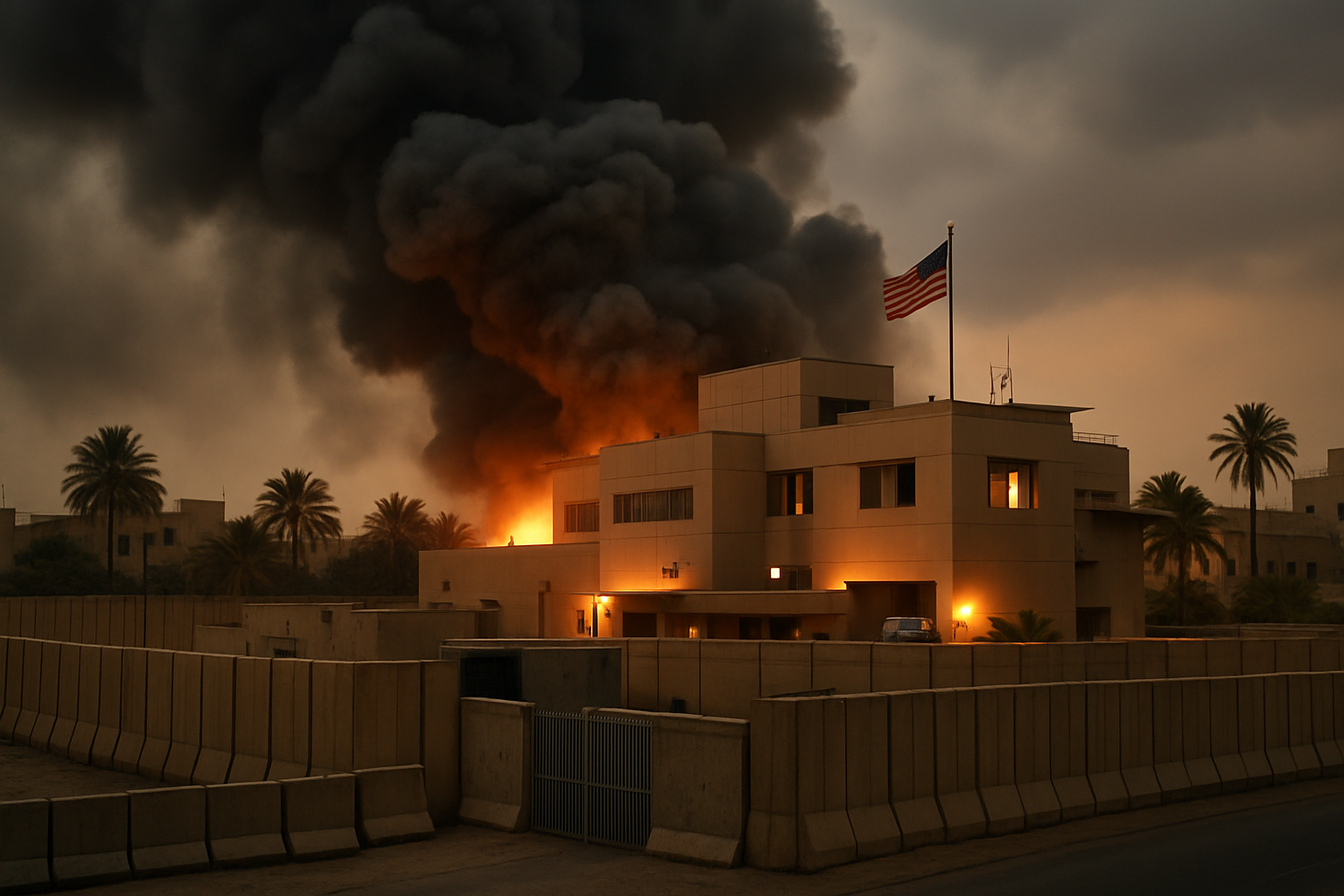
The United States Embassy in Baghdad came under sustained missile and drone attacks early Tuesday morning, marking another dangerous escalation in the broader Middle East conflict that has engulfed the region since early March 2026.
Iraqi security sources confirmed that multiple missiles and at least five drones targeted the heavily fortified embassy compound in Baghdad's Green Zone around dawn. According to reports from multiple international news agencies, projectiles successfully penetrated the embassy's advanced defensive systems, with at least one missile landing directly within the compound and others striking the helipad area.
Smoke was seen billowing from sections of the embassy complex during the early morning assault, though there were no immediate reports of casualties among American diplomatic personnel stationed at the facility. The attack represents a significant breach of the embassy's sophisticated security infrastructure and marks the latest in a series of Iranian-linked strikes against US diplomatic facilities across the region.
Part of Broader Iranian Campaign
The Baghdad embassy attack appears to be part of Iran's systematic "Operation True Promise 4" campaign, which has targeted US diplomatic and military installations throughout the Middle East following the confirmed death of Iran's Supreme Leader Ali Khamenei on March 1, 2026. The Iranian Revolutionary Guard Corps (IRGC) has declared that "no red lines remain" in their retaliatory operations against American and Israeli assets.
This coordinated assault follows a pattern of recent Iranian attacks that have included strikes on the US Embassy in Riyadh, the US Consulate in Dubai, Kuwait International Airport, and the unprecedented attack on RAF Akrotiri in Cyprus - marking the first assault on European territory since World War II.
The timing of the Baghdad attack coincides with the ongoing US-Israeli "Operation Epic Fury," the largest coordinated military campaign in the Middle East since the 2003 Iraq invasion. This operation has utilized an unprecedented dual-carrier deployment of the USS Gerald R. Ford and USS Abraham Lincoln, representing approximately one-third of the active US Navy fleet positioned 800 kilometers from Iran's coast.
Diplomatic Breakdown Context
The embassy attack occurs against the backdrop of a complete collapse in diplomatic relations between Washington and Tehran. Despite achieving what negotiators called a "broad agreement on guiding principles" during Geneva talks - representing the most significant progress since the 2018 JCPOA collapse - fundamental disagreements over scope proved insurmountable.
"Iran has excluded ballistic missiles and regional proxy operations as 'red lines' from nuclear-only discussions, while the US has demanded comprehensive agreements including missiles, armed groups, and human rights."
— Analysis of diplomatic sources
Iran continues enriching uranium to 60% purity with over 400 kilograms of material, approaching the 90% weapons-grade threshold. Intelligence assessments suggest Iran possesses sufficient fissile material for multiple nuclear weapons if a weaponization decision were made.
Regional Security Implications
The Baghdad attack demonstrates Iran's capability to strike American diplomatic infrastructure across the region despite massive US military presence. The breach of embassy defenses raises serious questions about the security of American personnel in Iraq and throughout the Gulf states.
This escalation severely strains the unprecedented regional coalition of Saudi Arabia, UAE, Qatar, and Egypt that had been supporting diplomatic solutions to prevent broader conflict. Egyptian President Abdel Fattah el-Sisi condemned attacks on "sisterly Arab countries," warning of "comprehensive chaos" if the crisis continues to expand.
The assault on Baghdad comes as the regional crisis has already caused:
- Over 18,000 flight cancellations worldwide due to simultaneous airspace closures
- Oil prices surging past $80 per barrel with Iran threatening the Strait of Hormuz
- The shutdown of Dubai International Airport, the world's busiest
- Mass evacuations of foreign nationals from 15+ Middle Eastern countries
Historical Context and Precedents
The US Embassy in Baghdad has faced security challenges throughout its existence since the 2003 US-led invasion of Iraq. However, the current attack occurs during the most dangerous international crisis since the end of the Cold War, according to UN Secretary-General António Guterres, who has described the situation as "the greatest test of multilateral cooperation and crisis management in the modern era."
The embassy compound, one of the largest and most expensive diplomatic facilities ever built, was designed to withstand significant attacks. Its apparent penetration by Iranian missiles and drones represents a major security breach that will likely prompt a comprehensive review of diplomatic security protocols throughout the region.
Global Economic and Strategic Impact
The Baghdad embassy attack contributes to a broader pattern of infrastructure targeting that has created a global economic crisis. Iran's effective closure of the Strait of Hormuz, which carries 40% of global seaborne oil transit, has stranded over 150 oil tankers worth billions of dollars in the Persian Gulf.
Major shipping companies including Maersk and MSC have suspended operations in the region, while Qatar has halted LNG production affecting approximately 20% of global natural gas exports. The crisis has caused natural gas prices to surge 24% in Europe and 78% in the United States.
Nuclear Governance Crisis
The embassy attack occurs within the broader context of a global nuclear governance crisis. The New START treaty between the United States and Russia expired on February 5, 2026, marking the first time in over 50 years without bilateral nuclear constraints between the superpowers. Combined with China's ongoing nuclear expansion, the Iran crisis represents what UN officials call nuclear risks at their "highest level in decades."
This template-setting crisis will likely influence international approaches to nuclear proliferation and conflict resolution for decades to come, as the rapid transition from diplomatic breakthrough to military confrontation demonstrates the fragility of modern crisis management mechanisms in an increasingly multipolar world.
Immediate Consequences and Future Outlook
The successful penetration of the Baghdad embassy's defenses sends a clear message about Iran's continued operational capabilities despite weeks of intensive US-Israeli bombardment. The attack underscores that Iran maintains the capacity to strike American interests throughout the region, even as it faces unprecedented military pressure.
Congressional leaders have expressed growing concern about the expansion of the conflict and potential deployment of US ground forces. Senator Richard Blumenthal stated he is "more concerned than ever" about the possibility of American boots on the ground, as the conflict's unpopularity reaches what some describe as "almost unprecedented" levels.
The Baghdad embassy attack represents more than a tactical strike - it symbolizes the dangerous expansion of a crisis that began with nuclear negotiations and has evolved into the most significant international confrontation since the Cold War. As diplomatic channels remain severed and military positions continue to harden, the stakes for regional war prevention, global energy security, and nuclear governance credibility have never been higher.
The coming days will be crucial in determining whether this latest escalation can be contained or whether it represents another step toward a broader Middle Eastern war with global implications extending far beyond the current crisis.