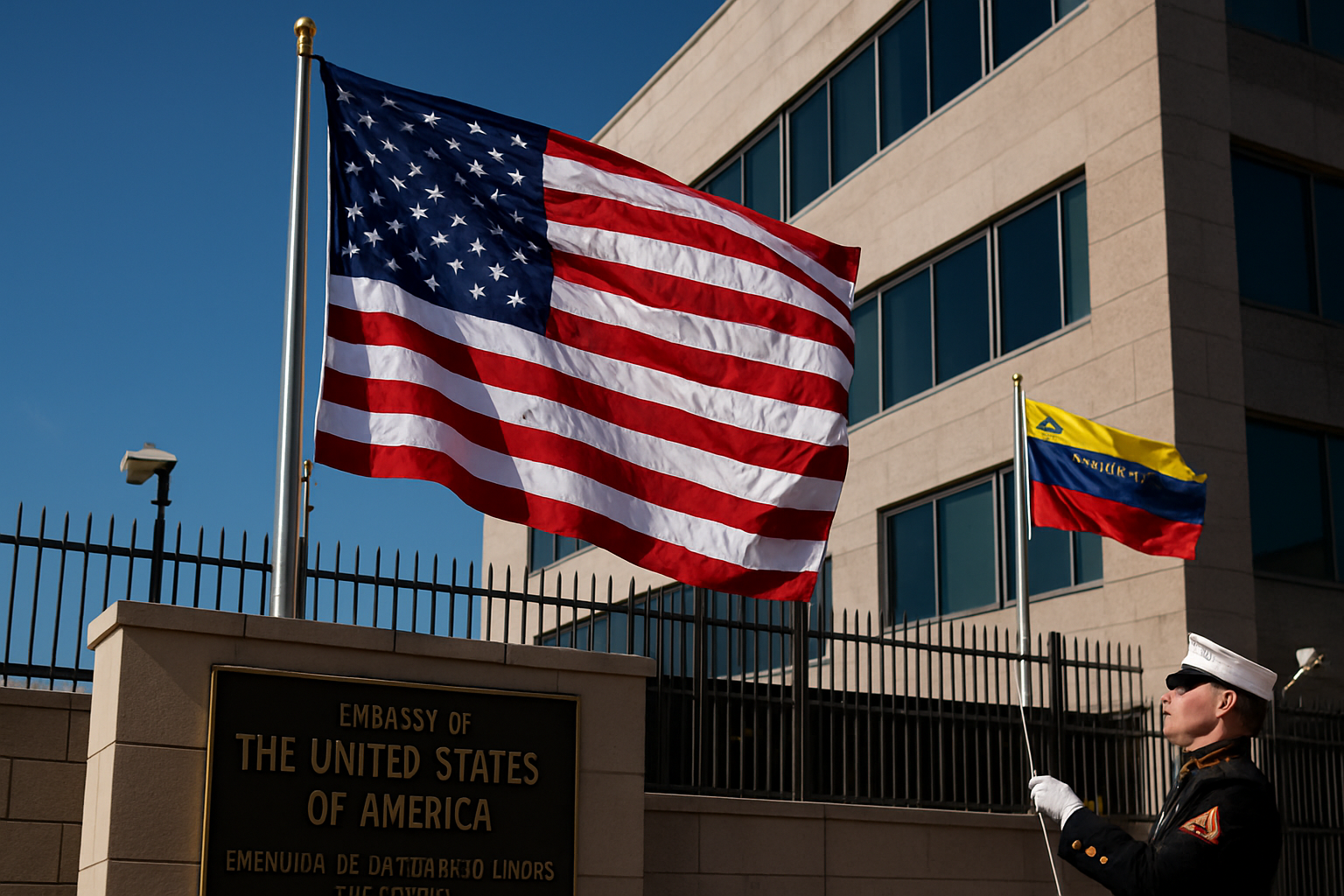
The American flag was raised over the United States embassy in Venezuela on Saturday for the first time since 2019, marking a pivotal moment in the dramatic transformation of US-Venezuelan relations that has unfolded since Acting President Delcy Rodríguez assumed power following Nicolás Maduro's capture in January 2026.
The flag-raising ceremony, conducted at precisely the same morning hour when it was last lowered in 2019, represents the culmination of the most significant diplomatic reversal in recent hemispheric history. The event follows the formal restoration of diplomatic relations between Washington and Caracas announced in March 2026, ending seven years of diplomatic isolation.
From Maximum Pressure to Strategic Partnership
The embassy's closure in 2019 came during the first Trump administration's "maximum pressure" campaign against the Maduro government, when the US recognized opposition leader Juan Guaidó as interim president. The dramatic policy reversal reflects Venezuela's transformation under Acting President Rodríguez, who has overseen unprecedented democratic reforms since assuming power.
US Chargé d'Affaires Laura Dogu, who has maintained high-level diplomatic engagement with the Venezuelan government throughout the transition, oversaw Saturday's ceremony. The embassy building, while now displaying the American flag, remains under renovation with full operational capacity still pending completion.
"This represents the beginning of a new era in US-Venezuelan relations based on mutual respect and constructive dialogue,"
— Acting President Delcy Rodríguez
Comprehensive Democratic Transformation
The flag-raising occurs against the backdrop of Venezuela's most comprehensive political reconciliation in recent Latin American history. Under Rodríguez's leadership, over 750 political prisoners have been released through a historic amnesty program covering the period from 1999-2026, spanning the entire Chávez-Maduro era.
The amnesty law, passed unanimously by Venezuela's National Assembly, represents what observers describe as the most ambitious political reconciliation effort in the region's recent history. Former Spanish Prime Minister José Luis Rodríguez Zapatero has mediated the process, while Cardinal Baltazar Porras has organized nationwide prayer vigils supporting the reconciliation effort.
Economic Partnership Drives Diplomatic Breakthrough
The diplomatic restoration has been accompanied by remarkable economic cooperation. Venezuelan oil exports have surged 60% since January 2026, reaching 800,000 barrels daily, with the United States displacing China as Venezuela's top customer following the lifting of sanctions.
Energy Secretary Chris Wright's historic February visit to Caracas resulted in comprehensive cooperation agreements signed at the Miraflores Palace, formally ending the 2019 oil embargo. Major international companies including Chevron, BP, Shell, Eni, and Repsol have been authorized for expanded operations under Treasury Department permissions.
Interior Secretary Doug Burgum's subsequent visit focused on mining code reforms, opening unprecedented opportunities for American companies to access Venezuela's critical mineral resources. The reforms address US supply chain security concerns and counter Chinese dominance in strategic materials.
Regional and International Implications
The diplomatic breakthrough has created a ripple effect throughout Latin America. The Dominican Republic has reopened full diplomatic and commercial relations with Venezuela, while Brazil and the European Union have expressed cautious support for the democratic transition.
The transformation represents a template for what officials term "bilateral energy diplomacy" - a strategic approach combining economic incentives with democratic transitions to counter Chinese influence in the Western Hemisphere. This model forms part of the broader "Corolario Trump" strategy, described as a 21st-century update to the Monroe Doctrine.
Ongoing Challenges and Future Prospects
Despite the dramatic improvements, significant challenges remain. Approximately 600 political prisoners are still detained according to human rights organizations, though releases continue under the comprehensive amnesty program. Venezuela's oil production, while recovering, remains at 700,000 barrels daily compared to the historical peak of 3 million barrels.
Infrastructure decay, hyperinflation, and power outages persist throughout the country, requiring sustained international investment and technical assistance. The success of the democratic transition depends on continued political reforms and economic modernization efforts.
Congressional and International Response
The rapid policy transformation has generated mixed reactions in Washington. Republican lawmakers support the approach as an effective strategy to counter Chinese influence in Latin America, while Democratic members have introduced legislation demanding greater transparency regarding Venezuelan oil sales.
International observers emphasize that the sustainability of the diplomatic breakthrough depends on Venezuela's continued commitment to democratic reforms and human rights improvements. María Corina Machado, the 2025 Nobel Peace Prize laureate, has announced her planned return to Venezuela "within weeks," serving as a crucial test of the government's democratic commitments.
Looking Forward
President Trump has announced his intention to visit Venezuela, which would make him the first US president to do so since 1997. Such a visit would represent the capstone of the most dramatic foreign policy transformation in recent American history.
The embassy flag-raising, while symbolic, reflects concrete progress in what Secretary of State Marco Rubio describes as a three-phase reconstruction plan: stabilization through prisoner releases, economic recovery through sanctions relief, and democratic transition through electoral reforms.
As international observers monitor Venezuela's democratic progress, the flag flying over the US embassy in Caracas serves as a powerful symbol of diplomatic possibilities. The success or failure of this unprecedented transformation will likely influence American foreign policy approaches to similar challenges worldwide, making Venezuela a crucial test case for 21st-century diplomacy in an era of great power competition.
The restoration of US-Venezuelan diplomatic relations represents more than a bilateral achievement - it demonstrates the potential for rapid diplomatic reversals when combined with democratic reforms and economic incentives, creating a template that may reshape international crisis resolution for years to come.