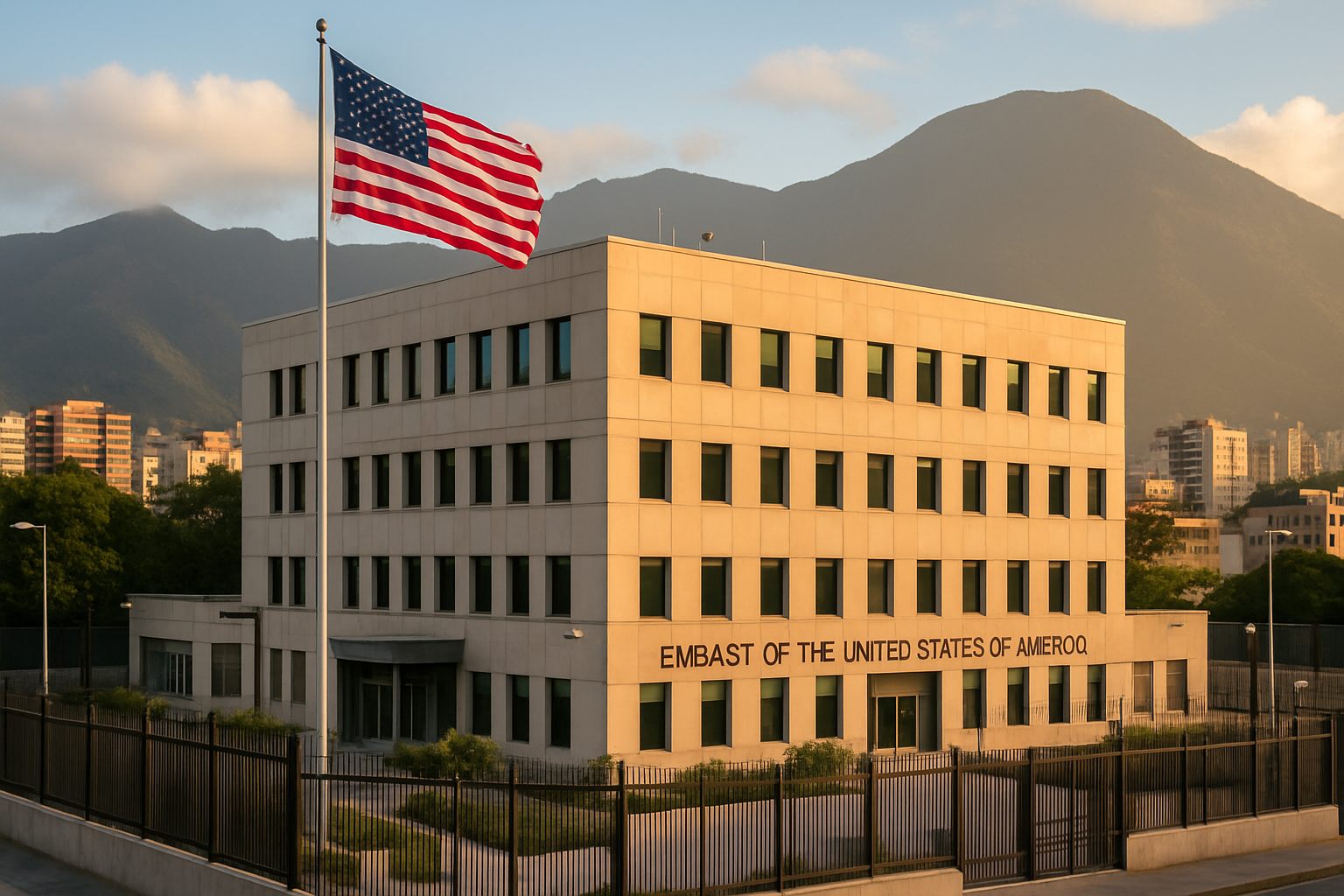
The United States embassy in Caracas officially resumed diplomatic operations on Monday, March 30, 2026, marking the end of a seven-year period of severed relations between Washington and Venezuela that began during the Trump administration's "maximum pressure" campaign against the former Maduro regime.
According to a State Department press release, the embassy's reopening represents "a new chapter in our diplomatic presence in Venezuela" under the interim government of Acting President Delcy Rodríguez, who assumed power following the dramatic removal of Nicolás Maduro in January 2026.
"We formally resume operations at the United States Embassy in Caracas, marking a new chapter in our diplomatic presence in Venezuela," the State Department announced in a statement confirming the restoration of full diplomatic functions.
From Maximum Pressure to Strategic Partnership
The embassy's reopening caps one of the most dramatic foreign policy reversals in recent American history. Relations between the two nations had been completely severed since January 2019, when the Trump administration recognized opposition leader Juan Guaidó as Venezuela's interim president and launched an unprecedented "maximum pressure" campaign against the Maduro government.
The transformation began following Maduro's capture by U.S. forces on January 3, 2026, in an operation that ended nearly three decades of Chavista rule in Venezuela. Since then, the relationship between Washington and Caracas has undergone a complete transformation from adversarial to collaborative.
US Chargé d'Affaires Laura Dogu, who has been conducting high-level diplomatic meetings at the Miraflores Presidential Palace since February, will oversee the embassy's full operational resumption. Her presence in Caracas represents the highest-level American diplomatic contact with Venezuela since 2019.
Economic Partnership Drives Restoration
The diplomatic breakthrough has been underpinned by remarkable economic cooperation. Venezuelan oil exports have surged by 60% since January, reaching 800,000 barrels per day, with the United States now serving as Venezuela's top customer, displacing China in a significant geopolitical realignment.
Energy Secretary Chris Wright's historic February visit to Caracas resulted in comprehensive cooperation agreements that effectively ended the 2019 oil embargo. Major American and international energy companies, including Chevron, BP, Shell, Eni, and Repsol, have been authorized by the Treasury Department to expand their Venezuelan operations significantly.
The energy partnership extends beyond oil to include natural gas, electricity production, and critical minerals. Interior Secretary Doug Burgum's March visit focused on mining code reforms that will provide "unlimited opportunities for cooperation" between American companies and Venezuela's mineral sector, addressing U.S. supply chain security concerns amid Chinese dominance in strategic materials.
Political Reconciliation Unprecedented in Scale
The interim Venezuelan government has implemented what analysts describe as the most comprehensive political reconciliation program in recent Latin American history. Over 750 political prisoners have been released since January under a sweeping amnesty program covering political offenses from 1999 to 2026—spanning the entire Chávez-Maduro era.
The National Assembly unanimously approved the historic amnesty law in February, with Acting President Rodríguez calling for "maximum speed" in implementation and emphasizing the need for national healing. "One must know how to ask for forgiveness and one must also know how to receive forgiveness, and this is the process that opens with this amnesty," Rodríguez stated.
However, challenges remain in the reconciliation process. Approximately 600 political prisoners are still detained according to human rights organizations, and some releases have come with restrictive conditions such as house arrest and electronic monitoring, raising questions about the depth of democratic reforms.
International Mediation and Support
The diplomatic restoration has been facilitated by significant international mediation efforts. Former Spanish Prime Minister José Luis Rodríguez Zapatero has been conducting mediation in Caracas since February, while Cardinal Baltazar Porras has organized nationwide prayer vigils to support the reconciliation process.
Regional support has been growing steadily. The Dominican Republic has reopened full diplomatic and commercial relations with Venezuela, while Brazil and the European Union maintain cautious but supportive positions regarding the democratic transition. The restoration represents a potential template for "bilateral energy diplomacy" as a tool for countering Chinese influence in Latin America.
Rubio's Three-Phase Reconstruction Plan
Secretary of State Marco Rubio has outlined an ambitious three-phase reconstruction plan for Venezuela: stabilization through political prisoner releases and institutional changes, economic recovery through sanctions relief and international investment, and democratic transition toward free and fair elections.
The first phase appears largely complete with the political prisoner releases and the restoration of diplomatic relations. The second phase is advancing rapidly with the energy cooperation agreements and growing international investment. The third phase—democratic transition—remains the most challenging, with questions about the timing and framework for future elections.
President Trump has indicated his intention to visit Venezuela, which would make him the first U.S. president to do so since 1997. Such a visit would represent the capstone of what officials describe as the most significant hemispheric realignment since the end of the Cold War.
Ongoing Challenges and Criticisms
Despite the diplomatic progress, significant challenges remain. Venezuela's oil production, while recovering, remains at only 700,000 barrels per day compared to its historical peak of 3 million barrels. The country continues to face hyperinflation, infrastructure decay, and power outages that affect millions of citizens.
Congressional reaction in Washington has been mixed, with Republicans supporting the reset as a strategic victory against Chinese influence, while Democrats have introduced legislation demanding greater transparency on Venezuelan oil sales and democratic progress. The House previously passed oversight requirements for Venezuelan oil deals by a narrow 219-211 margin, reflecting bipartisan concerns about the rapid policy reversal.
Human rights organizations have criticized aspects of the amnesty implementation as selective rather than comprehensive. Some prominent opposition figures remain under restrictive conditions, and the exclusion of certain categories of prisoners has drawn criticism from civil society groups.
Regional and Global Implications
The Venezuela case is being closely monitored as a potential model for rapid diplomatic transformation in an era of great power competition. The success of the "bilateral energy diplomacy" approach—combining military pressure, economic incentives, and selective engagement—could influence similar situations globally.
The restoration of U.S.-Venezuela relations represents more than a bilateral achievement; it demonstrates the potential for economic partnerships to drive geopolitical realignment. China's displacement as Venezuela's primary energy customer illustrates the gravitational pull of American economic partnerships when properly structured.
For the Caribbean region, the Venezuelan transformation serves as a laboratory for testing reimagined American hemispheric engagement in the 21st century. The "Corolario Trump" strategy represents an updated Monroe Doctrine that combines traditional power projection with modern economic cooperation frameworks.
Looking Forward: Tests of Sustainability
The ultimate test of the diplomatic restoration will be its sustainability beyond immediate economic and political benefits. The planned return of Nobel Peace Prize laureate María Corina Machado to Venezuela "within weeks" represents a crucial test of the interim government's commitment to genuine democratic space.
The embassy reopening occurs amid this broader context of uncertainty and opportunity. While the diplomatic infrastructure is now restored, the deeper questions of democratic consolidation, economic reconstruction, and social reconciliation remain works in progress.
As embassy operations resume in Caracas, both nations face the challenge of translating this diplomatic breakthrough into lasting institutional changes that can withstand future political transitions and economic pressures. The success or failure of this effort will likely influence American approaches to similar challenges worldwide, making Venezuela a critical test case for 21st-century diplomacy.
The reopening of the U.S. embassy in Caracas thus represents not just the restoration of diplomatic relations, but the beginning of a new chapter in hemispheric cooperation that could reshape regional geopolitics for decades to come.