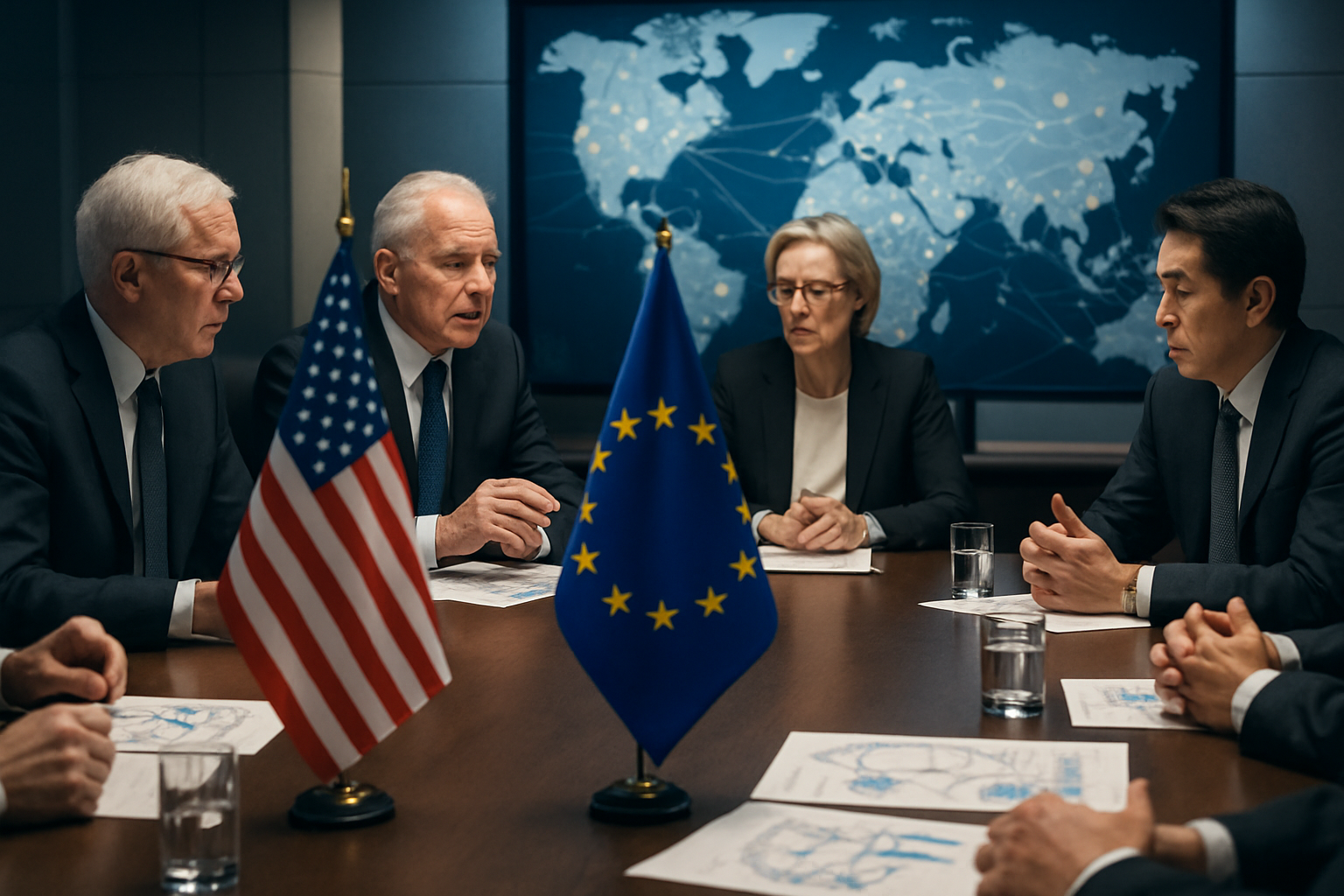
In a landmark move to challenge Beijing's stranglehold on the global critical minerals market, the United States, European Union, and Japan announced a strategic partnership on February 4, 2026, aimed at securing supply chains for materials essential to clean energy and advanced technology.
Speaking at the inaugural Critical Minerals Summit in Washington D.C., US Vice President J.D. Vance outlined an ambitious framework designed to rally more than 50 countries around reducing China's dominance in a sector where Beijing controls 60% of global production and an overwhelming 90% of refining capacity.
"This morning, the Trump administration is proposing a concrete mechanism to return the global critical minerals market to a healthier, more competitive state," Vance declared to ministers from 55 nations who attended the unprecedented gathering.
A Strategic Response to China's Market Control
The partnership represents a direct challenge to China's decades-long grip on materials crucial for renewable energy infrastructure, electric vehicles, and high-tech manufacturing. Critical minerals including lithium, cobalt, and rare earth elements have become the new battleground in global economic competition, with supply chain vulnerabilities threatening Western climate goals and technological advancement.
European Union auditors have repeatedly warned that the bloc's climate neutrality targets for 2030 and 2050 are at serious risk due to dangerous dependence on Chinese-controlled supply chains. The partnership announcement comes as the EU's diversification efforts through initiatives like the Critical Raw Materials Act have fallen short of reducing strategic vulnerabilities.
The timing is particularly significant as Japan has simultaneously made breakthrough progress in reducing its own mineral dependence. In early February 2026, Japan became the first nation to successfully retrieve rare earth-bearing mud from 6,000 meters depth off Minamitorishima island, with deposits containing concentrations up to 20 times higher than terrestrial mines.
Framework for Cooperation
The trilateral partnership includes commitments to establish minimum pricing mechanisms for critical minerals, develop alternative supply chains, and coordinate strategic stockpiling efforts. According to Polish and Italian sources, the partners plan to sign a formal memorandum of understanding within 30 days of the Washington summit.
The initiative builds on existing bilateral cooperation frameworks, including recent US-India discussions on critical minerals through the Quad partnership, and follows extensive EU-US negotiations led by European Commissioner for Industrial Strategy Stéphane Séjourné in early February.
Slovakia's coverage emphasized the alliance's goal to create a "trading bloc" specifically focused on critical minerals, putting aside the Trump administration's broader tariff threats to concentrate on supply chain security.
Economic and Strategic Implications
The partnership announcement coincides with broader volatility in global commodity markets, with natural gas prices surging 24% in Europe and 78% in the United States in recent months. Energy security concerns have intensified following geopolitical tensions and extreme weather events that have tested infrastructure resilience across multiple regions.
Industry analysts note that the success of the partnership will depend on substantial financial commitments and technological cooperation. The scale of investment required to establish alternative supply chains and processing capabilities represents one of the most significant industrial policy challenges since World War II.
The initiative also reflects growing recognition among Western allies that economic security and national security have become increasingly intertwined in critical technology sectors.
Regional and Global Reactions
South Korean coverage highlighted the broader implications for Asian allies, with the partnership potentially offering opportunities for countries seeking to diversify their own mineral supply sources. The framework is expected to include provisions for expanding membership to additional strategic partners.
The Chinese response to the partnership announcement has yet to materialize, but Beijing has previously characterized similar initiatives as protectionist measures designed to contain China's economic development.
African nations, which possess significant untapped mineral resources, are closely watching developments as potential beneficiaries of increased Western investment in alternative supply chains.
Implementation Challenges
Despite the political momentum behind the partnership, significant technical and economic challenges remain. Establishing new mining operations, processing facilities, and refining capabilities requires years of development and billions in investment.
Environmental concerns about increased mining activities in Western countries present additional complications, particularly as the partnership aims to support climate goals through expanded renewable energy deployment.
The partnership also faces the challenge of competing with China's cost advantages, built through decades of investment and economies of scale. Creating economically viable alternatives will require sustained political commitment across multiple electoral cycles.
Future Prospects
The Critical Minerals Partnership represents a fundamental shift in how Western allies approach economic security, moving from purely market-driven approaches to strategic coordination on critical supply chains.
Success will be measured not only by reduced dependence on Chinese supplies but also by the partnership's ability to accelerate clean energy transitions without compromising climate goals through supply shortages.
As the formal memorandum of understanding takes shape over the coming month, the partnership's effectiveness will ultimately depend on translating political commitments into concrete industrial capacity and sustained investment in alternative supply chains.
The February 4 summit marks the beginning of what officials describe as a long-term transformation of global critical minerals markets, with implications extending far beyond the immediate participants to reshape global trade patterns and technological development for decades to come.