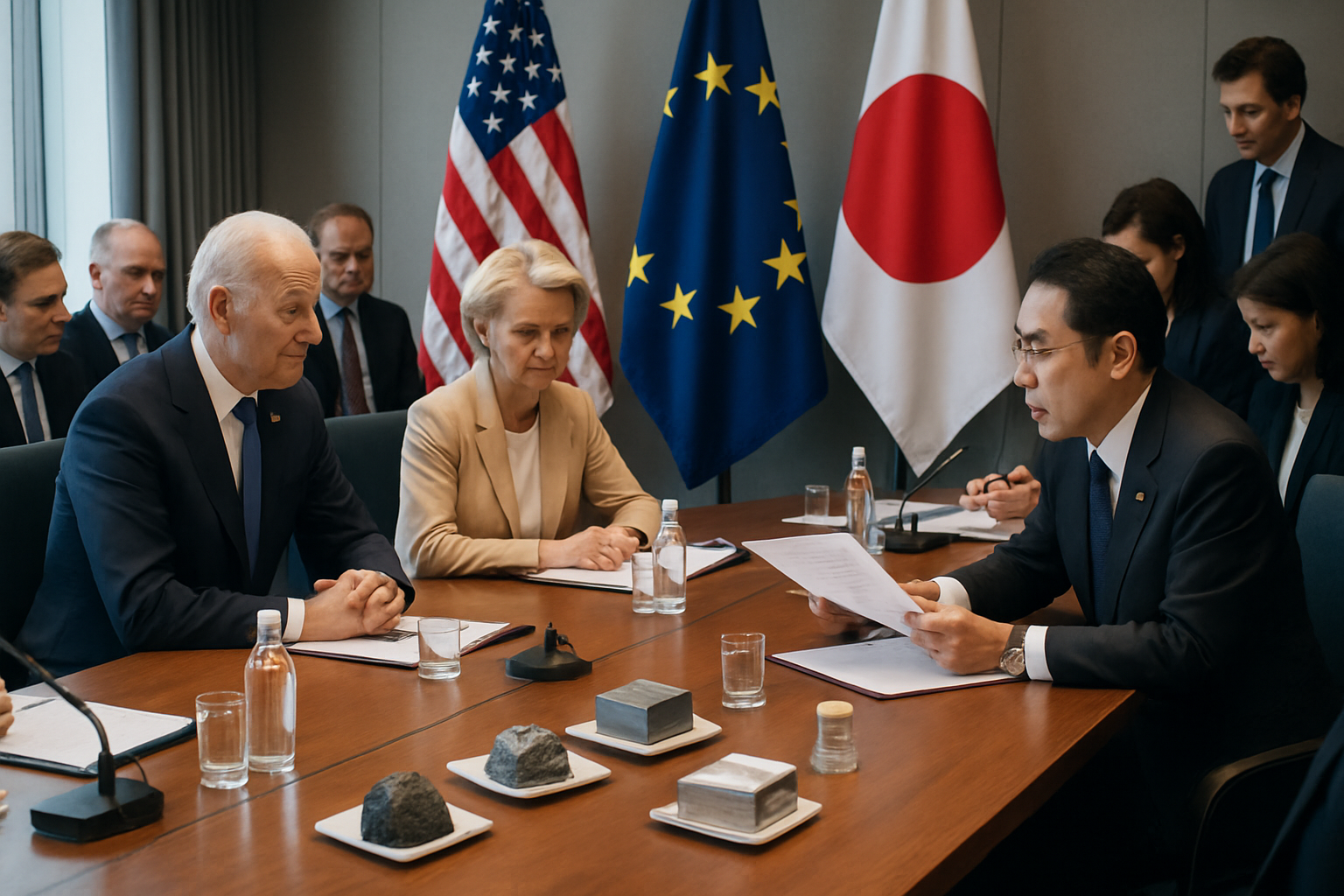
The United States, European Union, and Japan unveiled a landmark critical minerals partnership following a high-level summit in Washington D.C., marking the most significant coordinated challenge to China's overwhelming dominance in the global rare earth elements market.
The strategic alliance, announced after intensive negotiations involving representatives from 55 countries, establishes a comprehensive framework for reducing Western dependence on Chinese-controlled supply chains that currently account for 60% of global critical minerals production and 90% of refining capacity. The partnership represents a fundamental shift from market-driven approaches to strategic coordination on materials essential for renewable energy, electric vehicles, and advanced manufacturing.
Summit Achievements and Key Commitments
Vice President J.D. Vance led the U.S. delegation at the Washington summit, working alongside EU Commissioner for Industrial Strategy Stéphane Séjourné and senior Japanese officials to finalize the trilateral agreement. The partnership includes coordinated minimum pricing mechanisms, alternative supply chain development, and strategic stockpiling arrangements designed to create market stability independent of Chinese influence.
Foreign Minister Pablo Quirno of Argentina, announcing his country's parallel agreement with the United States, emphasized that "Argentina is committed to deepening cooperation with the United States on critical minerals, supporting secure supply chains and promoting a strategic partnership based on clear rules and long-term predictability."
The initiative builds on months of preliminary negotiations, with the EU and U.S. having worked toward cooperation frameworks since early 2026. European auditors had previously warned that EU climate goals were at "serious risk" due to critical raw materials shortages and dangerous dependence on China.
China's Strategic Stranglehold
Critical minerals encompass 17 rare earth metals that are notoriously difficult to extract from the Earth's crust but have countless applications in modern technology. These materials are essential for electric vehicle batteries, smartphone components, fighter jet systems, wind turbines, and missile guidance systems.
China's dominance stems from decades of strategic investment in mining, processing, and refining capabilities while Western nations focused primarily on market-driven approaches. The Asian superpower controls approximately 60% of global production and an overwhelming 90% of global refining capacity, creating what European officials describe as an "unacceptable strategic vulnerability."
The partnership announcement comes as supply chain disruptions have highlighted the risks of over-dependence on single-source suppliers. EU auditors specifically warned that the bloc's ambitious climate neutrality targets for 2030 and 2050 could be jeopardized without immediate diversification of critical materials sources.
Japan's Technological Breakthrough
Japan's participation in the alliance gained additional significance following the country's historic achievement in deep-sea rare earth mining. On February 2-3, 2026, Japanese researchers successfully extracted rare earth-bearing mud from 6,000 meters depth off Minamitorishima island, marking the world's first successful deep-sea mining trial at such depths.
The breakthrough operation, conducted under 600 times atmospheric pressure, revealed deposits containing concentrations up to 20 times higher than terrestrial mines. Japanese officials estimate the underwater reserves could supply the nation's critical minerals needs for centuries, potentially revolutionizing global supply dynamics.
Expanding Regional Partnerships
Beyond the core trilateral agreement, the United States announced complementary partnerships with Mexico and individual agreements with Argentina. The U.S.-Mexico initiative includes a 60-day timeline for developing "coordinated trade policies" to mitigate rare earth supply vulnerabilities, including coordinated geological mapping to explore new deposits.
According to Spanish-language reports, the agreements encompass measures to prevent supply interruptions and establish alternative processing capabilities. The Trump administration's approach represents a shift from tariff threats to cooperative frameworks, prioritizing strategic material security over pure trade competition.
Implementation Challenges and Timelines
The partnership faces substantial implementation challenges requiring billions of dollars in investment and years of development for new mining and processing facilities. Western nations must overcome significant cost disadvantages compared to China's established economies of scale and lower environmental standards.
Environmental concerns represent another major hurdle, as expanded Western mining operations will face stringent environmental regulations that have historically made domestic production less competitive. The alliance must balance strategic autonomy goals with environmental protection commitments.
A formal memorandum of understanding is expected within 30 days, with operational frameworks to be established throughout 2026. Success will depend on sustained political commitment across electoral cycles and continued international coordination.
Strategic Implications for Global Markets
The partnership signals a fundamental transformation in how developed nations approach critical supply chains, moving from market-driven optimization to strategic coordination based on security considerations. The alliance is open to additional members, with African nations potentially benefiting as alternative suppliers.
Market analysts note that the initiative could accelerate global interest in marine mining technologies and deep-sea exploration, following Japan's successful demonstration. The partnership may also drive innovation in recycling technologies and alternative material development to reduce overall dependence on rare earth elements.
China's Response and Market Impact
While the partnership documents avoid explicitly naming China, the strategic intent is clear to all participants. The coordinated approach represents the most significant challenge to Chinese market dominance since the country began building its rare earth empire in the 1990s.
Chinese control of critical minerals processing has previously allowed Beijing to restrict exports during trade disputes, most notably during tensions with Japan in 2010. The new partnership aims to create sufficient alternative capacity to eliminate such leverage.
The alliance also addresses concerns about forced labor in Chinese mining operations and environmental degradation associated with current extraction practices. Western alternatives are expected to maintain higher labor and environmental standards, though at increased costs.
Long-term Energy Transition Impact
The critical minerals partnership directly impacts global clean energy transition goals, as these materials are essential for renewable energy infrastructure, electric vehicle batteries, and energy storage systems. Without secure supply chains, Western nations face potential delays in achieving climate neutrality targets.
The alliance's success could accelerate renewable energy deployment by providing supply chain security for manufacturers and investors. Conversely, implementation delays could slow the global transition away from fossil fuels, highlighting the intersection between geopolitical strategy and climate policy.
As the partnership moves toward implementation, its success will be measured not only in economic terms but in its contribution to both strategic autonomy and global climate objectives. The initiative represents one of the most significant realignments in global resource politics since the end of the Cold War, with implications extending far beyond the three founding partners to affect global supply chains, international trade relationships, and the pace of technological transformation worldwide.