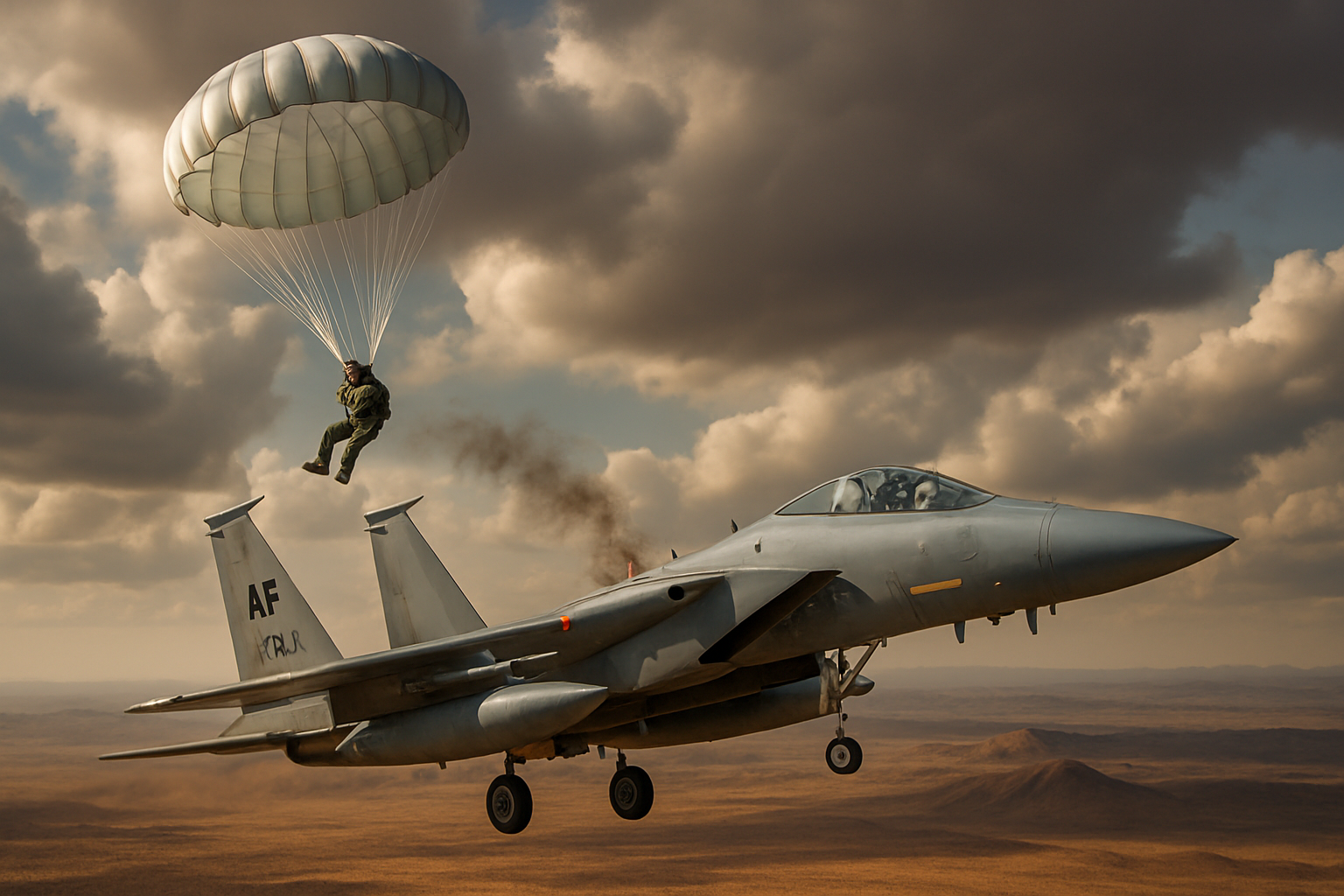
Three US F-15E Strike Eagle fighter jets were shot down by Kuwaiti air defense forces in a friendly fire incident during an Iranian missile attack on Monday, March 2, with all six crew members successfully ejecting and surviving the unprecedented accident.
US Central Command (CENTCOM) confirmed the incident at 23:03 ET on March 1, stating that the aircraft were flying in support of "Operation Epic Fury" when they crashed over Kuwait due to an "apparent friendly fire incident." The jets, operating from Ali Al Salem Air Base, were mistakenly engaged by Kuwaiti air defense systems during Iran's massive retaliatory strike campaign.
Dramatic Rescue Operations
Kuwaiti authorities immediately launched search and rescue operations after the incidents, successfully evacuating all crew members and transporting them to hospitals for medical evaluation. Officials confirmed that all six pilots are in stable condition with no fatalities reported from the friendly fire incidents themselves.
Dramatic footage circulating online shows one fighter jet crashing into the ground in flames, with a pilot ejecting mid-air and parachuting to safety. The crash occurred within approximately 10 kilometers of the US Ali Al Salem Air Base, according to CNN's geolocation analysis of the video.
"At 23:03 ET, March 1, three US F-15E Strike Eagles flying in support of Operation Epic Fury crashed over Kuwait due to an apparent friendly fire incident. All crew members are safe and accounted for."
— US Central Command Statement
Context of Operation Epic Fury
The friendly fire incident occurred during the largest US military operation in the Middle East since 2003, involving unprecedented dual-carrier deployment of USS Gerald R. Ford and USS Abraham Lincoln. The operation targeted Iranian leadership and military infrastructure following the breakdown of nuclear negotiations despite achieving "broad agreement on guiding principles" in Geneva.
Iranian Supreme Leader Ali Khamenei was confirmed killed in the coordinated US-Israeli strikes, along with Defense Minister Aziz Nasirzadeh, IRGC Chief Mohammad Pakpour, and over 40 high-ranking officials. The operation marked a dramatic escalation from diplomatic engagement to military confrontation within days.
Iran's Massive Retaliation Campaign
The friendly fire incident occurred amid Iran's "Operation True Promise 4," a coordinated retaliation campaign targeting US military installations across the Gulf region. Iranian Revolutionary Guards declared "no red lines remain" and designated all US and Israeli assets as "legitimate targets."
During the Iranian counter-attack, Kuwait International Airport was struck by drones causing employee injuries and flight suspensions. The UAE reported one civilian killed in Abu Dhabi from missile debris, while Qatar successfully intercepted 65 missiles and 12 drones using Patriot defense systems, though eight people were injured by falling fragments.
Air Defense Confusion During Crisis
Military experts suggest the friendly fire incident highlights the challenges of air defense coordination during complex, multi-national operations amid massive missile and drone attacks. Kuwaiti air defense forces were responding to one of the largest missile barrages in the region's history when the tragic mistake occurred.
The incident underscores the risks faced by coalition forces operating in environments with multiple air defense systems during active combat operations. Similar coordination challenges have occurred in previous conflicts, but the scale of Iran's retaliation created unprecedented complexity for allied air defense networks.
"The competent authorities immediately initiated search and rescue operations, evacuated the crew, and transported them to the hospital for medical examination and treatment in stable condition."
— Kuwaiti Ministry of Defense Statement
Regional Coalition Under Strain
The incident occurred as the unprecedented regional coalition of Saudi Arabia, UAE, Qatar, and Egypt faces severe strain from Iranian retaliation strikes targeting member territories. Egyptian President Sisi condemned attacks on "sisterly Arab countries," warning of potential "comprehensive chaos" in the region.
Kuwait, a key US ally hosting thousands of American military personnel, found itself directly in the crossfire of the escalating US-Iran confrontation. The friendly fire incident adds another layer of complexity to regional diplomatic relationships already strained by the rapid escalation from nuclear negotiations to military action.
Global Aviation Crisis
The incidents contributed to an unprecedented global aviation crisis, with Iran, Iraq, Israel, UAE, Qatar, Syria, Kuwait, and Bahrain simultaneously closing their airspace. Over 18,000 flights were cancelled worldwide, representing the most extensive regional aviation disruption since the COVID-19 pandemic.
Dubai International Airport, the world's busiest, completely shut down after sustaining missile damage, while major carriers including Emirates, Air France-KLM, Wizz Air, and Bulgaria Air suspended Middle East operations affecting hundreds of thousands of passengers globally.
Nuclear Diplomacy Collapse Context
The friendly fire incident occurred against the backdrop of completely collapsed nuclear diplomacy despite recent diplomatic breakthroughs. Geneva talks had achieved the most significant progress since the JCPOA collapse in 2018, but fundamental scope disagreements proved insurmountable.
Iran had excluded ballistic missiles and regional proxies as "red lines" from nuclear-only talks, while the US demanded comprehensive agreements including missiles, armed groups, and human rights issues. Iran was enriching uranium at 60% purity with over 400kg of material, approaching weapons-grade levels.
Historical Significance
March 1-2, 2026 marks the most dangerous moment since the Cold War's end, with the rapid transition from diplomatic framework to military escalation demonstrating the fragility of modern crisis management in the multipolar era. The friendly fire incident symbolizes the unintended consequences and chaos that can emerge from such rapid escalations.
The stakes include regional war prevention, global energy security, nuclear governance credibility, and international law enforcement mechanisms. Success in containing the escalation could provide a template for future nuclear crisis resolution, while failure may accelerate military solutions reshaping Middle Eastern geopolitics for decades.
Energy Security Implications
The crisis has created global energy security concerns, with oil prices surging and Iran warning that Strait of Hormuz shipping - representing 40% of global oil transit - is "not allowed." Natural gas prices increased 24% in Europe and 78% in the US, reflecting regional war risks disrupting worldwide supply chains.
The friendly fire incident occurred in a region critical to global energy infrastructure, highlighting how military miscalculations during crisis periods can have far-reaching economic consequences extending well beyond the immediate conflict zone.
As investigations into the friendly fire incident continue, the broader Middle East crisis represents a template-setting moment for 21st-century conflict resolution approaches, with implications extending decades beyond the current events and affecting international approaches to nuclear governance, energy security, and diplomatic versus military solutions to territorial and nuclear disputes globally.