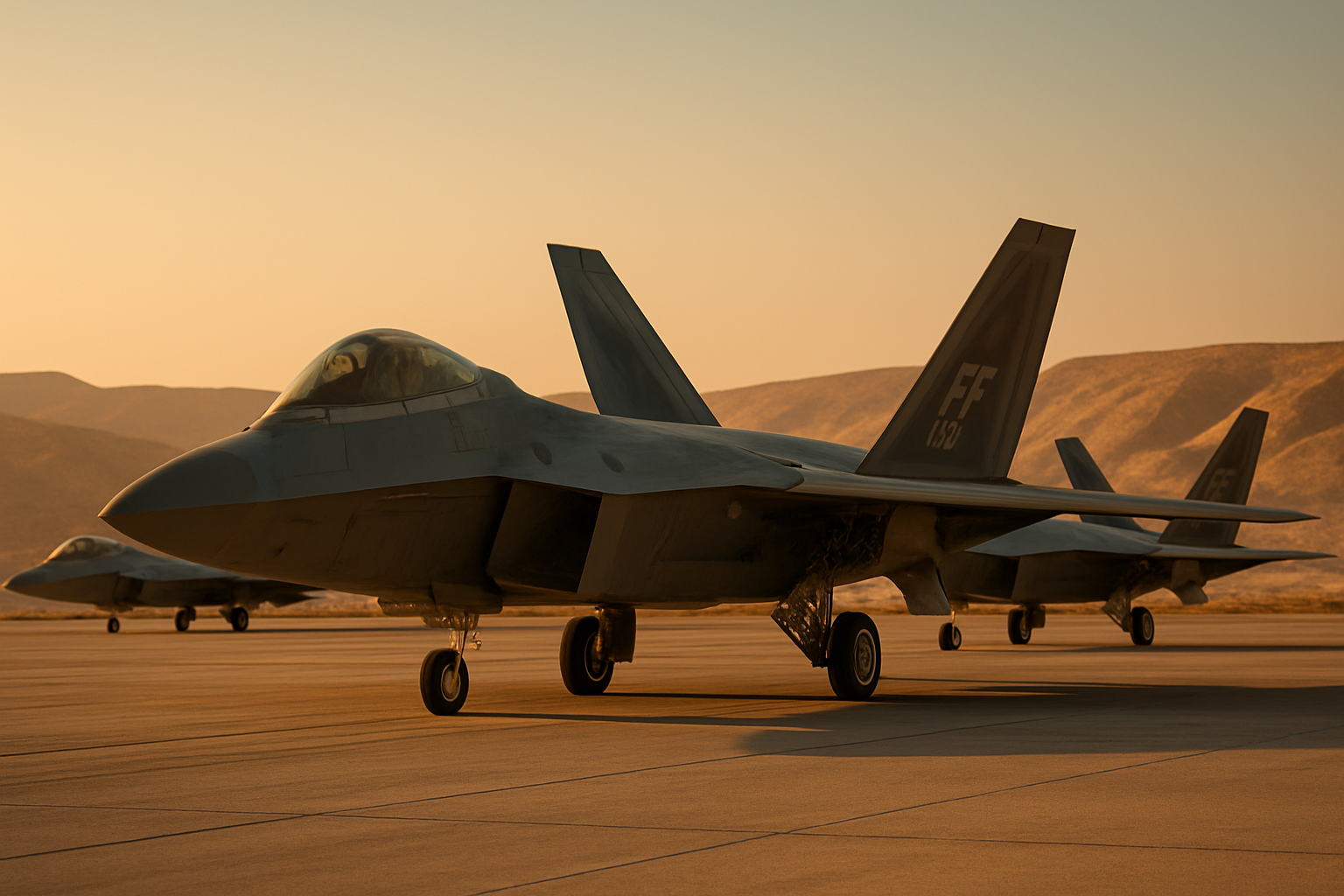
Twelve US F-22 Raptor stealth fighter jets have landed at Israeli military bases, arriving from the United Kingdom as part of an unprecedented American military buildup in the Middle East that officials describe as preparation for potential strikes against Iran.
The deployment of America's most advanced air superiority fighters comes as the Trump administration has positioned the largest US naval presence in the region since the 2003 Iraq invasion, with dual aircraft carrier strike groups now positioned approximately 800 kilometers from Iran's coast.
F-22s Join Massive Military Buildup
According to multiple international sources, the F-22 Raptors departed from RAF Lakenheath in the United Kingdom on Tuesday and arrived at an undisclosed Israeli Air Force base in the southern part of the country. The stealth fighters represent the most technologically advanced combat aircraft in the US arsenal, capable of evading enemy radar and achieving air superiority against any adversary.
The F-22 deployment is part of what Pentagon officials describe as preparations for "potentially weeks-long operations against Iran" that could range from targeted nuclear facility strikes to broader campaigns against Revolutionary Guard infrastructure.
These air assets join the USS Gerald R. Ford and USS Abraham Lincoln carrier strike groups, which together represent approximately one-third of the active US Navy fleet concentrated in the Arabian Sea. The unprecedented naval presence has drawn comparisons to the military buildup preceding major military operations.
Nuclear Negotiations at Critical Juncture
The military escalation occurs against the backdrop of nuclear negotiations that have achieved what Iranian Foreign Minister Abbas Araghchi calls a "broad agreement on guiding principles" - described as the most significant diplomatic progress since the collapse of the Joint Comprehensive Plan of Action (JCPOA) in 2018.
However, fundamental disagreements persist that threaten to derail any potential agreement. Iran maintains that ballistic missiles and regional proxy activities remain "red lines" that must be excluded from nuclear-only discussions. Meanwhile, US Secretary of State Marco Rubio insists that any comprehensive agreement must address Iran's missile program, support for armed groups, and human rights violations.
"Iran will never abandon uranium enrichment even if war is imposed upon us."
— Abbas Araghchi, Iranian Foreign Minister
Currently, Iran is enriching uranium at 60% purity - far above the 3.67% limit established by the original JCPOA and approaching the 90% threshold considered weapons-grade. Intelligence assessments suggest Iran possesses sufficient enriched uranium to produce multiple nuclear weapons if weaponized.
Regional Powers Rally Behind Diplomacy
In an unprecedented development, Saudi Arabia, the United Arab Emirates, Qatar, and Egypt have all backed the diplomatic process - representing extraordinary consensus among Middle Eastern powers that have historically opposed each other on regional issues.
Oman has leveraged its historical neutral mediation role from the original 2015 JCPOA negotiations, facilitating talks between Iranian and American representatives in Geneva with Swiss support. The venue evolution from Muscat to European neutral territory signals growing international investment in a diplomatic solution.
The Persian Gulf handles approximately 40% of global oil transit through the Strait of Hormuz, creating massive economic stakes for regional stability. Oil prices have already risen by more than $1 per barrel due to military tensions, with recent incidents including an F-35C shooting down an Iranian drone near the USS Abraham Lincoln and Islamic Revolutionary Guard Corps harassment of US tankers.
Israeli Security Concerns Drive Coordination
Israeli Prime Minister Benjamin Netanyahu has held multiple meetings with President Trump, emphasizing that any nuclear agreement must include comprehensive security arrangements. Israeli officials view nuclear-only frameworks as insufficient to address existential security threats from Iran's integrated missile and proxy network, including Hezbollah, Hamas, and the Houthis.
The coordination between Washington and Jerusalem has resulted in what Israeli officials describe as "red lines" requiring any agreement to include "limiting ballistic missiles and ending Iranian axis support." These demands align with broader US concerns about Iran's regional activities but conflict with Iranian insistence on compartmentalized nuclear negotiations.
Domestic Pressures Complicate Diplomacy
Both sides face significant domestic pressures that complicate negotiating flexibility. Iran has arrested more than 42,000 protesters since the 2022 uprising, with Nobel Peace Prize laureate Narges Mohammadi recently sentenced to an additional 7.5 years in prison during the ongoing talks.
The Iranian regime appears to prioritize maintaining nuclear capabilities over economic relief from sanctions, calculating that nuclear leverage provides more strategic value than immediate sanctions relief. Meanwhile, the Trump administration faces pressure from Republican hawks who view diplomatic engagement as appeasement while seeking foreign policy victories.
International Nuclear Governance Crisis
The Iran nuclear crisis unfolds against a broader breakdown in global nuclear governance. The New START treaty between the United States and Russia expired on February 5, marking the first time in over 50 years that the world's two largest nuclear powers operate without arms control constraints. China's rapid nuclear expansion adds another layer of complexity to multilateral frameworks.
UN Secretary-General António Guterres has warned that nuclear risks are at their "highest level in decades," making the outcome of Iran negotiations a critical test for 21st-century nuclear crisis resolution.
Military Scenarios and Verification Challenges
Pentagon planners have prepared multiple strike scenarios ranging from targeted attacks on nuclear facilities to broader campaigns against Revolutionary Guard infrastructure. Military officials expect that any action would trigger Iranian retaliation, potentially creating "back-and-forth attack cycles" that could destabilize the entire region.
Any diplomatic agreement would face unprecedented verification challenges given Iran's nuclear advancement since 2018. The Islamic Republic has deployed sophisticated centrifuge technology and expanded nuclear infrastructure across multiple facilities, requiring monitoring mechanisms far exceeding the complexity of the original JCPOA.
Intelligence suggests Iran might consider a three-year uranium enrichment halt and stockpile transfer to Russia as confidence-building measures, but hardline statements from Iranian officials cast doubt on the likelihood of such concessions.
Economic and Strategic Stakes
The economic implications extend far beyond the Middle East, with potential regional conflict threatening to disrupt global supply chains and energy markets. Natural gas prices have already increased 24% in Europe and 78% in the United States due to geopolitical pressures, while the threat of Strait of Hormuz closure affects worldwide oil distribution networks.
Iran has positioned potential energy cooperation as a "trillion-dollar opportunity" for US firms, framing nuclear negotiations not just as security arrangements but as commercial propositions. However, the Trump administration maintains maximum pressure through continued threats of 25% tariffs on countries trading with Iran.
Template-Setting Moment for International Relations
The outcome of current tensions will establish precedents for diplomatic versus military solutions to nuclear crises in an increasingly multipolar world order. Success could prevent regional war while providing a template for resolving nuclear disputes through innovative diplomatic mechanisms.
Failure, however, may accelerate military solutions that reshape Middle Eastern geopolitics for decades, encourage nuclear proliferation elsewhere, and undermine diplomatic credibility for resolving territorial and security disputes worldwide.
As F-22 Raptors take their positions alongside the largest US naval deployment in years, the coming days represent a decisive moment for whether 21st-century nuclear crises will be resolved through diplomatic innovation or military confrontation. The stakes extend far beyond Iran's nuclear program to encompass regional stability, global energy security, and the credibility of international law enforcement mechanisms in an era of great power competition.
The deployment of America's most advanced stealth fighters to Israel sends an unmistakable signal about US commitment to preventing Iranian nuclear weapons development, while the ongoing negotiations in Geneva represent perhaps the last opportunity for diplomatic resolution of a crisis that has consumed policymakers for over a decade.