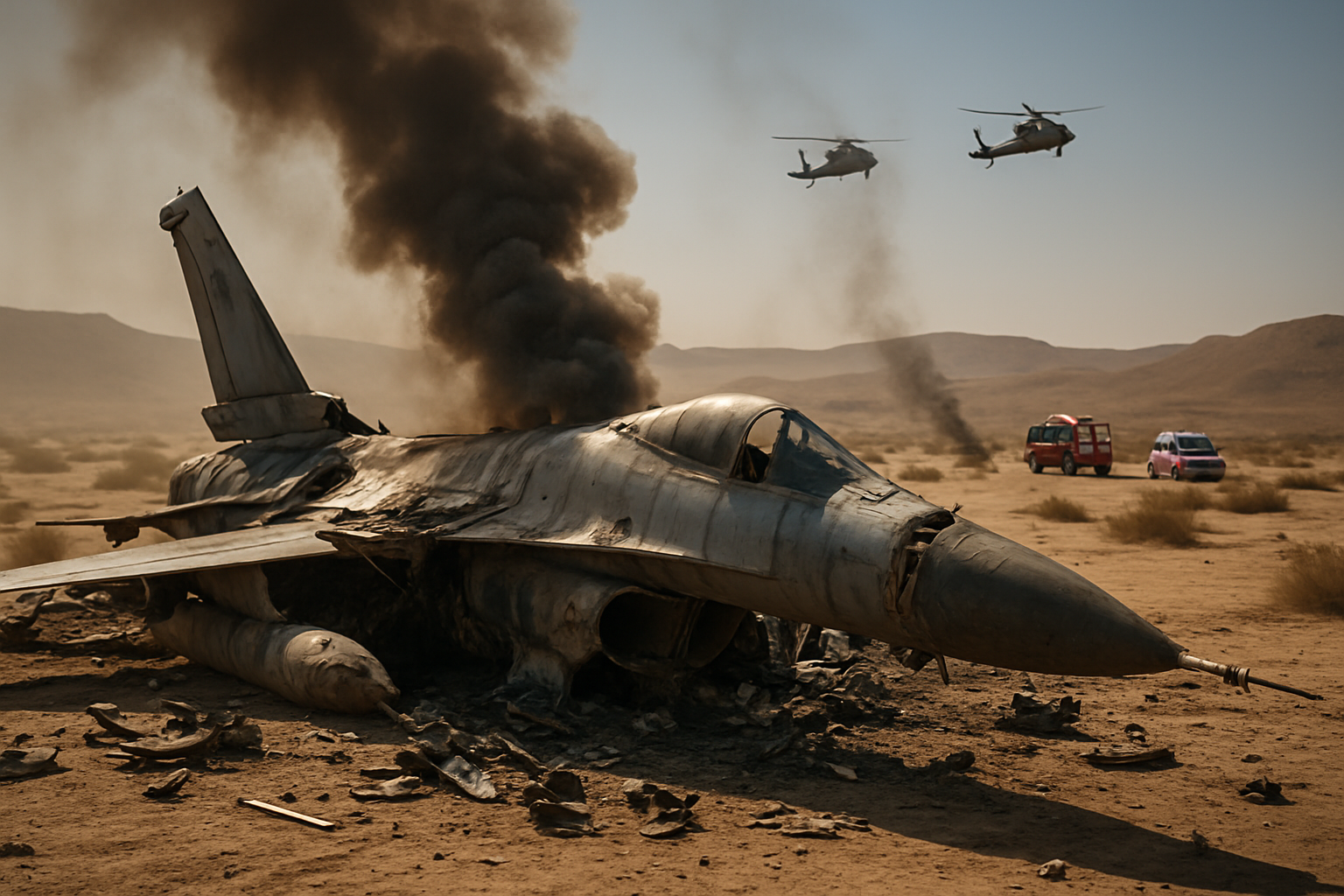
Iranian Revolutionary Guards claimed Friday to have shot down a US F-15E Strike Eagle fighter jet over central Iranian territory, marking the first confirmed loss of an American aircraft since the conflict between Iran and the United States began nearly five weeks ago.
One crew member has been rescued by US forces according to multiple American officials who spoke to Reuters on Friday, while search-and-rescue operations continue for the second missing pilot. The Pentagon and US Central Command have not officially confirmed the incident or responded to requests for comment.
Breaking Development in Five-Week War
The downing of the American fighter jet represents a significant escalation in the ongoing conflict that began February 28, 2026, when Israel launched preemptive strikes on Iran following the collapse of nuclear negotiations in Geneva. The crisis has since evolved into the most dangerous international confrontation since the Cold War.
Iranian state media released photographs and videos purported to show debris from the downed aircraft, with Revolutionary Guards units conducting what they described as "comprehensive field operations" to locate and capture the missing pilot. The Iranian military has offered civilian rewards for information leading to the pilot's capture.
"This represents the first time the US has lost aircraft in Iranian territory and marks a dramatic escalation in the war since it began five weeks ago."
— Irish Breaking News Report
Context of Operation Epic Fury
The aircraft loss comes during "Operation Epic Fury," the largest coordinated US-Israeli military campaign since the 2003 Iraq invasion. The operation has involved unprecedented dual-carrier deployment of the USS Gerald Ford and USS Abraham Lincoln, representing approximately one-third of the active US Navy fleet positioned 800 kilometers from Iran's coast.
The conflict's origins trace back to the complete breakdown of nuclear diplomacy despite achieving what Iranian Foreign Minister Abbas Araghchi called "broad agreement on guiding principles" - the most significant progress since the 2018 JCPOA collapse. However, fundamental disagreements over scope proved insurmountable, with Iran excluding ballistic missiles and regional proxies as "red lines" while the US demanded comprehensive agreements addressing missiles, armed groups, and human rights.
Global Crisis Dimensions
The war has created unprecedented global disruptions affecting multiple sectors. Over 18,000 flights have been cancelled worldwide - the most extensive aviation crisis since COVID-19 - with eight Middle Eastern countries maintaining simultaneous airspace closures. Dubai International Airport, the world's busiest with 86 million passengers annually, remains shuttered due to missile damage.
Energy markets have experienced severe volatility, with oil prices surging past $100 per barrel for the first time since 2014. Iran's closure of the Strait of Hormuz through naval mining operations affects 40% of global oil transit, stranding over 150 tankers worth billions in cargo. The International Energy Agency has released a record 400 million barrels from strategic petroleum reserves - the largest intervention in the agency's 50-year history.
Regional and International Implications
The conflict has fundamentally altered Middle Eastern geopolitics following the death of Iranian Supreme Leader Ali Khamenei on March 1, 2026. His son, Mojtaba Khamenei, has emerged as the new Supreme Leader in the first hereditary succession in the Islamic Republic's 47-year history, with Revolutionary Guards consolidating unprecedented military control over Iranian governance.
European territory has been directly attacked for the first time since World War II, with Iranian drones striking RAF Akrotiri in Cyprus. This prompted an unprecedented naval coalition response including HMS Dragon, Spanish frigates, and vessels from Italy, France, the Netherlands, and Greece.
The regional coalition of Saudi Arabia, UAE, Qatar, and Egypt - which had provided unprecedented consensus supporting diplomatic solutions - has been severely strained as Iranian retaliation under "Operation True Promise 4" has targeted their territories directly, causing casualties across the Gulf region.
Nuclear Governance Crisis
The current military confrontation unfolds against the backdrop of a broader nuclear governance crisis. The New START treaty expired on February 5, 2026, marking the first time in over 50 years without US-Russia nuclear constraints. Iran continues uranium enrichment at 60% purity with over 400 kilograms of weapons-grade material - sufficient for multiple nuclear weapons.
UN Secretary-General António Guterres has called the situation "the greatest test of multilateral cooperation and crisis management in the modern era," warning that nuclear risks are at their "highest level in decades."
Congressional and Public Response
The aircraft loss is likely to intensify Congressional scrutiny of the administration's Iran policy. Senator Richard Blumenthal has expressed being "more concerned than ever" about potential ground troop deployment, while the conflict maintains historically low public support at only 25% among Americans.
Operation Epic Fury has cost $11.3 billion in its first week alone, with Pentagon operations now planned through September 2026 - far beyond the initial 4-6 week timeline. The conflict has resulted in the first US casualties in the largest Middle Eastern operation since 2003, with three service members confirmed killed and over 150 wounded.
Search and Rescue Operations
US military sources indicate that search-and-rescue operations for the missing pilot represent potentially the first time American boots have been on Iranian soil since the war began. The Iranian government has called on civilians to be vigilant for survivors and has flooded social media with images purporting to show aircraft wreckage.
Israeli officials have reportedly postponed planned strikes in the area to allow for US search operations, highlighting the coordination challenges as the conflict involves multiple allied forces operating in contested airspace.
Template-Setting Moment
The downing of the US fighter jet occurs at what analysts describe as a template-setting moment for 21st-century international relations. The rapid transition from diplomatic breakthrough to military confrontation demonstrates the fragility of crisis management mechanisms in an increasingly multipolar world order.
Success in containing the current crisis could provide a framework for future nuclear dispute resolution, while failure might accelerate military solutions to international conflicts for decades to come, potentially encouraging nuclear proliferation globally and undermining diplomatic credibility worldwide.
As rescue operations continue for the missing American pilot, the incident represents the most dangerous escalation yet in a conflict that has already reshaped global energy markets, aviation networks, and international security architecture with implications extending far beyond the current crisis to affect diplomatic versus military solution precedents for future territorial and nuclear disputes worldwide.