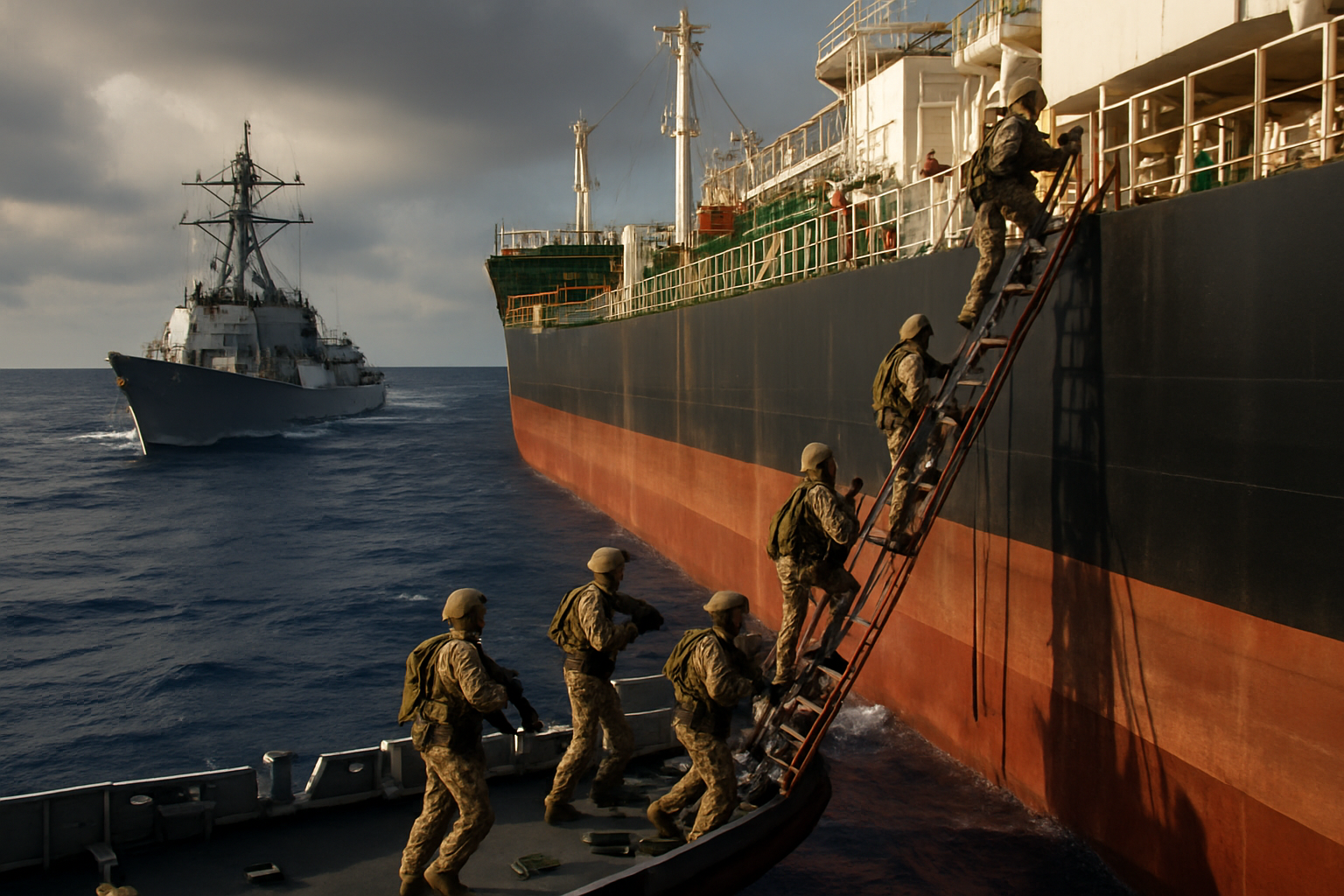
United States military forces boarded the oil tanker "Bertha" in the Indian Ocean without resistance overnight Tuesday, marking the third such operation in recent weeks as part of an intensified campaign to enforce sanctions against vessels defying international oil embargoes.
The operation, announced by the Pentagon through social media, targeted the Venezuelan-linked vessel that had been tracked from Caribbean waters as part of what officials described as President Trump's "quarantine of sanctioned vessels." Southern Command confirmed the boarding was executed seamlessly, with the tanker carrying crude oil cargo.
Escalating Maritime Enforcement Campaign
The seizure of the Bertha represents a significant escalation in U.S. maritime enforcement operations, building on a pattern of aggressive interdiction activities that have fundamentally shifted from traditional law enforcement approaches to direct military targeting of suspected trafficking and sanctions-evading vessels.
According to Pentagon sources, this marks the third such boarding operation in a concentrated period, demonstrating the Trump administration's commitment to what officials term a "comprehensive blockade" of sanctioned petroleum operations. The vessel was reportedly operating in defiance of established sanctions regimes targeting Venezuelan oil exports.
"This operation demonstrates our unwavering commitment to enforcing international sanctions and maintaining maritime security in critical shipping lanes."
— Pentagon Spokesperson
Strategic Maritime Context
The boarding operation occurs within a broader context of intensified maritime security operations across multiple theaters. Recent intelligence indicates that over 600 vessels worldwide participate in sophisticated "shadow fleet" operations, using false documentation and concealed ownership structures to circumvent Western sanctions.
The Indian Ocean has emerged as a critical enforcement zone, with U.S. naval forces maintaining enhanced presence to monitor and interdict suspicious vessel movements. The region handles crucial global energy transit routes, making effective enforcement essential for maintaining international sanctions integrity.
Historical context reveals this operation builds on previous successful interdictions, including recent seizures that have disrupted criminal networks valued at hundreds of millions of dollars. The Bertha's tracking from Caribbean waters demonstrates the sophisticated intelligence and coordination capabilities required for modern maritime enforcement.
International Legal Framework
Maritime law experts note that such boarding operations in international waters represent a complex intersection of sovereignty rights, international sanctions enforcement, and maritime security protocols. The legal authority for these operations stems from comprehensive sanctions regimes that permit interdiction of vessels violating established embargoes.
The Venezuelan connection adds additional legal complexity, as U.S. authorities have designated certain petroleum operations as supporting sanctioned entities. This designation provides the legal framework for military rather than purely law enforcement responses to sanctions violations.
Recent developments in maritime law enforcement show increasing coordination between military and civilian authorities, reflecting the sophisticated nature of modern sanctions evasion networks that require advanced intelligence and operational capabilities to counter effectively.
Regional Security Implications
The operation underscores broader regional security challenges facing international maritime commerce. The Indian Ocean serves as a critical transit route for approximately 40% of global oil shipments, making effective security operations essential for maintaining stable energy markets.
Intelligence sources indicate that sanctions-evading vessels often employ advanced concealment methods, including ballast tank modifications and sophisticated cargo transfer techniques that require specialized military capabilities to detect and counter. The successful boarding of the Bertha demonstrates enhanced operational sophistication in maritime enforcement.
Regional allies have expressed support for enhanced maritime security cooperation, recognizing that effective sanctions enforcement requires sustained international coordination and intelligence sharing to counter increasingly sophisticated evasion networks.
Operational Significance
Military analysts emphasize that successful maritime boarding operations require extensive planning, real-time intelligence, and precise coordination between multiple agencies. The tracking of the Bertha from Caribbean waters to the Indian Ocean demonstrates the global scope of modern maritime enforcement operations.
The operation's execution without resistance suggests effective intelligence preparation and operational planning that anticipated potential vessel responses. Such operations typically involve specialized naval units trained in maritime interdiction and vessel boarding procedures under international law.
Defense officials indicate that similar operations may continue as part of comprehensive efforts to enforce international sanctions and maintain maritime security in critical shipping lanes worldwide.
Economic and Strategic Impact
The boarding of the Bertha and similar operations have significant economic implications for sanctions-evading networks, disrupting revenue streams that support sanctioned entities and criminal organizations. Successful interdictions create uncertainty for vessel operators attempting to circumvent international sanctions.
Energy market analysts note that effective enforcement of maritime sanctions helps maintain the integrity of global oil markets by preventing unauthorized petroleum exports that undermine established trade restrictions. Such operations support broader international efforts to maintain stable energy pricing and supply chains.
The strategic impact extends beyond immediate enforcement, sending clear signals to potential sanctions violators about the risks and consequences of attempting to operate outside established international legal frameworks.
Future Maritime Security Outlook
Defense experts anticipate continued expansion of maritime security operations as technological capabilities advance and international coordination improves. Enhanced satellite surveillance, artificial intelligence-powered monitoring systems, and improved real-time communications enable more effective detection and interdiction of suspicious vessel activities.
The success of operations like the Bertha boarding provides templates for future maritime enforcement activities, demonstrating that coordinated international efforts can effectively counter sophisticated sanctions evasion networks operating across multiple jurisdictions.
As maritime commerce continues to grow and criminal networks adapt their methods, sustained investment in maritime security capabilities and international cooperation will remain essential for maintaining effective enforcement of international sanctions and maritime law.