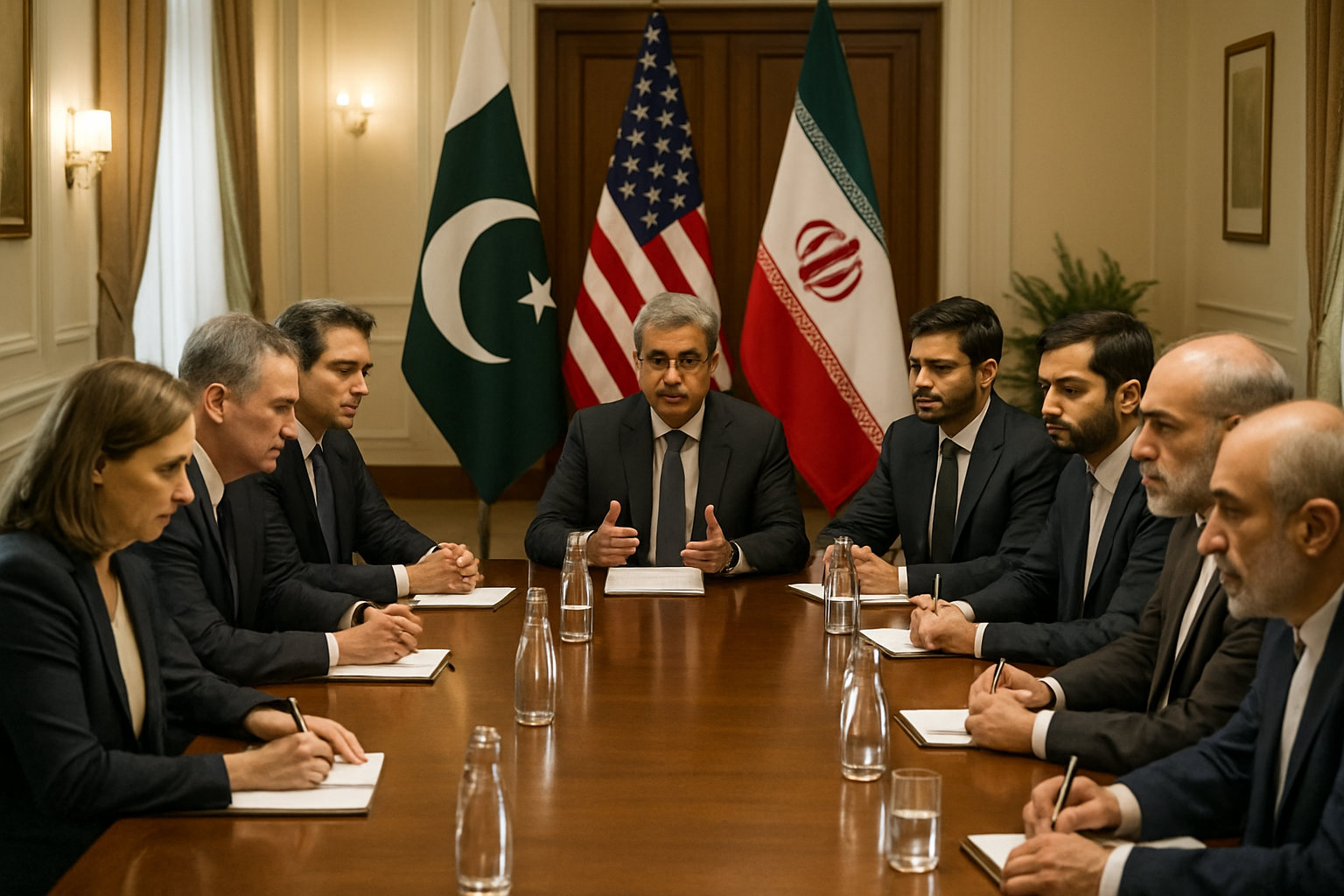
Pakistan has achieved a diplomatic triumph of unprecedented proportions, successfully mediating a breakthrough ceasefire between the United States and Iran just 88 minutes before President Trump's "whole civilization will die tonight" deadline, marking the most significant de-escalation of the world's most dangerous crisis since the Cold War.
The "Islamabad Accord" framework, brokered by Prime Minister Shehbaz Sharif and Field Marshal Asim Munir through intensive round-the-clock negotiations with VP JD Vance and Iranian Foreign Minister Abbas Araghchi, has created a critical two-week window for comprehensive peace talks scheduled to begin Friday in Pakistan's capital.
Dramatic Breakthrough Minutes Before Deadline
The ceasefire agreement was reached at 10:43 PM ET on April 8, with Trump accepting Iran's 10-point proposal as a "workable basis for negotiations" after Pakistan's sophisticated "message relay system" facilitated indirect talks when direct communication had become impossible between the adversaries.
Iran agreed to reopen the Strait of Hormuz for "safe passage" during the two-week ceasefire period, coordinated with Iranian armed forces. The strategic waterway, which carries 40% of global oil transit, had been effectively closed by Iranian mining operations deploying 2,000-6,000 naval mines.
The breakthrough represents a complete reversal from Trump's apocalyptic threats just hours earlier, when he warned Iran that "a whole civilization will die tonight" if the Strait of Hormuz remained closed. The dramatic policy shift marks the most significant presidential reversal in modern American history.
Pakistan's Unprecedented Mediation Success
Pakistan's emergence as the crucial mediator demonstrates the effective power of middle-power diplomacy when traditional mechanisms fail. PM Sharif and Field Marshal Munir maintained continuous contact with both American and Iranian officials, serving as what European diplomatic sources described as a "net regional stabilizer."
China's Foreign Minister Wang Yi expressed "full support" for Pakistan's initiative, calling the peace talks "conducive to restoring normal navigation" in the Strait of Hormuz. Germany noted "positive signs" for direct talks, with officials confirming this represents the most direct US-Iran diplomatic engagement in decades.
The Pakistani mediation framework has been hailed by UN Secretary-General António Guterres as representing the "greatest test of multilateral cooperation in the modern era," demonstrating that innovative diplomatic solutions remain possible even in the darkest hours of maximum international crisis.
High-Stakes Delegations Arriving
US Vice President JD Vance is expected to lead the American delegation, potentially joined by senior officials Steve Witkoff and Jared Kushner. Iranian President Masoud Pezeshkian confirmed his participation following what officials described as a "warm and cordial" 45-minute telephone conversation with PM Sharif.
Pakistan has declared two local holidays in Islamabad and Rawalpindi for April 9-10 to ensure security for the delegations. The Serena Hotel within the capital's Red Zone has been exclusively reserved for the talks, with special traffic arrangements implemented by Islamabad police.
Iran's comprehensive 10-point proposal addresses critical issues including Hormuz protocols, sanctions relief, regional conflicts, and security guarantees - representing the most detailed US-Iran framework since the 2015 nuclear agreement.
Immediate Global Relief
Oil prices crashed nearly 20% in the steepest decline in six years, with Brent crude falling from $119.50 to below $100 per barrel as markets responded to the ceasefire announcement. Asian stock markets experienced explosive rallies, led by Pakistan's KSE-100 index surging a record 8.15%.
The International Energy Agency (IEA) began reducing its record 400 million barrel strategic petroleum release - the largest intervention in the agency's 50-year history. Airlines are planning to resume Middle East routes after the aviation crisis that saw 18,000+ flights cancelled worldwide.
Dubai International Airport, the world's busiest, is preparing to reopen after being shut down due to missile damage. The shipping industry is mobilizing to free 150+ stranded tankers carrying billions of dollars in cargo that had been blocked in the Persian Gulf.
Lebanon Conflict Complicates Framework
Despite the breakthrough, tensions persist over the scope of the ceasefire. Israeli Prime Minister Benjamin Netanyahu explicitly stated that Lebanon operations are not covered by the ceasefire agreement, even as Pakistan maintains the accord "covers all fronts including Lebanon."
Israel conducted its deadliest bombardment of Lebanon since March, killing over 254 people in a single day while seeking talks with Lebanon focused on Hezbollah disarmament. This has created a critical loophole that threatens the broader peace framework, with Iran warning it may withdraw from talks unless a comprehensive ceasefire is enforced on all fronts.
The Lebanese humanitarian crisis has reached catastrophic proportions, with 1.2 million people displaced (25% of the population) and systematic targeting of medical personnel, including 26 paramedics killed since March.
Regional Coalition Preservation
Despite severe strains during the crisis, the unprecedented coalition of Saudi Arabia, UAE, Qatar, and Egypt has been preserved. These nations maintained consensus supporting diplomatic solutions even as Iranian attacks during "Operation True Promise 4" directly targeted their territories.
The coalition faced its greatest test when Iranian retaliation killed one civilian in Abu Dhabi, injured 32 in Kuwait, and wounded eight in Qatar. Egyptian President Abdel Fattah el-Sisi had warned of "comprehensive chaos" spreading across the region, but the diplomatic breakthrough has avoided this scenario.
The preservation of this regional framework represents a significant achievement for Middle Eastern stability and provides crucial support for the ongoing peace process.
Nuclear Diplomacy Window Created
The ceasefire creates a critical opportunity to address Iran's nuclear program through diplomatic means. The current crisis emerged from the complete collapse of Geneva nuclear talks despite achieving "broad agreement on guiding principles" - the most progress since the 2018 JCPOA breakdown.
Iran continues uranium enrichment at 60% purity with over 400 kilograms of weapons-grade material - sufficient for multiple nuclear weapons if weaponized. The diplomatic window is particularly crucial given that the New START treaty expired in February 2026, leaving the world without US-Russia nuclear constraints for the first time in over 50 years.
The fundamental disagreement remains between Iran's insistence on nuclear-only talks excluding missiles and proxies as "red lines," versus US demands for comprehensive agreements covering missiles, armed groups, and human rights issues.
Economic and Consumer Relief
The ceasefire brings immediate relief to consumers worldwide who were facing severe energy cost increases. Bangladesh is reviewing fuel rationing affecting 170 million people, while Pakistan is considering reversing wartime austerity measures that had driven fuel prices to record levels.
Natural gas prices, which had surged 24% in Europe and 78% in the United States, are beginning to retreat. Qatar is resuming LNG production, which represents approximately 20% of global exports and had been halted during the crisis.
However, experts warn that aviation recovery will require months rather than weeks, as fuel supply chains need time for complete restoration. The crisis exposed dangerous vulnerabilities in global energy architecture dependent on single chokepoint failures.
Template for 21st Century Diplomacy
Pakistan's mediation success provides a template for 21st-century conflict resolution, demonstrating that middle powers can effectively bridge divides between major adversaries when traditional diplomatic mechanisms fail. The "Islamabad Accord" framework shows how multilateral cooperation can prevent catastrophic military escalation.
The success comes after Operation Epic Fury - the largest Middle East military operation since 2003 - cost $11.3 billion in its first week alone. The operation concluded with three US service members killed and 150 wounded, while Iranian casualties exceeded 787 civilians according to Iran's Red Crescent.
The first attack on European territory since World War II occurred when Iranian drones struck RAF Akrotiri in Cyprus, prompting an unprecedented naval coalition response involving British, Spanish, Italian, French, Dutch, and Greek vessels.
Critical Two-Week Window
The success or failure of the Islamabad talks will determine whether this represents a lasting peace framework or merely temporary respite. The negotiations address the most comprehensive US-Iran framework since 2015, with stakes affecting territorial sovereignty, energy security paradigms, and conflict resolution approaches for decades to come.
Pakistan's emergence as a crucial mediator demonstrates that diplomatic innovation remains effective even in the most dangerous circumstances. The framework's success in converting a temporary pause into lasting stability will be critical in determining whether diplomatic credibility is strengthened or whether military solutions become the preferred approach for future international crises.
Congressional opposition had reached unprecedented levels, with only 25% American support for military operations - described as "almost unprecedented" unpopularity for early-stage operations. The diplomatic breakthrough provides relief from what Pentagon officials acknowledged could have extended through September 2026.
Historical Significance
April 8-9, 2026, represents a watershed moment in international relations, demonstrating that diplomatic innovation can triumph over military escalation in an increasingly volatile and interconnected global system. The Pakistan-mediated ceasefire prevented what could have become the most devastating regional war since World War II.
The crisis tested energy security, nuclear governance credibility, and international law enforcement mechanisms simultaneously. Success provides hope that multilateral cooperation remains effective for managing conflicts in a multipolar world, while failure could have accelerated military solutions and encouraged nuclear proliferation globally.
Most significantly, the breakthrough shows preference for diplomatic credibility over prolonged military confrontation, offering a model for future crisis management when the world faces similar existential challenges. The coming two weeks will determine whether this historic achievement can be converted into a lasting framework for Middle Eastern stability and global security.