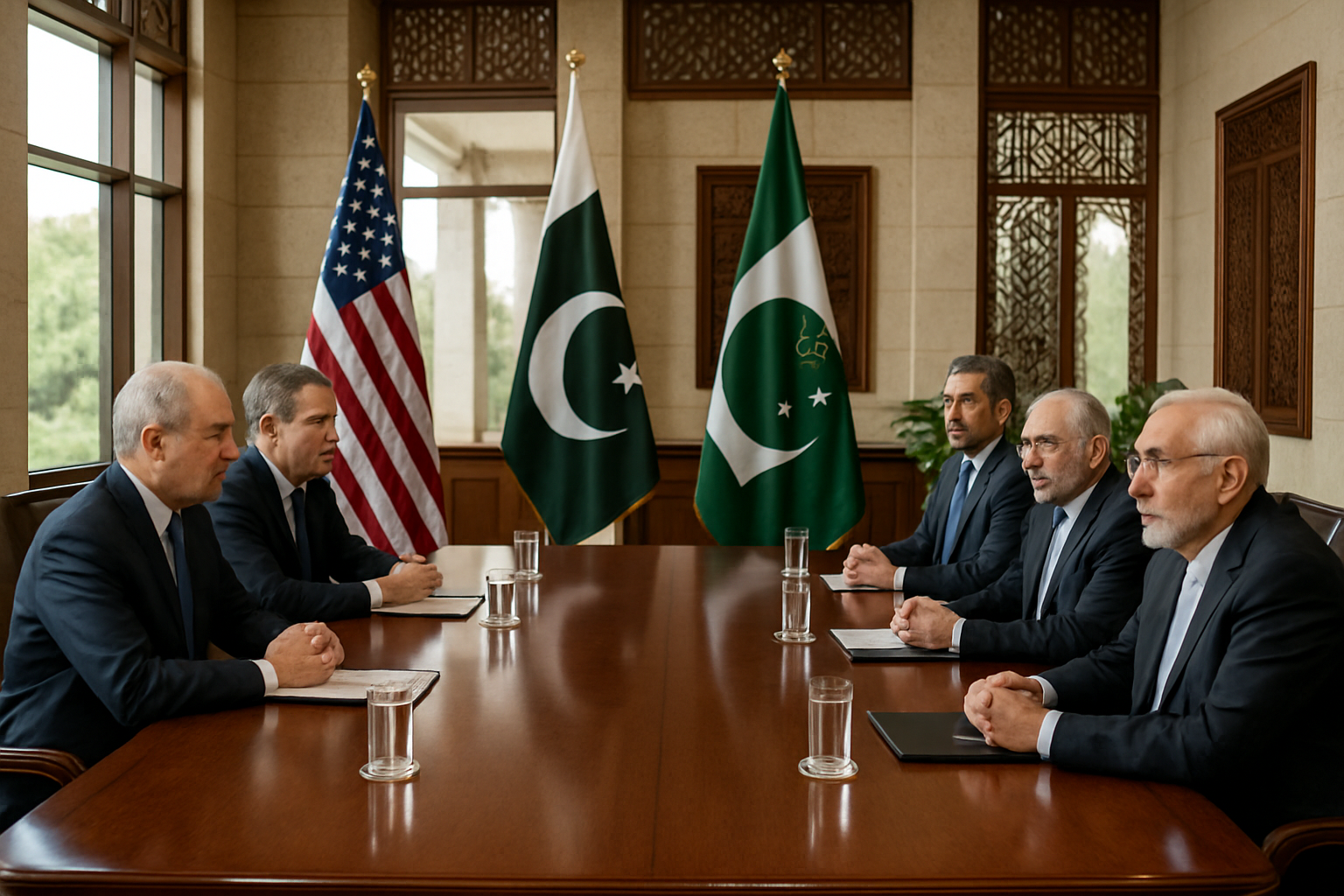
In a dramatic diplomatic breakthrough that averted a potential catastrophe, Pakistan successfully mediated a historic ceasefire agreement between the United States and Iran just 88 minutes before President Trump's "whole civilization will die tonight" deadline. The agreement, reached Wednesday evening, ended the most dangerous international crisis since the Cold War and paved the way for formal peace negotiations beginning Friday in Islamabad.
Prime Minister Shehbaz Sharif and Field Marshal Asim Munir emerged as the crucial mediators who bridged what appeared to be an unbridgeable divide between the two powers. Working through round-the-clock contact with US Vice President JD Vance and Iranian Foreign Minister Abbas Araghchi, the Pakistani leadership facilitated the breakthrough that sent global markets soaring and oil prices crashing by nearly 20%.
The Diplomatic Framework That Prevented War
The "Islamabad Accord," as the framework has been dubbed, represents the most direct US-Iran diplomatic engagement in decades. At its core is Iran's acceptance of a two-week ceasefire with the critical agreement to reopen the Strait of Hormuz for "safe passage" in coordination with Iranian forces. This waterway, which carries 40% of global oil transit, had been effectively closed by Iranian naval mining operations that deployed between 2,000-6,000 mines.
Iran's 10-point proposal, which Trump administration officials accepted as a "workable basis for negotiations," addresses several key areas including Hormuz protocols, sanctions relief, regional conflicts, and security guarantees. This represents the most comprehensive framework between the two nations since the collapse of nuclear diplomacy.
"A ceasefire is the first step. But our destination is lasting peace... Day after tomorrow, delegations from both sides will arrive in Islamabad for the most important talks of this century."
— Prime Minister Shehbaz Sharif
The Crisis That Brought the World to the Brink
The conflict, dubbed "Operation Epic Fury" by US forces, had reached unprecedented scale over five weeks of military escalation. With costs exceeding $11.3 billion in the first week alone, it became the largest US Middle Eastern operation since 2003. The human toll included over 787 civilian casualties according to Iran's Red Crescent, while the USS Charlotte's sinking of an Iranian frigate marked the first enemy vessel destroyed by a US submarine since World War II.
The crisis had paralyzed global commerce on a scale not seen since the COVID-19 pandemic. Over 18,000 flights were cancelled worldwide as eight countries simultaneously closed their airspace, creating what analysts called an "aviation black hole" between Asia and Europe. Dubai International Airport, the world's busiest with 86 million annual passengers, remained shuttered after sustaining missile damage.
Pakistan's Strategic Mediation Role
Pakistan's emergence as the key mediator represents what European diplomatic sources describe as a "net regional stabilizer" alongside Turkey and Egypt. The country's historical neutrality and diplomatic relationships across traditional alliance lines uniquely positioned it to facilitate dialogue when direct communication between adversaries became impossible.
The mediation success came through what officials described as a sophisticated "message relay system" that maintained communication channels even during the most intense military exchanges. This innovative approach demonstrates how middle powers can effectively bridge major adversary divides when traditional mechanisms fail.

China's Foreign Minister Wang Yi expressed "full support" for Pakistan's mediation initiative, while Germany noted "positive signs" for the direct talks beginning Friday. This international backing underscores the global investment in diplomatic solutions over military escalation.
High-Level Delegations Converge on Islamabad
White House Press Secretary Karoline Leavitt confirmed that Vice President JD Vance will lead the American delegation, accompanied by special envoy Steve Witkoff and presidential advisor Jared Kushner. The composition represents the highest-level US-Iran engagement in decades and signals the administration's commitment to the diplomatic process.
Iranian President Masoud Pezeshkian confirmed Tehran's participation following what Pakistani officials described as a "warm and cordial" 45-minute conversation with PM Sharif. The Iranian delegation will include senior officials from both the foreign ministry and the Revolutionary Guard, indicating broad governmental backing for the talks.
Security preparations in Islamabad have been extraordinary, with several Margalla Hills trails closed and unprecedented deployments around the capital. UAE and US military aircraft have been observed at Nur Khan Air Base, preparing for what officials describe as the most significant diplomatic operation in Pakistan's history.
Immediate Global Relief
The ceasefire announcement triggered the steepest oil price decline in six years, with Brent crude falling from its crisis peak of $119.50 to below $100 per barrel. Asian stock markets posted explosive rallies, led by Pakistan's KSE-100 index which surged a record 8.15% in a single day.
The International Energy Agency announced it would reduce its emergency strategic petroleum reserve release - the largest in 50 years at 400 million barrels - as supply concerns eased with the Strait of Hormuz reopening. Airlines immediately began planning to resume Middle Eastern routes, while shipping companies mobilized to free over 150 stranded oil and LNG tankers worth billions in cargo.
Regional Coalition Dynamics
The diplomatic breakthrough preserved an unprecedented regional coalition that had been severely tested during the crisis. Saudi Arabia, UAE, Qatar, and Egypt maintained their consensus supporting diplomatic solutions despite suffering casualties from Iranian retaliation operations. The UAE reported one civilian death in Abu Dhabi, Kuwait had 32 injured at its airport, and Qatar intercepted 65 missiles and 12 drones.
Egyptian President Abdel Fattah el-Sisi, who had warned of "comprehensive chaos" if the conflict expanded, welcomed the breakthrough. The preservation of this coalition represents a significant diplomatic achievement, maintaining decades-old security arrangements that could have collapsed under the pressure of direct Iranian attacks.
Nuclear Diplomacy Window Reopens
The crisis had emerged from the complete collapse of US-Iran nuclear negotiations in Geneva, despite achieving what officials called "broad agreement on guiding principles" - the most progress since the 2018 JCPOA collapse. Iran's continued uranium enrichment at 60% purity, approaching weapons-grade levels with over 400kg stockpiled, remains a central concern.
The ceasefire creates a crucial diplomatic window to address these nuclear concerns through the scheduled talks. This comes at a critical time for global nuclear governance, as the New START treaty expired in February 2026 - the first time in over 50 years without US-Russia nuclear constraints.
"This ceasefire demonstrates that diplomatic solutions are possible even in the darkest hours. The next two weeks will determine whether we can convert this temporary pause into a lasting framework for regional stability."
— UN Secretary-General António Guterres
European Territory Under Attack
One of the most significant escalations during the crisis was Iran's drone attack on RAF Akrotiri in Cyprus - the first attack on European territory since World War II. This unprecedented development prompted an equally unprecedented naval coalition response, with British HMS Dragon operating alongside Spanish, Italian, French, Dutch, and Greek vessels. The EU activated its ESTIA crisis mechanism for the first time in the bloc's history.
Congressional and Public Opinion Shifts
The ceasefire provides relief for the Trump administration, which faced unprecedented early-stage opposition to military operations. Only 25% of Americans supported the military action according to polls - historically low approval ratings that Senator Richard Blumenthal described as creating concerns about ground troop deployments.
Financial markets had become what analysts called the "ultimate constraint" on continued escalation, with Pakistan's stock exchange suffering its largest decline in history and global supply chains severely disrupted by the Persian Gulf logistics crisis.
Template for 21st Century Diplomacy
The successful mediation represents what UN Secretary-General Guterres called "the greatest test of multilateral cooperation in the modern era." Pakistan's innovative approach provides a template for how middle powers can effectively manage international crises when traditional mechanisms fail.
The framework's success demonstrates a preference for diplomatic credibility over military escalation, potentially influencing how future territorial and nuclear disputes are resolved. This is particularly significant given the multipolar nature of contemporary international relations and the fragility of crisis management mechanisms.
Critical Two-Week Window
The success or failure of the Islamabad talks will determine whether this breakthrough represents a temporary respite or the foundation for lasting regional stability. The talks address not only bilateral US-Iran relations but broader regional conflicts, including the situation in Lebanon and Gaza, making them potentially transformative for Middle Eastern geopolitics.
Consumer relief is already beginning globally, with Bangladesh reviewing fuel rationing for 170 million people, Pakistan considering reversing wartime austerity measures, and European households anticipating electricity and gasoline cost reductions. The aviation industry expects months of recovery time despite the immediate crisis resolution.
Historical Watershed Moment
April 8, 2026, will be remembered as a watershed moment in 21st-century diplomacy, when innovative multilateral cooperation prevented what could have been the most catastrophic conflict since World War II. The crisis had threatened to reshape the post-Cold War international order, testing energy security, nuclear governance, and international law enforcement simultaneously.
Most significantly, the breakthrough demonstrates that diplomatic innovation remains possible even when the world appears closest to catastrophic conflict. The Pakistan-mediated success provides hope that complex international disputes can be resolved through patient mediation and creative frameworks, even under the most dangerous circumstances.
As delegations prepare to arrive in Islamabad, the world watches to see whether this historic ceasefire can be transformed into the lasting peace framework that has eluded the region for decades. The stakes could not be higher - not just for US-Iran relations, but for the entire architecture of international conflict resolution in the modern era.