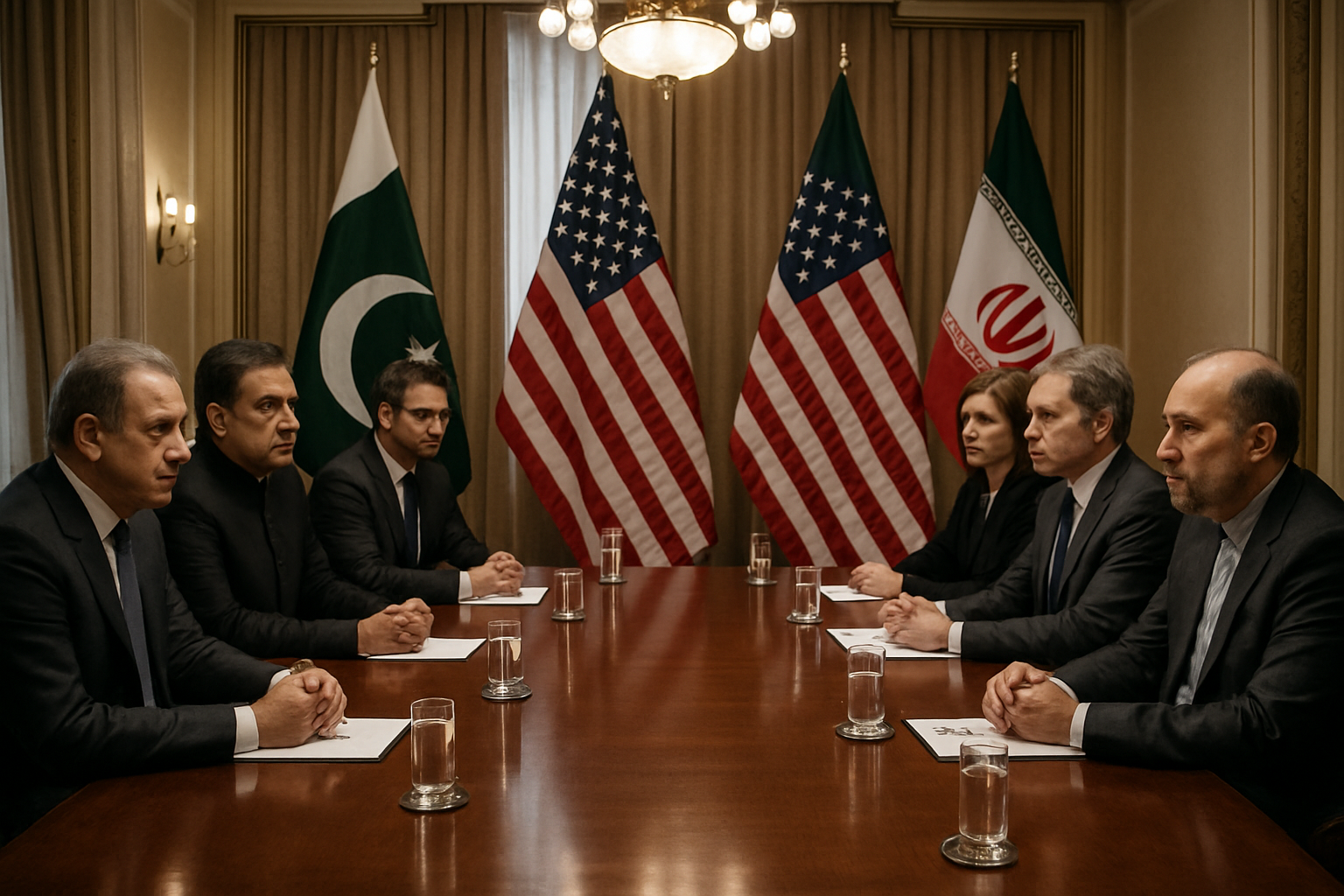
As the two-week ceasefire between the United States and Iran nears its Wednesday expiry, diplomatic efforts are reaching a critical juncture in Islamabad, where Pakistan continues its unprecedented mediation role amid uncertainty over Iran's participation in renewed negotiations.
US Vice President JD Vance is reportedly en route to Pakistan to lead a second round of indirect talks, despite mixed signals from Iranian officials about their willingness to participate. The uncertainty comes as Iranian state television has denied that any delegation has departed for Pakistan, while sources close to the mediation process indicate preparations for talks continue.
Pakistan's Historic Mediation Success at Risk
Pakistan's Foreign Minister Ishaq Dar and Prime Minister Shehbaz Sharif, alongside Field Marshal Asim Munir, achieved what many considered impossible just two weeks ago. Their innovative "message relay system" facilitated the historic ceasefire agreement reached just 88 minutes before President Trump's "whole civilization will die tonight" deadline on April 8, 2026.
The breakthrough, known as the "Islamabad Accord," led to immediate global relief as oil prices crashed nearly 20% from a peak of $119.50 per barrel to below $100, marking the steepest decline in six years. The partial reopening of the Strait of Hormuz, which handles 40% of global oil transit, ended what had become the most dangerous international crisis since the Cold War.
"Pakistan has demonstrated that middle powers can successfully bridge major adversaries when traditional diplomatic mechanisms fail," observes international relations expert Dr. Sarah Collins. "The 'message relay system' represents diplomatic innovation at its finest."
— Dr. Sarah Collins, Georgetown University
Current Negotiations Framework and Obstacles
Iran's comprehensive 10-point proposal, which addresses Strait of Hormuz protocols, sanctions relief, regional conflicts, and security guarantees, remains on the table as the most detailed US-Iran framework since the 2015 nuclear agreement. However, fundamental disagreements persist over Iran's nuclear program, with the United States demanding a commitment that Iran will not seek nuclear weapons development and will suspend uranium enrichment.
Iran continues to maintain 60% uranium enrichment levels with over 400 kilograms of weapons-grade material, sufficient for multiple nuclear weapons if weaponized, according to experts. Iranian Foreign Minister Abbas Araghchi has repeatedly stated that Iran will "never abandon enrichment even if war is imposed."
Lebanon Crisis Complicates Diplomatic Efforts
A critical complication remains what diplomats have termed the "Lebanon loophole." Israeli Prime Minister Benjamin Netanyahu explicitly excluded Lebanon from the Pakistan-mediated ceasefire, leading to continued Israeli strikes that killed over 254 people in a single day during the initial talks – the deadliest bombardment since the conflict began.
With 1.2 million Lebanese displaced (representing 25% of the population) and systematic targeting of medical personnel resulting in 26 paramedic deaths, Iran has threatened withdrawal from negotiations unless comprehensive enforcement covers all fronts. Vice President Vance previously acknowledged Iran's "legitimate misunderstanding" about Lebanon's inclusion, though the United States maintains it never agreed to include Israeli-Hezbollah operations in the ceasefire scope.
Regional and International Stakes
The unprecedented regional coalition of Saudi Arabia, UAE, Qatar, and Egypt has maintained unity despite Iranian attacks on their territories during the crisis. The UAE suffered one death in Abu Dhabi, Kuwait reported 32 injuries at airports, and Qatar had 8 wounded while intercepting missiles and drones during Iran's "Operation True Promise 4."
European allies have largely distanced themselves from broader military support, with UK Prime Minister Keir Starmer declaring Britain "will not be dragged into Iran war" and France and Germany emphasizing diplomatic approaches. This represents the most significant rejection of American military leadership since the Iraq War in 2003.
Economic and Energy Implications
The economic stakes remain enormous. Iran's deployment of 2,000-6,000 naval mines in the Strait of Hormuz has effectively closed the waterway to normal commercial traffic, with major shipping companies like Maersk and MSC suspending operations. Over 150 tankers remain stranded with billions of dollars worth of cargo.
The crisis has prompted the International Energy Agency to maintain its largest strategic reserve release in 50 years, deploying 400 million barrels from 32 countries. Consumer impacts are being felt globally, with Bangladesh reviewing fuel rationing for 170 million people and Pakistan considering austerity measures.
Iran has implemented an innovative cryptocurrency payment system requiring $1 per barrel from oil tankers transiting the strait, representing a dramatic shift in maritime commerce that circumvents traditional sanctions.
Nuclear Governance Crisis Context
The current crisis unfolds against the backdrop of the New START treaty's expiration in February 2026, marking the first time in over 50 years without US-Russia nuclear constraints. UN Secretary-General António Guterres has described nuclear risks as at their "highest levels in decades," calling the situation the "greatest test of multilateral cooperation in the modern era."
The collapse of the Geneva nuclear framework, despite achieving "broad agreement on guiding principles" – the most progress since the 2018 JCPOA breakdown – highlights the fundamental scope disagreement between Iran's nuclear-only focus and US demands for comprehensive coverage of missiles, proxies, and human rights issues.
Congressional and Domestic Pressures
Domestic pressure in the United States continues to mount, with only 25% public support for Operation Epic Fury representing "unprecedented" unpopularity for early-stage military operations. Senator Richard Blumenthal has expressed being "more concerned than ever" about potential ground troops deployment.
The operation's costs have reached $11.3 billion in the first week alone, with Pentagon operations now projected to continue through September, far beyond initial 4-6 week timelines. Financial markets serve as what analysts describe as the "ultimate constraint" on prolonged military confrontation.
Humanitarian Toll and War Crimes Concerns
The humanitarian impact has been severe, with the Iranian Red Crescent reporting over 787 civilian casualties. The Pentagon has acknowledged an elementary school strike that killed between 165-185 students due to "outdated targeting data," prompting war crimes investigations.
International evacuations have reached Arab Spring-scale proportions, with Australia reporting 115,000 trapped citizens and Germany evacuating 30,000. The European Union activated its ESTIA crisis mechanism for the first time in the bloc's history after Iranian drones struck RAF Akrotiri in Cyprus – the first attack on European territory since World War II.
Template for 21st Century Diplomacy
Pakistan's mediation represents what many analysts view as a template-setting moment for 21st-century conflict resolution. China has provided "full support" for the Pakistani initiative, while Germany noted "positive signs" for continued diplomatic momentum.
The success of Pakistan's middle-power diplomacy demonstrates that innovative solutions are possible even in the darkest hours of international crisis, when traditional great power mechanisms have failed. However, the fundamental disagreements over nuclear issues, regional conflicts, and sanctions relief remain the same structural obstacles that have prevented US-Iran breakthroughs for decades.
Critical 48-Hour Window
As the Wednesday deadline approaches, both sides face a critical decision point. Iran's Parliament Speaker Mohammad Bagher Qalibaf has warned that Iran possesses "new cards on the battlefield" and will not negotiate "under the shadow of threats." Meanwhile, President Trump has warned of "serious consequences" if Iran refuses to engage constructively.
The coming days will determine whether Pakistan's historic mediation achievement can be sustained and converted into a lasting peace framework, or whether the world will return to the most dangerous crisis since the Cold War. The stakes extend far beyond bilateral US-Iran relations, affecting global energy security, nuclear governance credibility, and international law enforcement mechanisms for decades to come.
Success would provide a framework for future crisis management in an increasingly multipolar world, demonstrating that diplomatic innovation can triumph over military confrontation. Failure could accelerate the preference for military solutions globally, undermining diplomatic credibility and international stability at a time when the world can least afford such an outcome.