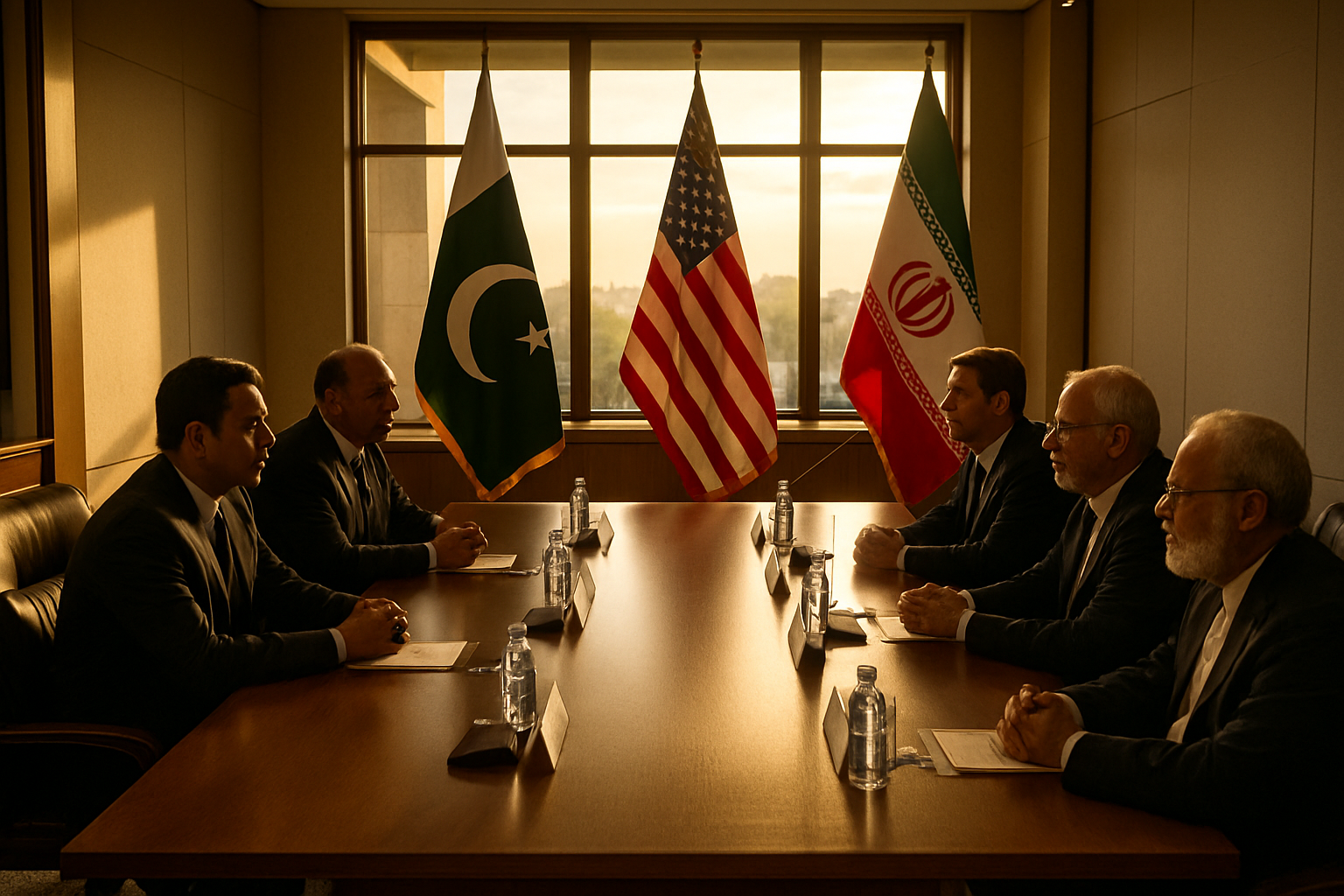
The United States and Iran reached a historic two-week ceasefire agreement on April 8, 2026, just 88 minutes before President Donald Trump's "whole civilization will die tonight" deadline, ending the most dangerous international crisis since the Cold War and immediately triggering massive global relief across energy markets and diplomatic circles.
The breakthrough came through unprecedented Pakistan mediation led by Prime Minister Shehbaz Sharif and Field Marshal Asim Munir, who maintained round-the-clock contact with US Vice President JD Vance and Iranian officials during the final critical hours. The agreement, announced at 10:43 PM ET on Tuesday, instantly crashed oil prices nearly 20% from $119.50 Brent crude to below $100 per barrel - the steepest decline in six years.
The Islamabad Accord Framework
The ceasefire, dubbed the "Islamabad Accord," represents the most direct US-Iran diplomatic engagement in decades. Iranian Foreign Minister Abbas Araghchi confirmed Tehran's agreement to reopen the Strait of Hormuz for "safe passage" during the two-week period "in coordination with Iranian armed forces," addressing the critical chokepoint that carries 40% of global oil transit.
Pakistan's role proved decisive as the Islamic Republic emerged as a trusted mediator capable of bridging major adversaries when traditional diplomatic mechanisms failed. "Both parties have displayed remarkable wisdom and understanding and have remained constructively engaged in furthering the cause of peace and stability," Prime Minister Sharif declared on social media platform X.
"We earnestly hope that the 'Islamabad Talks' succeed in achieving sustainable peace and wish to share more good news in coming days!"
— Shehbaz Sharif, Prime Minister of Pakistan
Global Crisis Scale and Resolution
The agreement ended what UN Secretary-General António Guterres called "the greatest test of multilateral cooperation in the modern era." The crisis had paralyzed global systems on an unprecedented scale:
- Over 18,000 flights cancelled worldwide - the most extensive disruption since COVID-19
- Eight Middle Eastern countries simultaneously closed airspace, severing Asia-Europe corridors
- Dubai International Airport, the world's busiest with 86 million passengers annually, remained shuttered due to missile damage
- The International Energy Agency released a record 400 million barrels from strategic reserves - the largest intervention in the agency's 50-year history
- Natural gas prices surged 24% in Europe and 78% in the United States
Iran's Revolutionary Guard had deployed between 2,000-6,000 naval mines in the Strait of Hormuz, effectively closing the waterway and stranding over 150 tankers carrying billions of dollars in cargo. Major shipping companies Maersk and MSC had suspended all Persian Gulf operations.
Trump's Dramatic Policy Reversal
President Trump's acceptance of the diplomatic solution marked one of the most dramatic policy reversals in modern presidential history. Just hours earlier, he had issued his most apocalyptic threats yet, warning that "a whole civilization will die tonight" and threatening to "destroy every bridge and power plant in Iran."
The about-face came after Iran presented a 10-point proposal that Trump's administration deemed a "workable basis for negotiations." Sources familiar with the talks indicate the proposal addresses Strait of Hormuz protocols, sanctions relief, regional conflicts, and security guarantees.
Iran's Supreme National Security Council declared the ceasefire a "historic victory," claiming they had "forced Trump to accept Iran's 10-point plan." This represents a major shift from Iran's earlier categorical rejection of any temporary measures.
Operation Epic Fury Concluded
The ceasefire brings to a close Operation Epic Fury, which Pentagon sources confirm cost $11.3 billion in the first week alone - making it the largest US military operation since the 2003 Iraq invasion. The campaign involved a dual-carrier deployment of the USS Gerald Ford and Abraham Lincoln, representing approximately one-third of the active US Navy fleet.
The operation resulted in the first American combat casualties since 2003, with three service members killed and 150 wounded, including eight in critical condition. The USS Charlotte submarine's sinking of Iranian frigate IRIS Dena near Sri Lanka marked the first enemy vessel destroyed by a US submarine since World War II.
European Territory Under Attack
The conflict marked several unprecedented developments, including the first attack on European territory since World War II. Iranian drones struck RAF Akrotiri in Cyprus, prompting an immediate multinational naval response involving HMS Dragon and vessels from Spain, Italy, France, the Netherlands, and Greece.
The European Union activated its ESTIA crisis mechanism for the first time in the bloc's history, fundamentally altering the conflict's scope from a Middle Eastern regional dispute to a matter of European security.
Congressional Relief and Market Response
The ceasefire announcement brought immediate relief to US lawmakers who had expressed unprecedented opposition to the military campaign. Senator Chris Blumenthal, who had stated he was "more concerned than ever" about potential ground troop deployments, welcomed the diplomatic breakthrough.
With only 25% American public support, Operation Epic Fury had achieved "almost unprecedented" unpopularity for an early-stage military operation. Congressional leaders had been demanding comprehensive briefings on strategy, costs, and exit plans that the administration had struggled to provide clearly.
Financial markets responded explosively to the ceasefire news. Asian stock markets posted massive gains, with Pakistan's KSE-100 index surging a record 8.15% - the highest single-day rally in absolute terms in the exchange's history. Airlines immediately began planning to resume Middle Eastern routes, while shipping companies mobilized vessels worth billions in stranded cargo.
Energy Market Relief
The energy sector saw the most dramatic recovery. Qatar announced preparations to resume LNG production, which represents approximately 20% of global exports. Jet fuel costs began declining from crisis levels of $150-200 per barrel toward normal ranges of $85-90.
European households anticipate relief from electricity and gasoline cost increases that had reached crisis levels in countries like Sweden. Ireland's heating oil prices, which had reached €2 per liter during what officials called "brazen rip-offs," are expected to normalize.
Nuclear Diplomacy Window
The ceasefire creates a crucial diplomatic window to address underlying nuclear concerns. The crisis had emerged from the complete collapse of Geneva nuclear talks in February, despite achieving what negotiators called "broad agreement on guiding principles" - the most progress since the JCPOA framework fell apart in 2018.
Iran continues enriching uranium to 60% purity with over 400 kilograms of weapons-grade material - sufficient for multiple nuclear weapons if weaponized. The fundamental scope disagreement that prevented breakthrough - Iran's exclusion of ballistic missiles and regional proxies versus US demands for comprehensive agreements - remains unresolved but may be addressed in the scheduled Islamabad negotiations.
Regional Coalition Preservation
The agreement preserves an unprecedented regional coalition of Saudi Arabia, UAE, Qatar, and Egypt that had maintained diplomatic consensus supporting peaceful resolution despite Iranian attacks on member territories. Egypt's President Abdel Fattah el-Sisi, who had warned of "comprehensive chaos" spreading across "sisterly countries," welcomed the breakthrough.
The coalition's survival represents a remarkable achievement given that Iranian retaliation during "Operation True Promise 4" had directly targeted member states, killing one civilian in Abu Dhabi and injuring 32 at Kuwait's airport, while Qatar intercepted 65 missiles and 12 drones.
International Humanitarian Relief
The ceasefire halts what had become a mounting humanitarian crisis. Iran's Red Crescent reported over 787 civilian casualties from US-Israeli strikes, including a devastating Pentagon-confirmed elementary school attack that killed between 165-185 students due to "outdated targeting data."
International evacuations had reached Arab Spring 2011 levels, with Australia reporting 115,000 citizens trapped in the region and Germany evacuating 30,000 stranded tourists. The end of hostilities will allow the largest coordinated repatriation effort since the 2011 Middle Eastern uprisings.
China's Supporting Role
President Trump acknowledged Chinese assistance in reaching the agreement, telling Agence France-Presse: "I hear yes" when asked whether China had helped bring Iran to negotiations. Foreign Ministry spokesperson Mao Ning confirmed Beijing's role, stating that "China has consistently advocated for an immediate ceasefire and cessation of hostilities."
Iran separately indicated its desire for China, as its largest trading partner, to serve among guarantors of regional peace - potentially giving Beijing a significant role in Middle Eastern security architecture.
Template for 21st Century Crisis Resolution
The successful mediation demonstrates the potential for middle-power diplomacy to bridge major adversary divides during international crises. Pakistan's "message relay system" facilitated indirect talks when direct communication proved impossible, providing a template for future crisis management in an increasingly multipolar world.
The breakthrough offers hope that diplomatic innovation can prevent military escalation even in the most dangerous circumstances. As UN Secretary-General Guterres noted, the crisis represented the "greatest test of multilateral cooperation in crisis management in the modern era."
"This news will come as a relief to the 20,000 seafarers who have been at the forefront of this crisis, while also paying tribute to civilians and seafarers who have been injured or killed."
— Thomas Kazakos, Secretary-General, International Chamber of Shipping
Critical Two-Week Window
The success of Friday's Islamabad talks will determine whether this temporary pause converts into lasting peace. The negotiations, scheduled for April 10, are expected to include high-level US participation, potentially featuring Vice President Vance, special envoy Steve Witkoff, and senior advisor Jared Kushner.
Iranian President Masoud Pezeshkian confirmed Tehran's participation in a 45-minute phone call with Prime Minister Sharif, describing the conversation as "warm and cordial." The Iranian leader expressed "deep appreciation for the Pakistani leadership's wisdom" while conveying respects to Supreme Leader Mojtaba Khamenei.
The framework's success will be measured by its ability to bridge fundamental disagreements that have persisted for decades. Iran's 10-point proposal reportedly addresses all major contentious issues, including regional conflicts, sanctions relief, reconstruction assistance, and formal Strait of Hormuz protocols.
Historical Significance
April 8, 2026, represents a watershed moment in international relations, demonstrating that innovative diplomatic solutions remain possible even during the most dangerous confrontations. The Pakistan-mediated breakthrough provides a template for 21st-century conflict resolution that prioritizes multilateral cooperation over military escalation.
The agreement's success in preventing broader regional war has implications extending far beyond the Middle East. At a time when the New START nuclear treaty has expired, leaving the world without US-Russia nuclear constraints for the first time in over 50 years, the diplomatic resolution strengthens precedents for peaceful dispute resolution.
As the world moves forward from the brink of what could have been a catastrophic regional conflict, the Islamabad Accord stands as testament to the enduring power of diplomacy to bridge even the deepest divides when nations commit to dialogue over destruction.