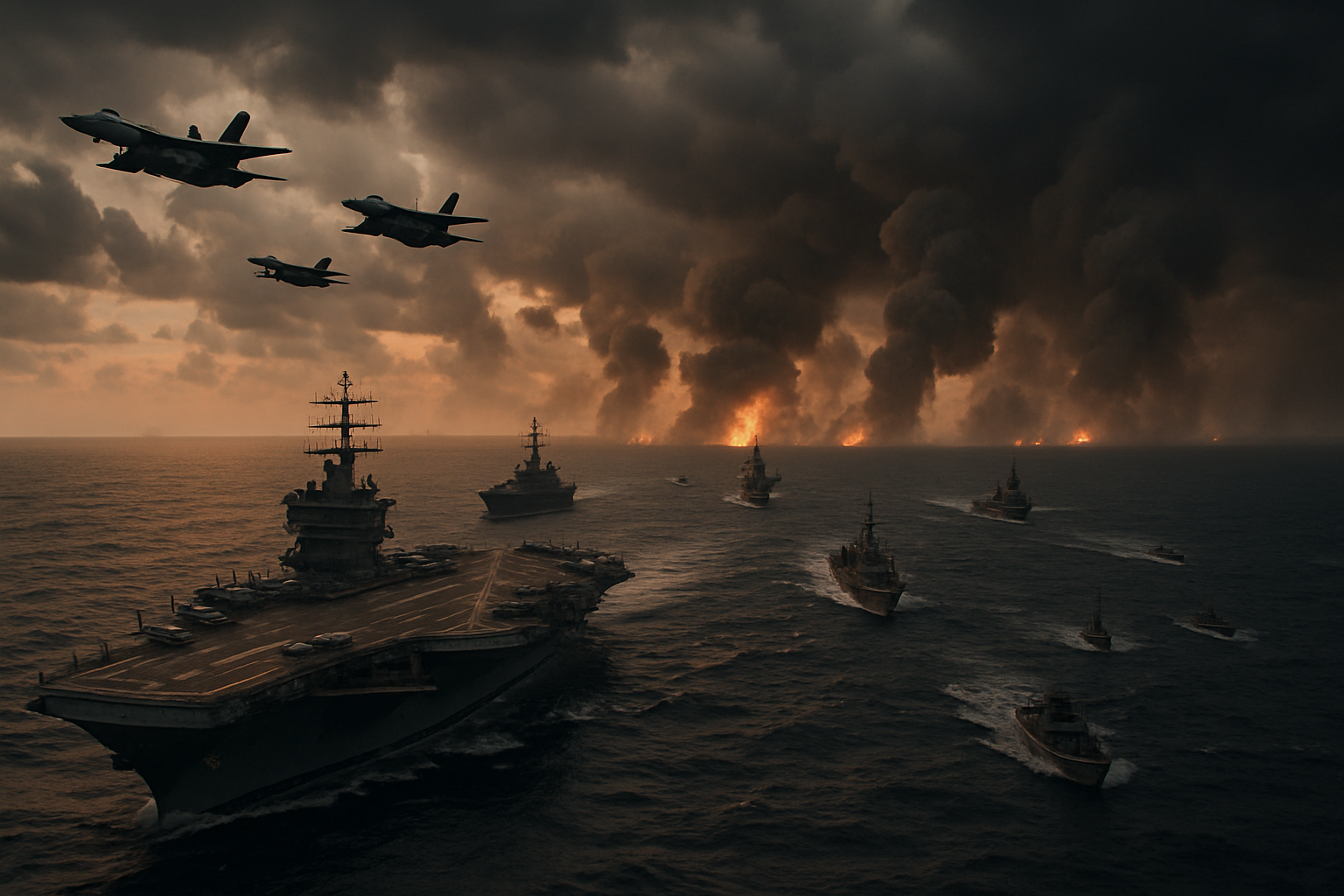
The ongoing US-Iran military confrontation has escalated to its most critical phase yet, with President Donald Trump issuing an explicit Tuesday 8 PM deadline for Iran to reopen the Strait of Hormuz or face strikes on critical infrastructure including power plants and bridges.
The ultimatum comes as US special forces successfully rescued an American airman whose aircraft was shot down over Iranian territory, marking a dangerous new chapter in what has become the most perilous international crisis since the end of the Cold War.
Trump's Infrastructure Threat Escalates Crisis
Speaking to Israeli television, Trump confirmed the rescue operation while issuing his most explicit threat yet against Iranian civilian infrastructure. "Tuesday will be Power Plant Day, and Bridge Day," the President declared on Truth Social, extending his previous deadline by 24 hours to give Tehran one final opportunity to comply.
The ultimatum represents a dramatic escalation from military-to-military confrontation to threats against Iran's civilian infrastructure, potentially affecting millions of Iranian civilians who depend on electricity and transportation networks.
"I don't think they want the consequences of not making a deal. Tuesday, 8:00 P.M. Eastern Time!"
— Donald Trump, US President
Iranian authorities have dismissed Trump's demands as "helpless and nervous," with officials describing the ultimatum as evidence of American desperation. Iran's Revolutionary Guard has maintained its position that the Strait of Hormuz, through which 40% of global seaborne oil passes, remains "unsafe for shipping."
Dramatic Rescue Operation in Iranian Territory
The successful extraction of the downed US airman represents one of the most daring special operations missions in recent memory, with the Pentagon confirming that Israeli forces provided critical assistance in the operation. Trump revealed to Israeli media that initial concerns arose when the crew member sent an "unusual message," raising fears of a potential ambush or capture.
According to multiple sources, the rescue mission involved helicopters and transport aircraft penetrating deep into Iranian territory. Iran's state media claimed to have destroyed multiple US aircraft during the operation, including two C-130 transport planes and two Black Hawk helicopters, though US officials have not confirmed these losses.
The operation required the destruction of two US C-130 aircraft that became stuck in sand during the mission, with Pentagon sources confirming the aircraft were deliberately destroyed to prevent capture of sensitive equipment and intelligence.
Global Energy Crisis Deepens
The confrontation has created the most severe global energy crisis in decades, with oil prices surging past $100 per barrel as Iran continues to effectively blockade the Strait of Hormuz. Over 150 oil tankers worth billions of dollars remain stranded in the Persian Gulf, unable to transit the critical waterway.
The International Energy Agency has authorized the largest strategic petroleum reserve release in its 50-year history, with 400 million barrels being released from 32 countries to stabilize global markets. Natural gas prices have exploded by 24% in Europe and 78% in the United States, while Qatar has been forced to halt LNG production at facilities responsible for 20% of global exports.
Major shipping companies including Maersk and MSC have suspended all operations in the Persian Gulf, creating supply chain disruptions that extend far beyond energy markets to affect automotive, electronics, and textile manufacturing worldwide.
Aviation Crisis Reaches Unprecedented Scale
The conflict has triggered the most extensive aviation disruption since the COVID-19 pandemic, with over 18,000 flights cancelled worldwide as eight Middle Eastern countries maintain simultaneous airspace closures. Dubai International Airport, the world's busiest with 86 million passengers annually, remains completely shut down due to missile damage.
Emirates, Air France-KLM, Wizz Air, and Bulgaria Air have suspended operations indefinitely, stranding hundreds of thousands of passengers globally and severing critical Europe-Asia air corridors. The disruption demonstrates the vulnerability of modern aviation networks to regional conflicts.
Congressional Opposition Mounts
The escalating crisis has prompted unprecedented bipartisan opposition in Congress, with lawmakers demanding immediate briefings on strategy, costs, and the potential deployment of ground troops. Senator Richard Blumenthal has expressed being "more concerned than ever" about the prospect of American boots on the ground.
Public support for the military operations remains historically low at just 25%, creating significant political pressure on the Trump administration. The Pentagon has quietly prepared operations extending through September, far beyond the initial 4-6 week timeline originally projected by the White House.
Operation Epic Fury, as the US-Israeli campaign has been designated, has already cost $11.3 billion in its first week alone, making it one of the most expensive military operations since the 2003 Iraq invasion.
International Evacuations on Arab Spring Scale
The crisis has triggered the largest coordinated international evacuation since the Arab Spring of 2011, with Australia reporting 115,000 nationals trapped in the region and Germany working to extract 30,000 stranded tourists and residents.
The European Union activated its Emergency Transit, Identification, and Assistance (ESTIA) evacuation plan for the first time in the bloc's history following Iranian drone strikes on RAF Akrotiri in Cyprus—the first attack on European territory since World War II.
Nuclear Diplomacy Collapse
The military escalation emerged from the complete breakdown of nuclear negotiations between Washington and Tehran, despite earlier breakthroughs in Geneva talks that achieved "broad agreement on guiding principles"—the most significant diplomatic progress since the JCPOA collapse in 2018.
The fundamental disagreement centered on scope: Iran insisted on nuclear-only discussions while excluding ballistic missiles and regional proxy forces as "red lines," while the United States demanded comprehensive agreements addressing missiles, armed groups, and human rights.
Iran continues uranium enrichment at 60% purity with over 400 kilograms of weapons-grade material—sufficient for multiple nuclear weapons if weaponized. The collapse of talks occurred amid the broader nuclear governance crisis following the February expiration of New START, marking the first time in over 50 years without US-Russia nuclear constraints.
Regional Coalition Under Severe Strain
The unprecedented coalition of Saudi Arabia, UAE, Qatar, and Egypt that had backed diplomatic efforts is now severely strained as Iranian retaliation has directly targeted member territories. One civilian was killed in Abu Dhabi, 32 people were injured in airport strikes in Kuwait, and Qatar intercepted 65 missiles and 12 drones despite sustaining 8 injuries.
"We cannot accept attacks on sisterly Arab countries. This threatens comprehensive chaos spreading across the region."
— Abdel Fattah el-Sisi, Egyptian President
The coalition fracturing represents a significant blow to Middle Eastern stability, undermining decades-old security arrangements and forcing Gulf states to choose between their US alliance and protection from Iranian pressure.
European Security Implications
The Iranian attack on Cyprus marked a watershed moment, prompting an unprecedented naval coalition response with HMS Dragon, Spanish frigates, and vessels from Italy, France, Netherlands, and Greece deploying to protect European territory. However, European allies have largely rejected Trump's demands for assistance in reopening the Strait of Hormuz.
German Defense Minister Boris Pistorius led European resistance, questioning "What does Donald Trump expect a handful of European frigates to do that the powerful US Navy cannot?" The response demonstrates growing European strategic autonomy and reluctance to support what many view as discretionary American military interventions.
Historical Significance and Global Implications
UN Secretary-General António Guterres has characterized the crisis as "the greatest test of multilateral cooperation in the modern era." The rapid transition from diplomatic breakthrough to military confrontation demonstrates the fragility of crisis management in the multipolar era.
The stakes extend far beyond the Middle East, affecting global energy security, nuclear governance credibility, international law enforcement, and post-World War II order principles. Success in containing the crisis could provide a framework for resolving future nuclear disputes, while failure may accelerate the preference for military solutions over diplomacy for decades to come.
Looking Ahead: Point of No Return
As the Tuesday 8 PM deadline approaches, the world faces what could be a defining moment of the 21st century. Trump's threats against civilian infrastructure represent a potential point of no return, with consequences that would extend far beyond the immediate crisis.
The confrontation has already fundamentally altered global energy architecture, exposed dangerous vulnerabilities in supply chains, and demonstrated the catastrophic potential of conflicts involving strategic chokepoints like the Strait of Hormuz.
With Iran continuing to reject any surrender demands and the United States maintaining unprecedented military pressure, the coming hours may determine whether this crisis can be contained as a regional confrontation or will explode into a broader Middle Eastern war with global implications extending decades beyond the current events.