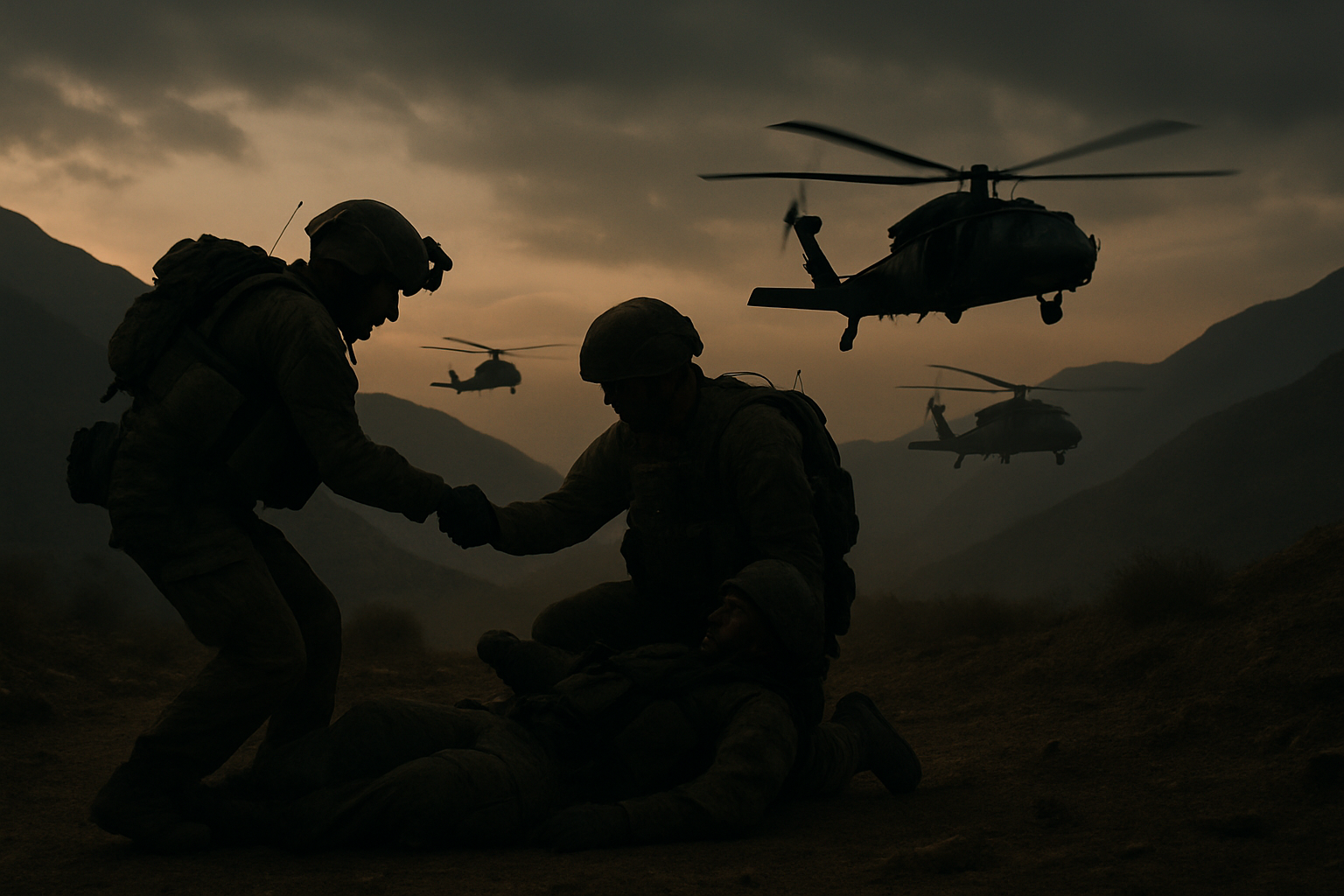
In a dramatic escalation of the ongoing US-Iran military crisis, Iranian Revolutionary Guard forces shot down multiple American aircraft during a high-risk rescue operation, while President Donald Trump issued his most explicit threat yet, warning of devastating strikes on Iran's power plants and bridges if Tehran fails to reopen the Strait of Hormuz by Tuesday.
The confrontation reached a new peak on Sunday when Iran claimed to have downed two US Black Hawk helicopters and a C-130 transport aircraft during what American officials described as "one of the most daring Search and Rescue Operations in US History" to extract a stranded F-15E crew member from Iranian territory.
Rescue Operation Under Fire
According to Iranian sources, the incident began when US forces attempted to rescue the second crew member of an F-15E Strike Eagle that had been shot down over Iranian territory on Friday - the first confirmed American aircraft loss during the six-week "Operation Epic Fury" campaign. The missing pilot, identified as a colonel and weapons systems officer, had evaded capture for over 48 hours in southwestern Iran's mountainous terrain.
President Trump confirmed the successful rescue in a social media post early Sunday, declaring: "WE GOT HIM! My fellow Americans, over the past several hours, the United States Military pulled off one of the most daring Search and Rescue Operations in U.S. History." He added that the operation involved "dozens of aircraft, armed with the most lethal weapons in the World" and that while the rescued airman "sustained injuries," he would "be just fine."
However, Iranian state media painted a different picture, with the semi-official Tasnim News Agency reporting that Revolutionary Guard forces successfully destroyed multiple American aircraft during the rescue attempt. Iran's Islamic Revolutionary Guard Corps (IRGC) stated that "joint operations involving the Aerospace Force, ground units, popular and Basij forces, law enforcement, and the Army successfully destroyed the enemy aircraft."
Trump's Infrastructure Ultimatum
As the rescue drama unfolded, President Trump escalated his rhetoric against Iran with an unprecedented ultimatum delivered via social media. In characteristically blunt language, Trump declared that Tuesday would be "Power Plant Day and Bridge Day, all wrapped up in one, in Iran."
"Open the Fuckin' Strait, you crazy bastards, or you'll be living in Hell – JUST WATCH!"
— President Donald Trump, Truth Social
The president's inflammatory post, which he concluded with "Praise be to Allah," represents the most direct threat against Iranian civilian infrastructure since the crisis began. The ultimatum specifically targets Iran's continued closure of the Strait of Hormuz, a critical waterway that handles approximately 40% of global seaborne oil transit.
Contradictory Diplomatic Signals
In a striking paradox typical of the current crisis, Trump simultaneously offered what appeared to be diplomatic overtures. Speaking to Fox News, the president claimed there was a "good chance" of reaching an agreement with Iran by Monday, stating that Tehran was actively negotiating.
"I think there are a lot of good chances that we will make a deal tomorrow. Right now they are negotiating," Trump told Fox News correspondent Trey Yingst. However, he also warned that if negotiations failed, he was considering "destroying everything" and "taking the oil."
These contradictory signals reflect the complex dynamics of a crisis that has seen the complete breakdown of nuclear diplomacy despite achieving what Iranian Foreign Minister Abbas Araghchi called "broad agreement on guiding principles" during Geneva talks in February.
Global Economic Impact
The continued closure of the Strait of Hormuz has created the most severe global energy crisis in decades. Oil prices have surged past $100 per barrel, with some analysts warning of potential spikes toward $200 if the crisis continues. More than 150 oil and LNG tankers worth billions of dollars remain stranded in Persian Gulf waters.
The International Energy Agency has authorized the largest strategic petroleum reserve release in its 50-year history - 400 million barrels from 32 countries - in an attempt to stabilize markets. Natural gas prices have exploded 24% in Europe and 78% in the United States, while Qatar's LNG production, representing about 20% of global exports, remains halted due to Iranian attacks.
The aviation sector continues to experience COVID-19-scale disruptions, with over 18,000 flights cancelled worldwide. Eight Middle Eastern countries have simultaneously closed their airspace, severing critical Europe-Asia air corridors. Dubai International Airport, the world's busiest with 86 million passengers annually, remains shuttered due to missile damage.
European Territory Under Fire
The crisis has expanded beyond the Middle East, with Iranian drones striking RAF Akrotiri in Cyprus - marking the first attack on European territory since World War II. This unprecedented escalation prompted an emergency naval coalition response, with HMS Dragon and vessels from Spain, Italy, France, the Netherlands, and Greece deploying to protect European interests.
The European Union has activated its ESTIA crisis mechanism for the first time in its history, while multiple countries have issued urgent travel warnings and begun evacuating personnel from the region.
Nuclear Diplomacy Collapse
The military confrontation stems from the complete breakdown of nuclear negotiations that had achieved the most significant progress since the 2018 JCPOA collapse. Despite establishing a framework for agreement during Geneva talks mediated by Switzerland and Oman, fundamental disagreements over scope proved insurmountable.
Iran insisted on nuclear-only discussions, excluding ballistic missiles and regional proxies as "red lines," while the United States demanded a comprehensive agreement addressing missiles, armed groups, and human rights concerns. Iran continues uranium enrichment at 60% purity, approaching the 90% weapons-grade threshold, with intelligence assessments suggesting sufficient material for multiple nuclear weapons if weaponized.
Regional Coalition Under Strain
The unprecedented regional coalition of Saudi Arabia, UAE, Qatar, and Egypt that had supported diplomatic efforts is now severely strained as Iranian "Operation True Promise 4" systematically targets member territories. The UAE has reported one civilian death in Abu Dhabi, Kuwait has suffered 32 injuries from airport strikes, and Qatar has intercepted 65 missiles and 12 drones using Patriot systems.
Egyptian President Abdel Fattah el-Sisi has condemned attacks on "sisterly countries," warning of "comprehensive chaos" if the situation continues to deteriorate.
Congressional Opposition Mounts
Operation Epic Fury, the largest US-Israeli coordinated campaign since the 2003 Iraq invasion, has cost over $11.3 billion in its first week alone, with Pentagon operations now expected to continue through September - far beyond Trump's initial 4-6 week timeline.
Congressional opposition is mounting, with Senator Richard Blumenthal stating he is "more concerned than ever" about potential ground troop deployment. The conflict maintains historically low public support at just 25%, creating significant political constraints on the administration's military options.
Nuclear Governance Crisis
The crisis unfolds against the backdrop of a broader nuclear governance breakdown. The New START treaty expired in February 2026, marking the first time in over 50 years without US-Russia nuclear constraints. Combined with China's nuclear expansion and Iran's advancing enrichment program, UN Secretary-General António Guterres has warned that nuclear risks are at their "highest in decades."
Template-Setting Moment
International observers view the current crisis as a template-setting moment for 21st-century conflict resolution. The rapid transition from diplomatic framework to military confrontation demonstrates the fragility of crisis management in the multipolar era.
Success in containing the crisis could provide a framework for future nuclear dispute resolution and strengthen non-proliferation norms globally. However, failure may accelerate the preference for military solutions over diplomatic ones, potentially reshaping Middle Eastern geopolitics for decades while encouraging nuclear proliferation worldwide and undermining diplomatic credibility.
As Tuesday's deadline approaches, the world watches to see whether Trump's ultimatum will force Iranian compliance, trigger devastating infrastructure strikes, or open space for the diplomatic breakthrough that has thus far proven elusive. The stakes extend far beyond the Middle East, with implications for global energy security, nuclear governance, and the fundamental principles of international law that have governed the post-World War II order.
The coming hours will determine whether the most dangerous international crisis since the end of the Cold War can be resolved through last-minute diplomacy or whether it will escalate into a broader regional conflict with global implications extending decades beyond the current confrontation.