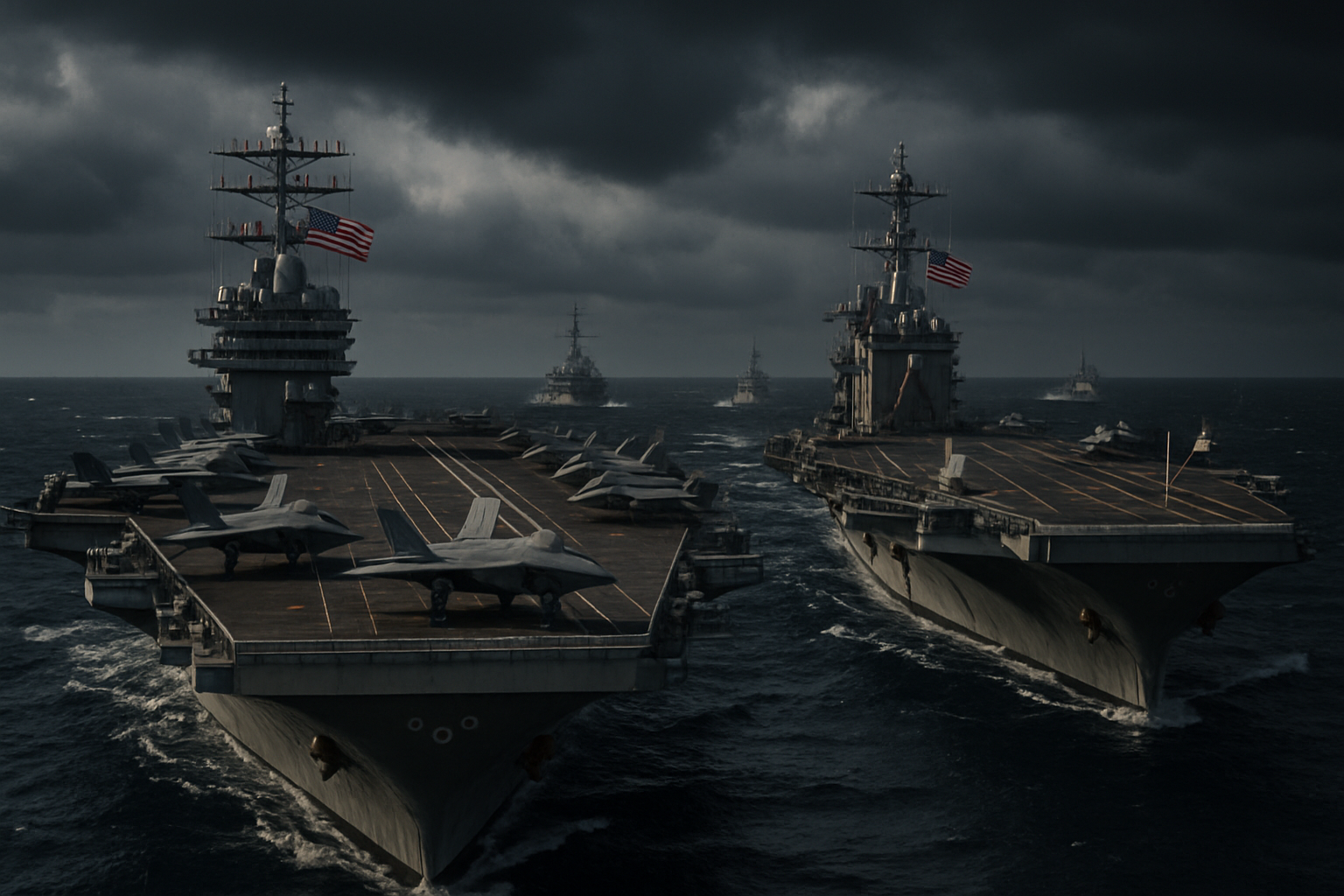
The Pentagon is preparing for potentially weeks-long military operations against Iran as President Donald Trump deployed a second aircraft carrier to the Middle East and made his most explicit call for regime change, declaring it would be "the best thing that could happen" to the Iranian people.
According to multiple U.S. officials speaking to Reuters, the military is developing scenarios for sustained operations that could far exceed previous confrontations between the two nations. The planning comes as Trump announced the deployment of the USS Gerald R. Ford, the world's largest aircraft carrier, to join the USS Abraham Lincoln already positioned 800 kilometers from Iran's coast in the Arabian Sea.
Unprecedented Naval Buildup Creates Strike Capability
The dual-carrier deployment represents the largest U.S. naval presence in the Middle East in years, providing multiple strike capabilities and enhanced defensive coverage for sustained 24/7 readiness. Trump described the deployment as preparation "in case we don't make a deal" with Iran over its nuclear program, but added ominously that "if we need it, we'll have it ready."
Speaking at Fort Bragg, North Carolina, Trump made his most direct endorsement of regime change, stating that overthrowing Iran's clerical establishment "seems like that would be the best thing that could happen." When asked who he wanted to lead Iran, Trump cryptically replied, "there are people."
"For 47 years, they've been talking and talking and talking. In the meantime, we've lost a lot of lives while they talk. Legs blown off, arms blown off."
— President Donald Trump
Military Planning Scope Expands Beyond Nuclear Facilities
Pentagon sources confirm that strike scenarios range from targeted attacks on nuclear facilities to broader campaigns against Revolutionary Guard infrastructure. Officials expect Iranian retaliation would create "back-and-forth attacks," requiring sustained military engagement rather than single-strike operations.
Recent incidents have already escalated tensions. An F-35C fighter jet from the USS Abraham Lincoln shot down an Iranian Shahed-139 drone that aggressively approached the carrier, while Iranian Revolutionary Guard Corps vessels harassed U.S.-flagged tankers in the Strait of Hormuz, which handles 40% of global oil transit.
Nuclear Diplomacy Continues Despite Military Preparations
The military buildup occurs paradoxically alongside ongoing nuclear negotiations. Iranian Foreign Minister Abbas Araghchi and U.S. Special Envoy Steve Witkoff held talks in Oman on February 7, which both sides described as having a "positive atmosphere." However, fundamental disagreements persist over the scope of any agreement.
Iran maintains uranium enrichment at 60% purity—far above the 3.67% limit established by the collapsed 2015 nuclear deal and approaching the 90% threshold needed for weapons-grade material. Araghchi has declared Iran will "never abandon uranium enrichment even if war is imposed," while excluding ballistic missiles and regional proxy activities as "red lines" from nuclear-only talks.
The U.S., led by Secretary of State Marco Rubio, insists any comprehensive agreement must address Iran's missile capabilities, support for armed groups like Hezbollah and Hamas, and human rights violations. This scope disagreement has prevented breakthrough agreements for over a decade.
Regional Coalition Seeks Diplomatic Solution
Despite the military escalation, an unprecedented regional coalition including Saudi Arabia, the UAE, Qatar, and Egypt is backing the diplomatic process—representing remarkable Middle Eastern consensus for preventing military confrontation. Oman's neutral mediation, leveraging its historical role in the 2015 nuclear negotiations, has proved essential for maintaining dialogue.
However, Israeli Prime Minister Benjamin Netanyahu, who met with Trump at the White House this week, emphasized that "all negotiations must include limiting ballistic missiles and ending support for the Iranian axis." Israel views nuclear-only agreements as insufficient for addressing existential security threats from Iran's integrated missile and proxy network.
Domestic Pressures Drive Both Sides
Iran faces severe domestic pressure with over 42,000 protest arrests since 2022 and economic sanctions creating a regime survival crisis. However, the leadership appears to prioritize nuclear capabilities over economic relief, with officials declaring enrichment an "inalienable right."
The Trump administration faces pressure from Republican hawks viewing engagement as appeasement while seeking a foreign policy victory. Trump's dual-track approach maintains "maximum pressure" through sanctions and military deterrence while keeping diplomatic channels open.
Global Nuclear Governance at Critical Juncture
The crisis unfolds against a deteriorating global nuclear governance landscape. The New START treaty between the U.S. and Russia expired February 5, marking the first time in over 50 years without nuclear arms control between the superpowers. China's expanding nuclear arsenal further complicates multilateral frameworks.
UN Secretary-General António Guterres has warned that nuclear risks are "higher than at any time in decades," while the Iran crisis tests 21st-century nuclear governance amid broader arms control breakdown.
Economic and Energy Security Stakes
Oil prices have risen over $1 per barrel on tensions, with natural gas up 24% in Europe and 78% in the U.S. amid geopolitical pressures. Any closure of the Strait of Hormuz would affect 40% of global oil transit, with regional war risks disrupting supply chains far beyond the Middle East.
Intelligence reports suggest Iran might consider a three-year uranium enrichment halt and transfer of stockpiles to Russia as potential concessions, but hardline statements following recent talks suggest such compromises are increasingly unlikely without corresponding U.S. concessions addressing Iran's scope demands.
Coming Weeks Prove Decisive
The framework establishment from recent talks represents diplomatic progress, but fundamental positions remain unchanged. The critical test ahead is whether innovative compromise solutions can bridge decade-old challenges or whether the current trajectory leads to military confrontation.
Success could prevent a regional war that would destabilize the Persian Gulf with global implications, encourage nuclear proliferation elsewhere, and undermine diplomatic solutions' credibility for territorial disputes worldwide. Failure may accelerate military solutions that could reshape Middle Eastern geopolitics for decades.
As Trump declared "tremendous power" will soon be in the Middle East, the intersection of military deterrence and diplomatic engagement faces its ultimate test. The stakes include not only regional stability and nuclear governance but also the credibility of international law enforcement and conflict resolution mechanisms for the 21st century.