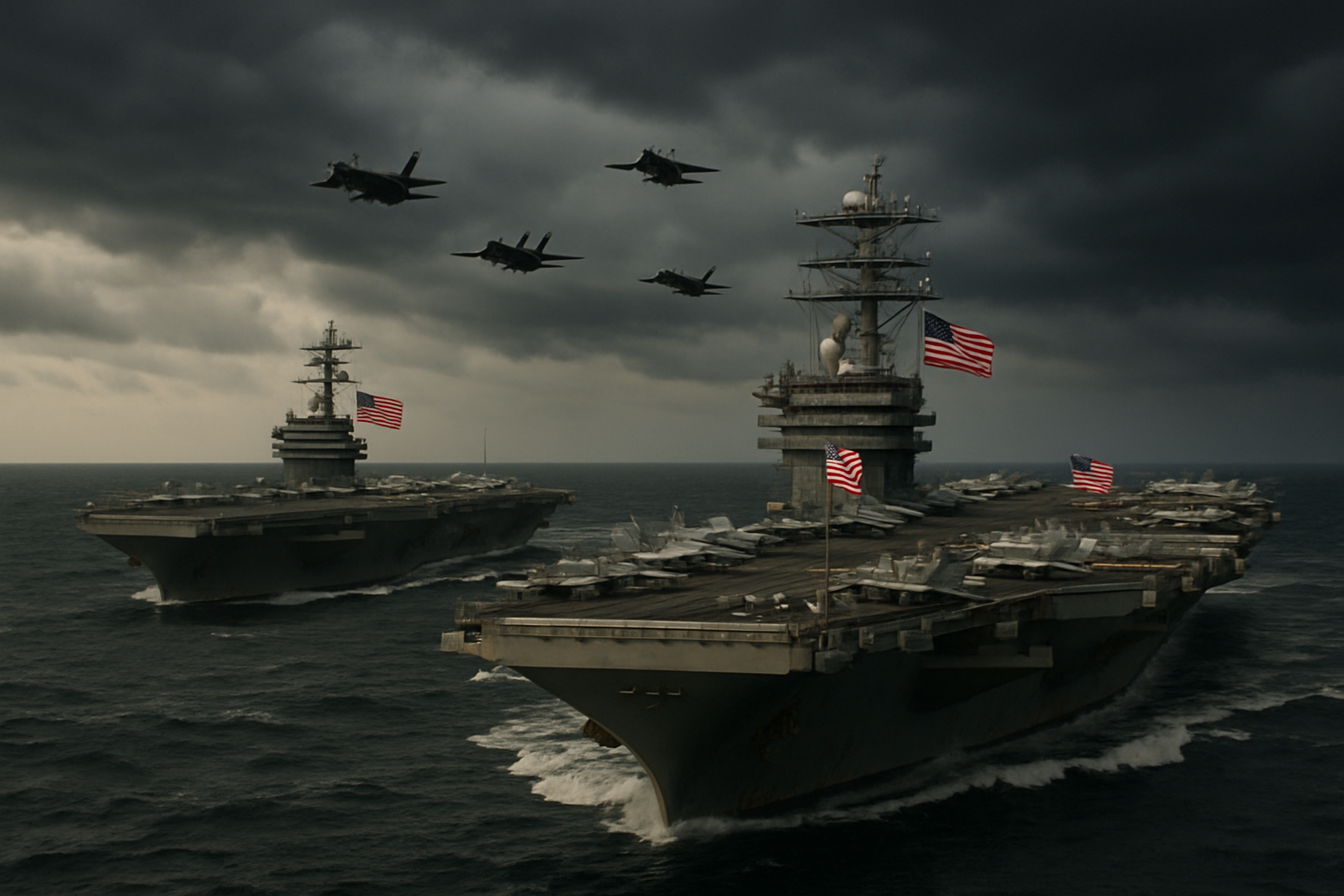
The United States military stands ready to conduct strikes against Iran as early as this weekend, according to multiple high-level sources, while President Donald Trump deliberates on authorizing potentially the most significant military action of his presidency.
Multiple international news outlets, including CNN and major European media, have confirmed that the Pentagon has briefed the White House that American forces could be prepared for military action against Iran by the weekend. However, sources familiar with the matter caution that Trump has yet to make a final decision on whether to proceed with strikes.
The unprecedented military readiness comes after months of escalating tensions between Washington and Tehran, despite ongoing diplomatic efforts through nuclear negotiations in Geneva and Oman that have yielded mixed results.
Unprecedented Military Buildup
The Trump administration has deployed an extraordinary dual-carrier strike force to the Middle East, with the USS Gerald R. Ford joining the USS Abraham Lincoln in the Arabian Sea, creating the largest American naval presence in the region in years. The carriers are positioned approximately 800 kilometers from Iran's coast, providing multiple strike capabilities and enhanced defensive coverage.
Pentagon officials have prepared scenarios ranging from targeted strikes on Iranian nuclear facilities to broader campaigns against Revolutionary Guard infrastructure. Military planners expect Iranian retaliation, potentially creating what one source described as a "back-and-forth attacks" cycle that could escalate into a wider regional conflict.
The military buildup has been accompanied by a series of incidents that have heightened tensions. An F-35C fighter jet from the USS Abraham Lincoln recently shot down an Iranian Shahed-139 drone that aggressively approached the American carrier. Additionally, Islamic Revolutionary Guard Corps (IRGC) vessels have repeatedly harassed US-flagged tankers in the Strait of Hormuz, through which 40% of global oil transit passes.
Trump's Internal Deliberations
Sources close to the White House reveal that Trump has been polling advisers and allies on the best course of action, arguing both for and against military strikes in private discussions. The president has made increasingly explicit threats, recently warning Iran that "I don't think they want the consequences of not making a deal."
Trump has also made his most direct regime change comments to date, declaring that "a change in power in Iran would be the best thing that could happen" – representing a significant escalation in rhetoric from his previous nuclear-focused approach to a broader political transformation agenda.
The decision weighs heavily on Trump as he balances pressure from Republican hawks who view diplomatic engagement as appeasement against his desire for a foreign policy victory that could prevent a devastating regional war.
Diplomatic Efforts Continue Despite Military Preparations
Even as military preparations intensify, diplomatic channels remain open. Nuclear negotiations have continued in Geneva with Iranian Foreign Minister Abbas Araghchi and US Special Envoy Steve Witkoff, mediated by Switzerland and Oman. The talks achieved what Araghchi described as "broad agreement on guiding principles" – the most significant diplomatic breakthrough since the JCPOA collapse in 2018.
However, fundamental disagreements persist. Iran maintains uranium enrichment at 60% purity – significantly above the 3.67% limit set by the original nuclear deal and approaching the 90% weapons-grade threshold. Tehran has declared ballistic missiles and regional proxy activities as "red lines" that will not be included in any nuclear-only agreement.
The United States, led by Secretary of State Marco Rubio, insists on a comprehensive agreement that addresses not only nuclear issues but also Iran's ballistic missile program, support for armed groups throughout the region, and human rights violations.
Regional and International Stakes
An unprecedented regional coalition has emerged supporting diplomatic resolution of the crisis. Saudi Arabia, the UAE, Qatar, and Egypt have all backed the negotiation process – representing remarkable consensus among typically competing Middle Eastern powers. This unity reflects shared concerns about the economic and security implications of a regional war.
Israel has coordinated closely with the Trump administration, with Prime Minister Benjamin Netanyahu meeting Trump multiple times to emphasize Israeli red lines. Netanyahu insists that any agreement with Iran must include "limiting ballistic missiles and ending support for the Iranian axis" – referring to proxy groups like Hezbollah, Hamas, and the Houthis.
The crisis unfolds against the backdrop of a broader nuclear governance crisis. The New START treaty between the US and Russia expired on February 5, 2026, marking the first time in over 50 years that the two nuclear superpowers operate without arms control constraints. Combined with China's nuclear expansion, Iran's potential weaponization represents a critical test for 21st-century non-proliferation efforts.
Domestic Pressures on Both Sides
Iran faces severe domestic challenges that complicate its negotiating position. The Islamic Republic has arrested over 42,000 protesters since the 2022 uprising, and Nobel Peace Prize laureate Narges Mohammadi was recently sentenced to an additional 7.5 years in prison during the current diplomatic talks. Despite economic sanctions creating a regime survival crisis, Iranian leaders appear to prioritize nuclear capabilities over sanctions relief.
Trump faces his own domestic pressures, with Republican hawks viewing any engagement with Iran as insufficient while demanding more aggressive action. The administration must balance these pressures against the potentially catastrophic consequences of a regional war that could disrupt global energy markets and destabilize the broader Middle East.
Economic and Global Implications
Oil markets have already reacted to the escalating tensions, with prices rising over $1 per barrel on reports of military preparations. The potential closure of the Strait of Hormuz – a critical chokepoint for 40% of global oil transit – could have devastating effects on the world economy, far beyond the immediate region.
The crisis comes at a time when global supply chains are still recovering from previous disruptions, and a Middle East war could create worldwide economic instability affecting everything from energy prices to international trade routes.
Technical and Verification Challenges
Even if diplomatic talks succeed, implementation would face unprecedented technical challenges. Iran's nuclear program has advanced significantly since the 2018 JCPOA withdrawal, with sophisticated centrifuge technology and dispersed facilities requiring monitoring mechanisms far more complex than the original agreement.
Intelligence assessments suggest Iran possesses sufficient enriched uranium for multiple nuclear weapons if it chooses to weaponize its program. This creates urgent timeline pressures for any diplomatic resolution, as each day of delay brings Iran closer to an irreversible nuclear threshold.
The Coming Decision
As the weekend approaches, the world watches for Trump's decision on whether to authorize military action or give diplomacy more time. Sources indicate that while the military capability exists for immediate strikes, the political decision remains fluid.
The stakes could not be higher. Success in diplomatic efforts could prevent a regional war and provide a template for resolving nuclear crises in the 21st century. Failure might accelerate military solutions that could reshape Middle Eastern geopolitics for decades, encourage nuclear proliferation elsewhere, and undermine the credibility of diplomatic solutions for future international crises.
The coming days will determine whether innovative diplomatic solutions can bridge decades-old challenges or whether the region moves inexorably toward military confrontation with implications extending far beyond the immediate parties involved.