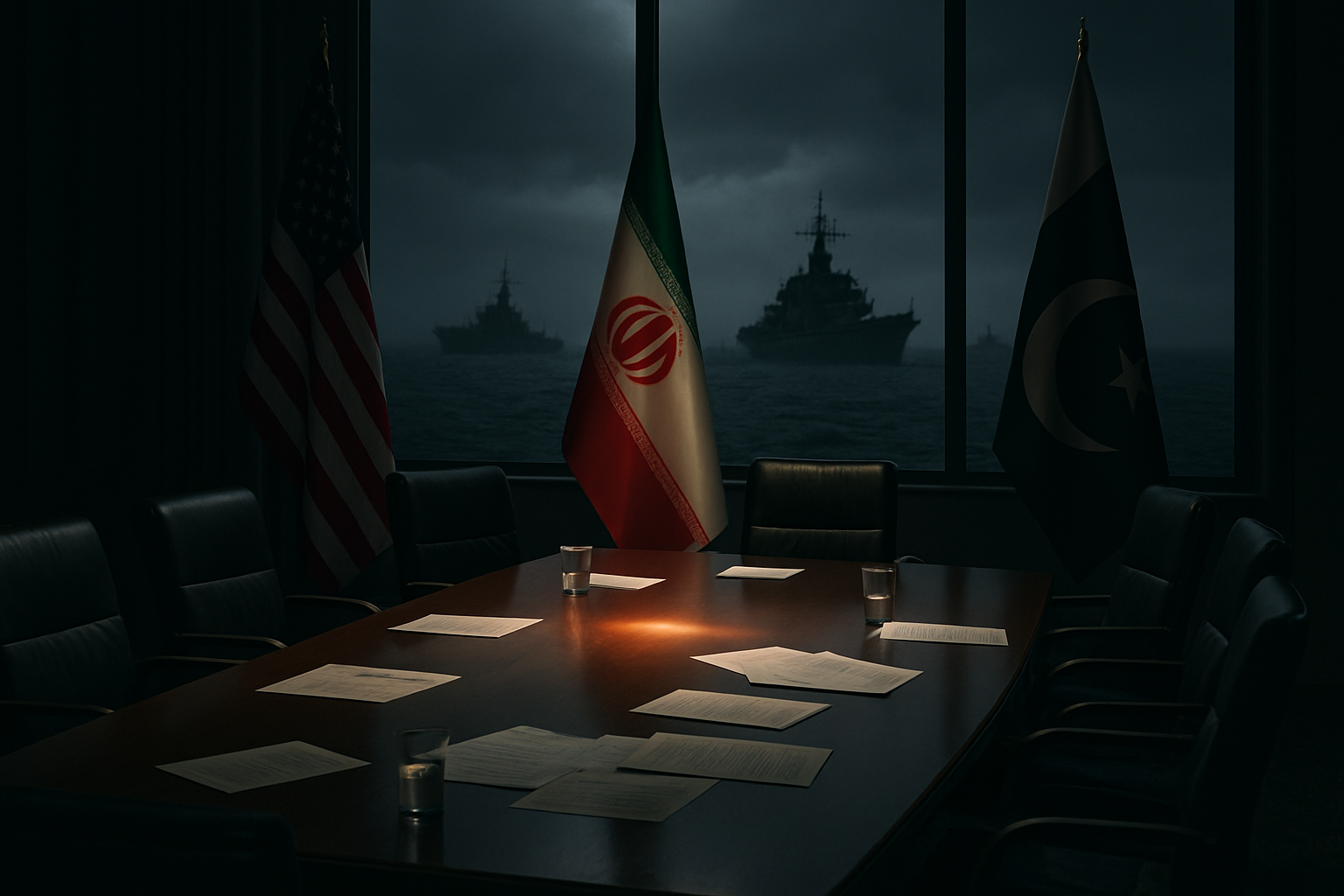
Iran's parliamentary speaker Mohammad Bagher Qalibaf announced Saturday that talks with the United States have made meaningful progress, though both sides remain "far from agreement" as the critical Strait of Hormuz stays closed, affecting global oil supplies and keeping international tensions at dangerous levels.
Speaking on Iranian television, Qalibaf, who serves as Iran's chief negotiator, confirmed that Tehran and Washington have achieved results on some issues while others remain unresolved. "We have made progress in negotiations on certain topics, and in others we have not, and there is still distance until reaching a final agreement," he stated during the late Saturday interview.
The negotiations represent the latest attempt to resolve what has become the most dangerous international crisis since the Cold War, following the historic Pakistan-mediated ceasefire achieved in April that pulled the world back from the brink of catastrophic conflict.
Strait of Hormuz Remains Critical Flashpoint
The strategic waterway, through which approximately 40% of global oil transit flows, continues to be effectively controlled by Iran's Revolutionary Guard Corps (IRGC), which has declared it will remain under strict military supervision until the United States lifts its naval blockade of Iranian ports. This standoff has kept oil markets volatile and global supply chains disrupted.
According to multiple international sources, Iran has deployed between 2,000 to 6,000 naval mines in the narrow 21-mile strait, making commercial navigation extremely hazardous. Major shipping companies including Maersk and MSC have suspended operations in the Persian Gulf indefinitely, leaving over 150 oil and gas tankers stranded with cargo worth billions of dollars.
President Trump characterized Iran's actions as having "got a little cute" but maintained that negotiations are proceeding "really well" despite the pressure tactics. However, he warned that Iran "can't blackmail us" with strait control while keeping the US naval blockade "in full force."
Nuclear Program at Center of Disputes
The fundamental sticking point in negotiations remains Iran's nuclear program, with Tehran maintaining uranium enrichment at 60% purity - significantly above the 3.67% limit set by the 2015 Joint Comprehensive Plan of Action (JCPOA) and approaching the 90% threshold needed for weapons-grade material.
Intelligence assessments confirm that Iran possesses over 400 kilograms of enriched uranium, sufficient for multiple nuclear weapons if weaponized. Foreign Minister Abbas Araghchi has consistently declared that Iran will "never abandon enrichment even if war is imposed," while the United States demands concrete commitments against nuclear weapons development.
The scope of disagreement extends beyond nuclear issues, with Iran excluding ballistic missiles and regional proxy support as "red lines" from any agreement, while US Secretary Marco Rubio insists on comprehensive arrangements addressing missiles, armed groups, and human rights concerns.
Pakistan's Historic Mediation Success
The current diplomatic engagement builds upon the unprecedented mediation success by Pakistan in April, when Prime Minister Shehbaz Sharif and Field Marshal Asim Munir achieved a breakthrough ceasefire just 88 minutes before President Trump's "whole civilization will die tonight" deadline.
"The 'Islamabad Accord' represents the most significant middle-power diplomacy success in decades, demonstrating that innovative solutions are possible even in the darkest hours."
— UN Secretary-General António Guterres
This Pakistan-mediated framework, utilizing a sophisticated "message relay system," triggered an immediate 20% crash in oil prices from $119.50 to below $100 per barrel and ended the most severe aviation crisis since COVID-19, with over 18,000 flights having been cancelled worldwide.
China has provided "full support" for Pakistan's mediation efforts, while Germany noted "positive signs" for continued diplomatic engagement, highlighting the international investment in preventing a return to military confrontation.
Regional Coalition Under Maximum Strain
The unprecedented coalition of Saudi Arabia, UAE, Qatar, and Egypt supporting diplomatic solutions faces severe pressure from Iran's "Operation True Promise 4" retaliation campaign, which has caused casualties across member territories. The UAE reported one civilian killed in Abu Dhabi, Kuwait suffered 32 injuries from airport strikes, and Qatar recorded eight wounded despite successfully intercepting 65 missiles and 12 drones using Patriot defense systems.
Egyptian President Abdel Fattah el-Sisi's warning about "comprehensive chaos" affecting "sisterly countries" has proven prophetic as the regional coalition struggles to maintain unity while defending against Iranian attacks on their territories.
The crisis has expanded beyond the Middle East, with Iranian drones striking RAF Akrotiri in Cyprus - the first attack on European territory since World War II. This unprecedented targeting prompted a multinational naval coalition response involving British, Spanish, Italian, French, Dutch, and Greek vessels, while the European Union activated its ESTIA crisis mechanism for the first time in the bloc's history.
Global Economic Impact Continues
The ongoing crisis has created the worst global energy disruption in decades, with the International Energy Agency (IEA) maintaining its largest strategic petroleum reserve release in 50 years - 400 million barrels from 32 countries. Despite these emergency measures, oil prices remain above $100 per barrel for only the second time in 2026, following the March crisis peak of $119.50.
Natural gas prices have surged 24% in Europe and 78% in the United States, while Qatar's halt of LNG production - representing approximately 20% of global exports - has created additional energy security concerns worldwide.
Consumer impacts are being felt globally, with Bangladesh implementing fuel rationing for 170 million people, Pakistan maintaining wartime austerity measures, and European households facing significant heating cost increases. The aviation industry continues recovery efforts from what industry analysts describe as the most severe disruption since the COVID-19 pandemic.
Nuclear Governance Crisis Context
The US-Iran standoff unfolds against the backdrop of a broader nuclear governance crisis, with the New START treaty between the United States and Russia having expired in February 2026 - the first time in over 50 years without bilateral nuclear constraints between the superpowers. This development, combined with China's nuclear expansion and UN Secretary-General Guterres' warning that nuclear risks are at their "highest in decades," adds urgency to finding a diplomatic resolution.
The current negotiations represent what experts consider a template-setting moment for 21st-century nuclear crisis resolution, with success potentially providing a framework for managing similar challenges while failure could accelerate military solutions and encourage nuclear proliferation globally.
Humanitarian Toll and War Crimes Concerns
The Iranian Red Crescent reports over 787 civilian casualties from US-Israeli strikes, including Pentagon-acknowledged responsibility for elementary school attacks that killed between 165-185 students due to what officials termed "outdated targeting data." These incidents have prompted war crimes investigations and raised serious concerns about systematic civilian targeting.
International evacuations have reached Arab Spring 2011 proportions, with Australia reporting 115,000 citizens trapped in the region and Germany evacuating 30,000 nationals. Multiple countries have ordered immediate evacuations due to "extremely uncertain" security conditions.
In Lebanon, the humanitarian situation remains critical with 1.2 million people displaced - representing 25% of the country's population - following Israeli strikes that killed 254+ people in a single day during recent diplomatic talks. The systematic targeting of medical personnel has resulted in 26 paramedics killed and 51 wounded, with emergency shelters overwhelmed and thousands sleeping on Beirut streets.
Congressional and Allied Opposition
Domestic opposition to military action has reached unprecedented levels, with only 25% of Americans supporting continued operations - described by analysts as "almost unprecedented" unpopularity for early-stage military engagement. Senator Richard Blumenthal has expressed being "more concerned than ever" about potential ground troop deployment, while bipartisan lawmakers demand answers on strategy, costs, and timeline.
Operation Epic Fury has cost $11.3 billion in its first week alone, making it the largest Middle East operation since the 2003 Iraq invasion. The Pentagon projects operations continuing through September, far beyond initial 4-6 week estimates, creating what financial markets view as the "ultimate constraint" on military escalation.
International allies have largely rejected expanded military support, with UK Prime Minister Keir Starmer declaring Britain "will not be dragged into an Iran war," while France and Germany have distanced themselves from US military actions, emphasizing diplomatic approaches instead.
Looking Ahead: Critical Diplomatic Window
The current negotiations represent what may be the final diplomatic opportunity before broader regional war with global consequences. Iran's evaluation of "new proposals" from the United States, as announced by the Supreme National Security Council, suggests potential movement despite fundamental disagreements remaining unchanged.
Norwegian media reports describe President Trump as viewing talks as "very good" with Iran appearing "very eager" to engage, though Iranian officials maintain they "will not make the slighest concession" on core sovereignty issues including ballistic missiles and regional proxy support.
The success or failure of these diplomatic efforts will have template-setting implications for 21st-century conflict resolution, determining whether innovative multilateral cooperation can prevent catastrophic war or whether military solutions become the preferred approach for resolving international disputes.
"This represents the greatest test of multilateral cooperation and crisis management in the modern era. The stakes could not be higher for regional war prevention, global energy security, and nuclear governance credibility."
— UN Secretary-General António Guterres
As the world watches these delicate negotiations unfold, the Strait of Hormuz remains a critical pressure point where economic warfare and traditional diplomacy intersect. The outcome will determine not only the immediate crisis resolution but also establish precedents for how international disputes are managed in an increasingly multipolar world where middle powers like Pakistan can play decisive roles in preventing global catastrophe.