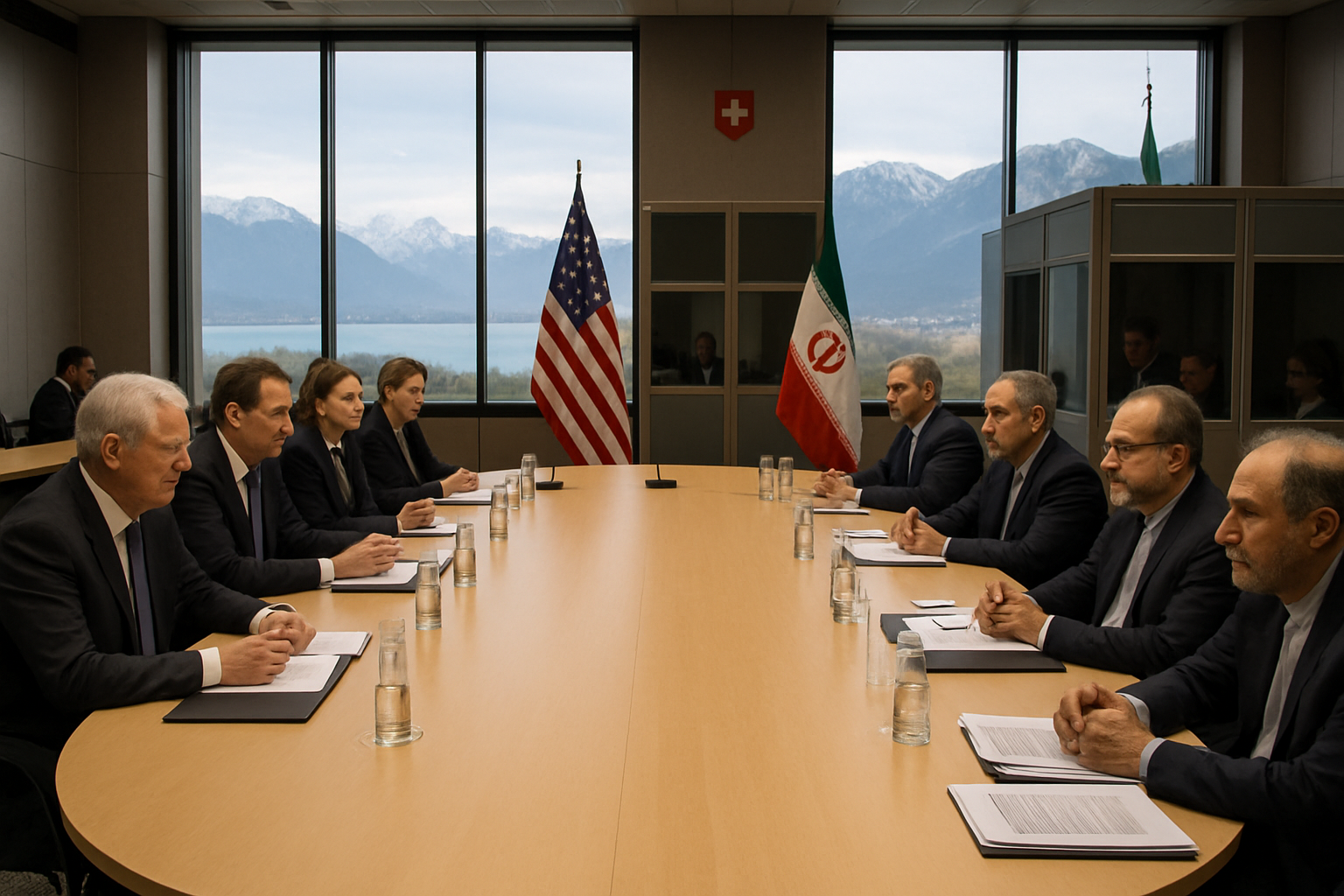
Nuclear negotiations between the United States and Iran resume Thursday in Geneva amid the highest military tensions in decades, as President Trump threatens force while simultaneously pursuing what could be the most significant diplomatic breakthrough since the 2018 JCPOA collapse.
The third round of talks, mediated by Oman and officially supported by Switzerland, comes as Iranian Foreign Minister Abbas Araghchi announced a potential nuclear deal is "within reach" - the most optimistic assessment from either side in years. However, fundamental disagreements over scope persist while Trump has deployed an unprecedented dual-carrier naval force to the Persian Gulf.
Military Escalation Reaches Historic Levels
The deployment of USS Gerald R. Ford alongside USS Abraham Lincoln represents the largest US Middle East naval presence since the 2003 Iraq invasion, with approximately one-third of the active US Navy fleet concentrated 800 kilometers from Iran's coast. Pentagon sources confirm forces are prepared for "potentially weeks-long operations against Iran" ranging from nuclear facilities to Revolutionary Guard infrastructure.
Military tensions have escalated dramatically with recent incidents including an F-35C fighter jet shooting down an Iranian Shahed-139 drone near the Abraham Lincoln, and Islamic Revolutionary Guard Corps vessels harassing US tankers in the Strait of Hormuz, which handles 40% of global oil transit. Oil prices have risen over $1 per barrel on these tensions.
"I don't think they want the consequences of not making a deal"
— President Donald Trump
Geneva Talks Show Framework Progress
Despite military tensions, diplomatic momentum has built through multiple rounds of Geneva negotiations. Araghchi announced "broad agreement on guiding principles" with the US delegation - described as the most significant progress since the Joint Comprehensive Plan of Action (JCPOA) collapsed in 2018. The framework establishes continued negotiation structures with both sides committed to "working on the text of a potential agreement."
The venue evolution from initial talks in Muscat, Oman to European neutral territory in Geneva signals growing international investment in a diplomatic solution. Switzerland's official support combined with Oman's proven mediation capabilities from the 2015 JCPOA negotiations has created an unprecedented platform for sustained dialogue.
Nuclear Status Remains Critical
Iran continues enriching uranium at 60% purity - far exceeding the 3.67% limit established under the JCPOA and approaching the 90% threshold considered weapons-grade. Former IAEA inspector Dr. Yusri Abu Shadi confirms Iran possesses over 400 kilograms of enriched uranium, making weapons development "easily achievable" if Iran chose to weaponize.
Iranian President Masoud Pezeshkian has declared Iran "open to verification" - a major policy shift that suggests potential concessions including a three-year enrichment halt and stockpile transfer to Russia. However, Araghchi maintains Iran will "never abandon enrichment even if war imposed," highlighting the delicate balance between diplomatic flexibility and core positions.
Fundamental Scope Disagreements Persist
The primary obstacle remains a structural disagreement over negotiation scope that has prevented breakthrough for over a decade. Iran maintains ballistic missiles and regional proxy activities as "red lines" excluded from nuclear-only talks, demanding compartmentalized negotiations focused solely on atomic issues.
US Secretary of State Marco Rubio insists any comprehensive agreement must address Iran's missile capabilities, support for armed groups including Hezbollah and Hamas, and human rights violations. This same structural disagreement has prevented agreements since the JCPOA collapse, with neither side willing to compromise on their fundamental approach.
Regional Coalition Provides Unprecedented Support
Perhaps most remarkably, Saudi Arabia, UAE, Qatar, and Egypt are all backing the diplomatic process - representing extraordinary Middle Eastern consensus for preventing military confrontation. This regional coalition reflects shared concerns over energy security, with Persian Gulf instability potentially disrupting global markets and supply chains.
Oman's neutral mediation has proved essential, leveraging its successful historical role in the 2015 JCPOA negotiations. The sultanate's diplomatic relationships with both Washington and Tehran enable continued dialogue despite deep mistrust between the primary parties.
Domestic Pressures Complicate Negotiations
Both sides face severe domestic constraints that limit negotiating flexibility. Iran has conducted over 42,000 arrests since the 2022 protests, with Nobel Peace Prize laureate Narges Mohammadi sentenced to an additional 7.5 years in prison during the current talks. The regime appears to prioritize nuclear capabilities and domestic control over economic relief through sanctions removal.
President Trump faces pressure from Republican hawks viewing engagement as appeasement, while simultaneously needing a foreign policy victory. The administration maintains "maximum pressure" through new sanctions targeting Iran-trading countries, even as diplomatic talks continue.
Israeli Coordination Shapes US Position
Israeli Prime Minister Benjamin Netanyahu's multiple meetings with Trump have established comprehensive red lines requiring any agreement to include "limiting ballistic missiles" and "ending Iranian axis support." Israel views nuclear-only frameworks as insufficient for addressing existential security threats from Iran's integrated missile and proxy network.
This Israeli coordination significantly constrains US negotiating flexibility, as any deal that doesn't address Iran's regional activities would likely face Israeli opposition and potential unilateral military action.
International Nuclear Governance Crisis
The talks occur within a broader nuclear governance crisis, with the New START treaty expiring February 5 - marking the first time in over 50 years without US-Russia nuclear constraints. China's rapid nuclear expansion and UN Secretary-General Antonio Guterres' warning that nuclear risks are at their "highest in decades" add urgency to preventing Iranian weapons development.
Success could provide a template for 21st-century nuclear crisis resolution, while failure might accelerate military solutions and encourage proliferation elsewhere, fundamentally undermining diplomatic credibility for territorial and security disputes worldwide.
Verification Challenges Present Technical Obstacles
Any agreement would require monitoring mechanisms exceeding the original JCPOA's complexity, given Iran's advanced centrifuge technology and sophisticated infrastructure developed since 2018. With IAEA inspections suspended since November 2025, rebuilding verification systems would require years of implementation and substantial technical innovation.
The challenge extends beyond nuclear facilities to encompass Iran's expanded missile capabilities and regional proxy network, creating unprecedented verification requirements that push the boundaries of international monitoring capabilities.
Economic Stakes Extend Globally
The economic implications extend far beyond the immediate region, with natural gas prices rising 24% in Europe and 78% in the US amid geopolitical tensions. Iran has positioned potential economic cooperation as "trillion-dollar opportunities" in energy and mining sectors for US firms, framing agreements as commercial propositions beyond security arrangements.
Oil market volatility demonstrates global vulnerability to Persian Gulf instability, with potential Strait of Hormuz closures affecting worldwide supply chains and energy security for major economies.
Coming Days Prove Decisive
The resumption of Geneva talks represents a template-setting moment for diplomacy versus military confrontation in the multipolar era. Framework progress has been achieved despite fundamental positions remaining unchanged on decade-old challenges, creating both opportunity and risk for breakthrough or continued deadlock.
Success would prevent regional war, provide a nuclear crisis diplomatic template, and strengthen global non-proliferation norms. Failure might accelerate military solutions that could reshape Middle Eastern geopolitics for decades while encouraging nuclear proliferation and undermining diplomatic credibility for international disputes.
With unprecedented military forces deployed and diplomatic channels still active, the coming weeks will determine whether innovative compromise solutions can bridge longstanding disagreements or whether the region moves toward military confrontation with global implications for nuclear governance, international law enforcement, and Middle East stability architecture evolution.