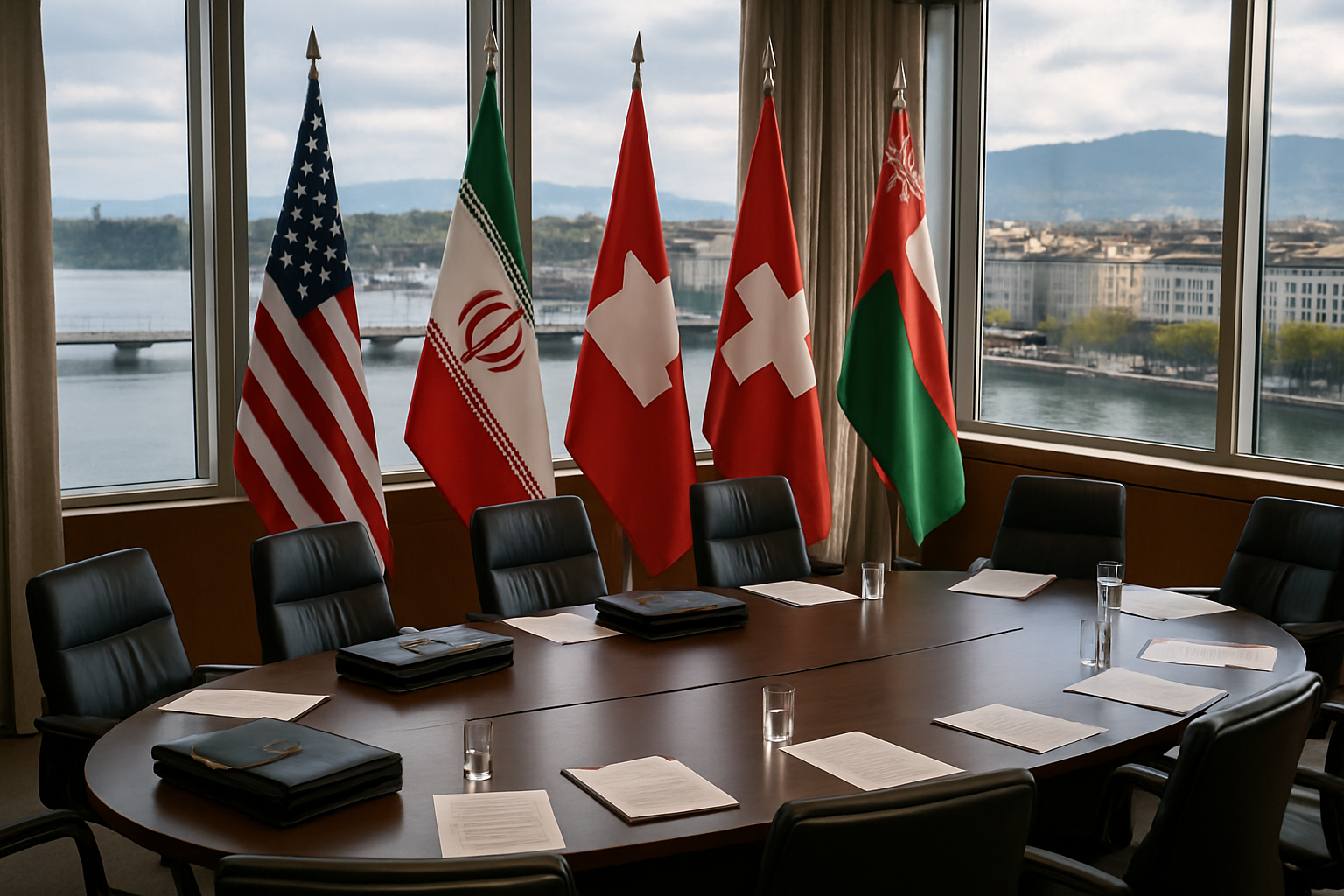
Switzerland announced Saturday that Geneva will host the second round of nuclear negotiations between the United States and Iran on February 17, with Oman serving as mediator following the constructive but limited progress achieved in Muscat earlier this month.
The Swiss Foreign Ministry confirmed that "Switzerland stands ready at all times to offer its good offices to facilitate dialogue between the United States and Iran," marking a significant diplomatic venue change that underscores the international community's investment in preventing nuclear conflict in the Middle East.
Second Round Framework Established
According to multiple diplomatic sources, US Middle East Envoy Steve Witkoff and President Trump's son-in-law Jared Kushner will lead the American delegation, while Iranian Foreign Minister Abbas Araghchi is expected to head Tehran's negotiating team. Oman's Foreign Minister H.E. Sayyid Badr al Busaidi will attend as mediator, leveraging the Gulf nation's successful role in the February 6 Muscat talks.
The Geneva meeting builds on indirect negotiations held in Oman on February 6, which both sides described as establishing a "positive atmosphere" despite fundamental disagreements over the scope and substance of any potential agreement. President Trump declared those talks "very good" while acknowledging that Iran was "very eager to make a deal."
Fundamental Disagreements Persist
The core obstacle remains unchanged from previous diplomatic efforts: Iran maintains that ballistic missiles and regional proxy activities are "red lines" excluded from nuclear-only discussions, while the Trump administration demands a comprehensive agreement addressing all dimensions of Iran's strategic capabilities.
"All negotiations must include limiting ballistic missiles, ending support for Iranian axis"
— Benjamin Netanyahu, Israeli Prime Minister
Iran continues enriching uranium at 60% purity—significantly above the 3.67% limit established in the original 2015 Joint Comprehensive Plan of Action (JCPOA)—and approaching the 90% threshold required for weapons-grade material. Foreign Minister Araghchi has declared Iran will "never abandon uranium enrichment even if war is imposed," representing a hardened stance despite diplomatic engagement.
Trump's Zero Enrichment Demand
President Trump has insisted that any nuclear agreement must require "zero uranium enrichment," a position that directly contradicts Iran's declared "inalienable right" to nuclear technology. This fundamental disagreement over enrichment levels represents one of the most significant obstacles to reaching a comprehensive deal.
Military Tensions Amid Diplomacy
The diplomatic track continues against a backdrop of escalating military tensions. The United States has deployed two aircraft carriers—the USS Abraham Lincoln and USS Gerald R. Ford—creating an unprecedented dual-carrier presence approximately 800 kilometers from Iran's coast. Recent incidents include an F-35C fighter jet shooting down an Iranian Shahed-139 drone that approached the Abraham Lincoln, and IRGC vessels harassing US-flagged tankers in the Strait of Hormuz.
These military encounters have contributed to oil price volatility, with crude rising over $1 per barrel during periods of heightened tension. The Strait of Hormuz handles approximately 40% of global oil transit, making regional stability crucial for international energy markets.
Unprecedented Regional Coalition
One of the most remarkable aspects of the current diplomatic effort is the unprecedented support from Middle Eastern powers traditionally opposed to Iran. Saudi Arabia, the UAE, Qatar, and Egypt have all backed the negotiation process, representing a rare consensus among regional players who typically find themselves on opposing sides of Middle Eastern conflicts.
This regional coalition reflects shared concerns about the potential for military confrontation to destabilize the Persian Gulf, with its critical energy infrastructure and maritime trade routes. The involvement of multiple Gulf states also provides political cover for continued engagement despite domestic pressures on all sides.
Oman's Critical Mediation Role
Oman's selection as mediator leverages the sultanate's historical neutrality and successful role in facilitating the original JCPOA negotiations in 2015. The country's unique diplomatic position—maintaining positive relations with both Washington and Tehran while avoiding regional sectarian divisions—makes it an ideal facilitator for sensitive nuclear discussions.
Domestic Pressures Shaping Negotiations
Both governments face significant internal pressures that complicate diplomatic flexibility. Iran confronts its worst domestic crisis in decades, with over 42,000 protest arrests since 2022 and severe economic sanctions creating regime survival imperatives. The recent sentencing of Nobel Peace Prize laureate Narges Mohammadi to additional prison time demonstrates the government's continued prioritization of domestic control over international diplomacy.
The Trump administration must balance engagement with Iran against Republican pressure from lawmakers who view negotiations as potentially rewarding Iranian aggression. The recent deployment of a second aircraft carrier serves dual purposes: providing military deterrence while demonstrating resolve to domestic audiences skeptical of diplomatic concessions.
International Context and Stakes
The Iran nuclear crisis unfolds within a broader collapse of international arms control frameworks. The New START treaty between the United States and Russia expired on February 5, marking the first time in over 50 years that the world's two largest nuclear powers lack formal constraints on their arsenals. China's rapid nuclear expansion further complicates multilateral arms control efforts.
UN Secretary-General António Guterres has warned that nuclear risks are "higher than they have been in decades," adding urgency to preventing Iranian weapons development. Success in the US-Iran talks could provide a template for nuclear crisis resolution in the 21st century, while failure might accelerate military solutions and encourage nuclear proliferation elsewhere.
Verification Challenges
Any potential agreement would require unprecedented verification mechanisms to address Iran's advanced nuclear infrastructure. Since withdrawing from the JCPOA in 2018, Iran has developed sophisticated centrifuge technology, expanded enrichment facilities, and built capabilities that far exceed those present during the original agreement.
Intelligence reports suggest Iran possesses sufficient enriched uranium for multiple nuclear weapons if weaponized, though US officials believe Tehran has not yet made the decision to build actual warheads. The technical complexity of monitoring Iran's current nuclear program would exceed the original JCPOA verification requirements.
Potential Concessions Under Discussion
Diplomatic sources indicate Iran might consider a three-year halt to uranium enrichment and transfer of existing stockpiles to Russia as confidence-building measures. However, such concessions would likely require corresponding US actions, including sanctions relief and security guarantees that the Trump administration has been reluctant to provide.
Israeli Coordination and Concerns
Israeli Prime Minister Benjamin Netanyahu has maintained close coordination with President Trump, emphasizing that any agreement must address Iran's ballistic missile program and support for regional proxies including Hezbollah, Hamas, and the Houthis. Israel views nuclear-only agreements as insufficient to address what it considers existential security threats from Iran's integrated military capabilities.
The Israeli position adds another layer of complexity to negotiations, as Tel Aviv has demonstrated willingness to use military force against Iranian nuclear facilities and maintains that option remains available if diplomatic efforts fail.
Economic Warfare Alongside Diplomacy
The Trump administration has maintained its "maximum pressure" campaign even while engaging diplomatically, recently threatening 25% tariffs on countries conducting business with Iran. This dual-track approach—combining engagement with economic coercion—represents an evolution of traditional sanctions policy to include third-country trade relationships.
The economic pressure has contributed to Iran's willingness to engage diplomatically while potentially undermining trust-building efforts. European allies have expressed concerns about the extraterritorial nature of such sanctions affecting sovereign trade relationships.
Coming Weeks Decisive
The February 17 Geneva talks represent a critical test of whether innovative diplomatic solutions can bridge decade-old challenges or constitute another false start in nuclear crisis resolution. Both sides have established frameworks for continued engagement, but fundamental positions on enrichment levels, missile capabilities, and regional activities remain largely unchanged.
Success requires unprecedented compromise from both parties: Iran would need to accept significant constraints on its nuclear program and regional activities, while the United States would need to provide meaningful sanctions relief and security assurances. The presence of multiple regional mediators and international support provides diplomatic momentum, but core disagreements remain formidable obstacles.
Strategic Implications
The stakes extend far beyond bilateral US-Iran relations. Success could prevent a regional war that would destabilize global energy markets, provide a diplomatic template for nuclear crisis resolution, and strengthen international non-proliferation norms. Failure might accelerate military confrontation, encourage nuclear proliferation elsewhere, and undermine diplomatic credibility for resolving territorial and security disputes through negotiation.
The Geneva talks occur as the international community grapples with multiple crises requiring diplomatic innovation: the ongoing Ukraine conflict, rising US-China tensions, and the collapse of traditional arms control frameworks. The Iran nuclear negotiations thus serve as a test case for whether 21st-century diplomacy can successfully address security challenges that have defied resolution for decades.
As negotiators prepare for Geneva, the international community watches closely to determine whether sustained engagement backed by regional support can produce the breakthrough that has eluded previous diplomatic efforts, or whether the fundamental disagreements over Iran's nuclear program and regional role will once again prove insurmountable.