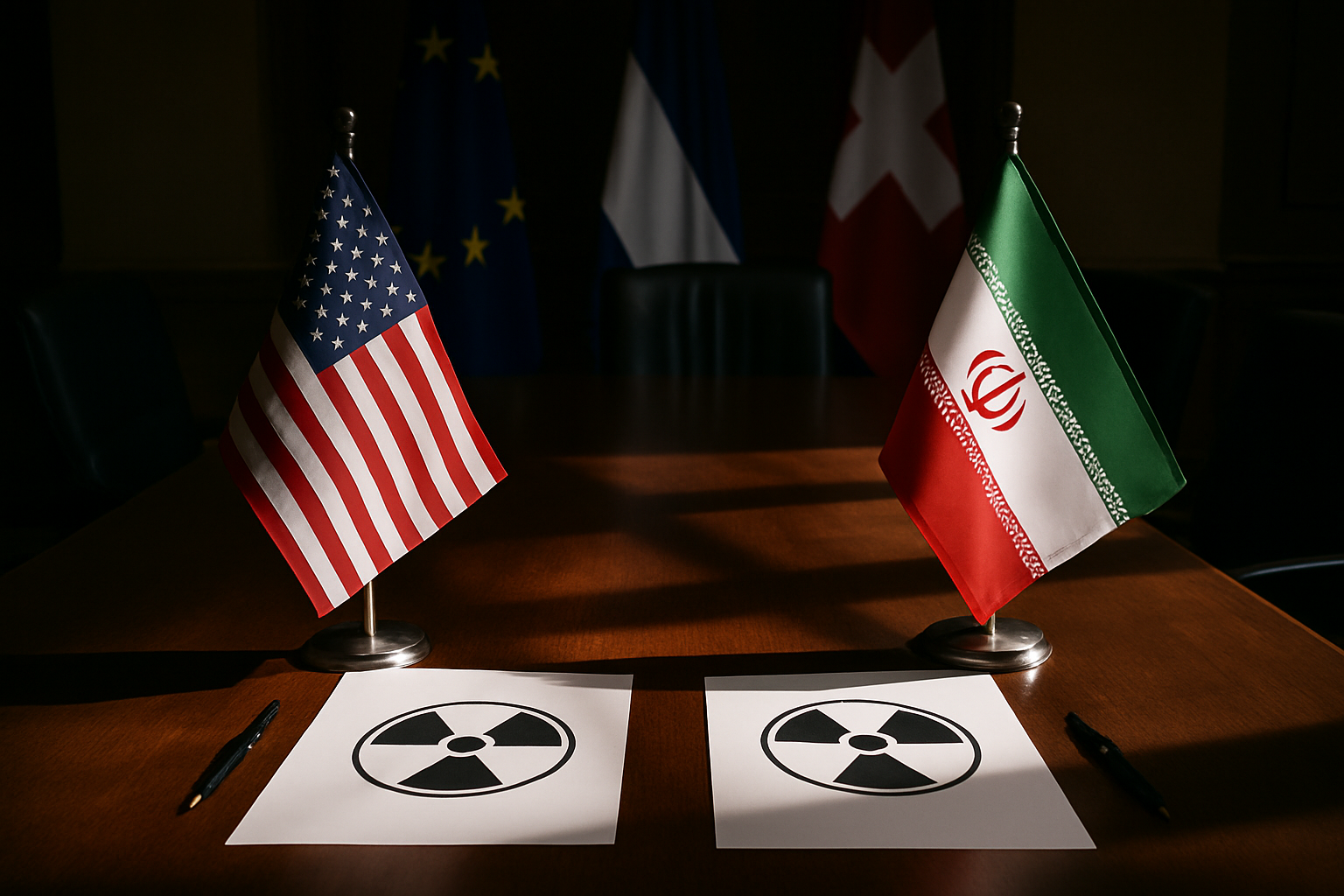
Rising tensions between the United States and Iran over nuclear negotiations reached a critical juncture on February 27, 2026, as President Donald Trump expressed dissatisfaction with Tehran's approach to talks, while multiple nations issued urgent travel advisories for the Middle East region.
Following the conclusion of the third round of Geneva nuclear talks, Trump told reporters that he was "not happy" with how Iran had negotiated, though he emphasized that he had not yet made a "final decision" on whether the United States would pursue military action against the Islamic Republic.
Diplomatic Breakdown Despite Framework Progress
The latest round of talks in Geneva, mediated by Oman and Switzerland, had initially shown promise with Iranian Foreign Minister Abbas Araghchi declaring a nuclear deal "within reach" - the most optimistic assessment from Tehran in years. Previous rounds had achieved what Araghchi described as "broad agreement on guiding principles," representing the most significant diplomatic progress since the collapse of the Joint Comprehensive Plan of Action (JCPOA) in 2018.
However, fundamental disagreements persist over the scope of negotiations. Iran maintains that ballistic missiles and regional proxy activities are "red lines" that must be excluded from nuclear-only talks. In contrast, US Secretary of State Marco Rubio insists that any comprehensive agreement must address Iran's missile program, support for armed groups, and human rights violations.
"We cannot accept a nuclear-only framework that ignores the broader threat matrix Iran poses to regional security."
— Marco Rubio, US Secretary of State
International Travel Warnings Escalate
As diplomatic tensions mounted, multiple countries issued unprecedented travel advisories for the Middle East region. The United Kingdom, France, Germany, and Poland all warned their citizens against travel to Israel, while several nations advised their nationals to leave Iran immediately.
The US State Department authorized the departure of non-essential embassy personnel and family members from Israel, with Ambassador Mike Huckabee advising staff who wished to leave to "do so today" in an internal communication. Cyprus's Foreign Ministry similarly advised citizens to avoid all travel to Iran and Gaza, and to avoid non-essential travel to Israel and the West Bank.
Turkey's national airline and two Iranian carriers cancelled flights from Istanbul to Tehran on Friday evening, reflecting the deteriorating security situation. Airlines across the region have begun reassessing their Middle East routes as tensions escalate.
Nuclear Status at Critical Threshold
At the heart of the crisis lies Iran's uranium enrichment program, which has reached 60% purity - significantly above the 3.67% limit established in the original JCPOA and approaching the 90% weapons-grade threshold. Former International Atomic Energy Agency (IAEA) inspector Dr. Yusri Abu Shadi confirmed that Iran possesses over 400 kilograms of enriched uranium, making weapons development "easily achievable."
The IAEA has been unable to verify whether Iran has suspended all uranium enrichment activities after being denied access to nuclear facilities. In a confidential report circulated to member states, the watchdog expressed particular concern about "regular vehicular activity" observed outside Iran's Isfahan nuclear storage facility, relying on commercial satellite imagery due to suspended inspections.
Unprecedented Military Buildup
The diplomatic crisis unfolds against the backdrop of the largest US military presence in the Middle East since the 2003 Iraq invasion. Trump has deployed a dual-carrier strike force, with the USS Gerald R. Ford joining the USS Abraham Lincoln in the Arabian Sea, positioning approximately one-third of the active US Navy fleet just 800 kilometers from Iran's coast.
Military incidents have escalated alongside diplomatic efforts. An F-35C fighter jet from the USS Abraham Lincoln shot down an Iranian Shahed-139 drone, while Islamic Revolutionary Guard Corps vessels have harassed US tankers in the strategically vital Strait of Hormuz, through which 40% of global oil transit passes.
Regional Coalition Supports Diplomacy
Despite the mounting tensions, an unprecedented Middle Eastern coalition continues to back the diplomatic process. Saudi Arabia, the United Arab Emirates, Qatar, and Egypt have all expressed support for negotiations - representing extraordinary regional consensus for preventing military confrontation.
Oman has leveraged its historical role as a neutral mediator, drawing on its successful facilitation of the original 2015 JCPOA negotiations. The venue evolution from Muscat to Geneva signals growing international investment in finding a diplomatic solution.
Domestic Pressures Mount
Internal pressures on both sides complicate the negotiating dynamics. Iran has conducted over 42,000 arrests since the 2022 uprising, with Nobel Peace Prize laureate Narges Mohammadi receiving an additional prison sentence even as nuclear talks proceeded. The regime appears to prioritize maintaining its nuclear capabilities over securing economic relief through sanctions removal.
Trump faces pressure from Republican hawks who view any engagement with Iran as appeasement, while simultaneously seeking a foreign policy victory that could define his administration's approach to nuclear nonproliferation.
Israeli Security Coordination
Israeli Prime Minister Benjamin Netanyahu has coordinated closely with the Trump administration, establishing red lines that any agreement must include "limiting ballistic missiles and ending Iranian axis support." Israel views nuclear-only frameworks as insufficient to address existential security threats from Iran's integrated missile and proxy network, which includes Hezbollah, Hamas, and the Houthis.
Global Nuclear Governance Crisis
The Iran nuclear crisis unfolds amid broader challenges to international arms control architecture. The New START treaty between the United States and Russia expired on February 5, marking the first time in over 50 years without bilateral nuclear constraints between the superpowers. Combined with China's nuclear expansion and multilateral arms control breakdown, the stakes for successful resolution have never been higher.
UN Secretary-General António Guterres has warned that nuclear risks are at their "highest level in decades," making the Iran negotiations a critical test of 21st-century diplomatic mechanisms for preventing nuclear proliferation.
Economic and Energy Implications
Oil prices have risen over $1 per barrel due to regional tensions, with energy analysts warning of potential supply chain disruptions if the crisis escalates. The Persian Gulf's role in global energy security - handling 40% of international oil transit - means that regional instability could have worldwide economic implications.
Iran has positioned potential economic cooperation in energy and mining sectors as incentives for US engagement, framing commercial opportunities as part of a broader strategic arrangement. However, the Trump administration maintains its "maximum pressure" campaign, threatening 25% tariffs on countries conducting business with Iran.
Verification Challenges
Any future agreement would face unprecedented technical challenges. Iran's nuclear infrastructure has significantly expanded since 2018, featuring advanced centrifuge technology, sophisticated facilities, and dispersed capabilities that would require monitoring mechanisms far exceeding the original JCPOA's complexity.
The suspension of IAEA inspections since November 2025 has created additional obstacles, with the international community lacking real-time verification of Iran's nuclear activities at this critical juncture.
Template-Setting Moment
The current crisis represents a template-setting moment for international conflict resolution in the multipolar era. Success could prevent a regional war that would destabilize energy markets, provide a diplomatic framework for nuclear crisis resolution, and strengthen global nonproliferation norms.
Failure, however, might accelerate military solutions that could reshape Middle Eastern geopolitics for decades, encourage nuclear proliferation elsewhere, and undermine diplomatic credibility for resolving territorial and security disputes worldwide.
As technical discussions are scheduled to resume in Vienna next week at IAEA headquarters, the international community watches closely to see whether innovative diplomatic solutions can bridge longstanding disagreements or whether the region moves inexorably toward military confrontation.
The stakes could not be higher: regional war prevention, global energy security, nuclear governance credibility, and the evolution of Middle East stability architecture all hang in the balance as negotiations enter what may prove to be their most decisive phase.