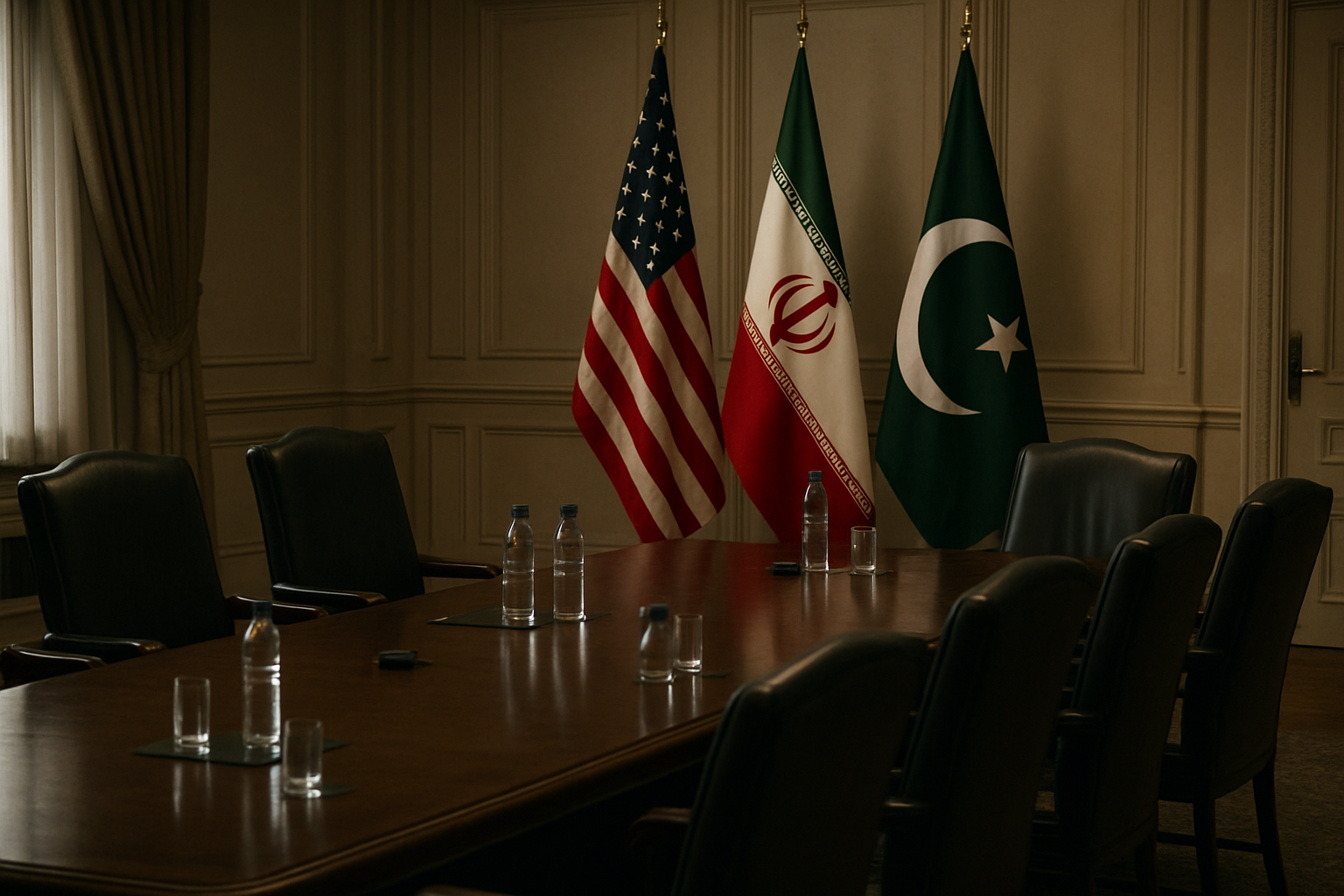
Vice President JD Vance announced Sunday that 21 hours of marathon peace negotiations between the United States and Iran in Islamabad had ended without agreement, marking a dramatic setback for the most significant diplomatic engagement between the two nations in decades.
The talks, held at Pakistan's Serena Hotel under unprecedented security measures, concluded with Vance stating that Iran had chosen not to accept American terms, including firm commitments on nuclear weapons development. The failure threatens to unravel Pakistan's historic mediation success that had achieved a fragile ceasefire just days earlier.
"The bad news is that we have not reached an agreement, and I think that's bad news for Iran much more than it's bad news for the United States of America," Vance told reporters before departing Pakistan. "We've made very clear what our red lines are."
Collapse of Historic Diplomatic Breakthrough
The failed negotiations represent a crushing blow to Pakistan's unprecedented mediation efforts, which had achieved what many considered impossible – direct face-to-face talks between the US and Iran. Prime Minister Shehbaz Sharif and Field Marshal Asim Munir had successfully brokered the "Islamabad Accord" ceasefire framework just 88 minutes before President Trump's "whole civilization will die tonight" deadline on April 8.
That breakthrough had triggered immediate global relief, with oil prices crashing 20% from $119.50 Brent crude to below $100, ending the most dangerous international crisis since the Cold War. Asian markets had surged, with Pakistan's KSE-100 achieving a record 8.15% rally, while aviation and shipping industries began planning recovery from massive disruptions.
Iran's comprehensive 10-point proposal had addressed Strait of Hormuz protocols, sanctions relief, regional conflicts, and security guarantees – representing the most detailed US-Iran framework since the 2015 nuclear deal. The proposal had been accepted as a "workable basis for negotiations" by the Trump administration, raising hopes for a lasting resolution.
Key Sticking Points and Iranian Response
According to multiple sources, the primary obstacle remained Iran's nuclear program. Vance emphasized that Washington required "an affirmative commitment that they will not seek a nuclear weapon, and they will not seek the tools that would enable them to quickly achieve a nuclear weapon."
Iranian Foreign Ministry Spokesperson Esmail Baghaei acknowledged that progress had been made on some issues but confirmed that "two or three important topics" remained unresolved. He indicated that new issues, including control of the Strait of Hormuz, had been added to the discussions during the talks.
"We achieved understanding on some issues, but a gap remained on two or three important issues," Baghaei stated, adding that diplomacy would continue through further contacts involving Iran, Pakistan, and regional partners.
"If we face representatives of 'Israel First,' there will be no deal; we will inevitably continue our defense even more vigorously than before."
— Mohammad-Reza Aref, Iran's First Vice President
Lebanon Crisis Complicates Framework
A critical complication emerged from Israel's exclusion of Lebanon from the ceasefire framework. Prime Minister Netanyahu had explicitly stated that Lebanon was not covered by the "Islamabad Accord," creating what observers termed a "critical loophole." Israeli strikes killed 254+ people in Lebanon in a single day during the talks – the deadliest bombardment since the conflict began.
Iran had consistently demanded comprehensive ceasefire enforcement across all fronts, threatening withdrawal unless Israeli operations against Hezbollah ceased. The humanitarian crisis in Lebanon, with 1.2 million displaced (25% of the population), had become a major point of Iranian grievance during negotiations.
Vance acknowledged Iran's "legitimate misunderstanding" regarding Lebanon's inclusion but maintained that the US had never agreed to include Israeli-Hezbollah operations in the ceasefire framework.
Economic and Energy Implications
The failure threatens to reverse significant economic relief that had begun following the initial ceasefire. Iran's cryptocurrency payment system requiring $1 per barrel for oil tankers passing through the Strait of Hormuz had allowed limited resumption of shipping, but vessel owners remained reluctant to send tankers, fearing they could become stranded if the ceasefire collapsed.
The Strait of Hormuz, through which 40% of global oil transit passes, remains vulnerable to renewed closure. Iran's Revolutionary Guard had previously deployed an estimated 2,000-6,000 naval mines, effectively paralyzing the crucial waterway during the height of the crisis.
Consumer relief efforts in Bangladesh, which had been reviewing fuel rationing for 170 million people, and Pakistan, which was considering reversing wartime austerity measures, now face uncertainty. European households that had anticipated reductions in energy costs may see those hopes dashed.
Regional Coalition Strain
The unprecedented Saudi/UAE/Qatar/Egypt coalition that had supported the diplomatic process weathered significant strain during the crisis. Iranian attacks under "Operation True Promise 4" had resulted in casualties across Gulf states – one killed in the UAE, 32 injured in Kuwait, and eight wounded in Qatar. Despite this pressure, the regional coalition maintained support for Pakistan's mediation efforts throughout.
Egyptian President Abdel Fattah el-Sisi's warnings of "comprehensive chaos" were narrowly avoided through the initial ceasefire, but the current impasse raises fresh concerns about regional stability.
Nuclear Diplomacy Window
The crisis had emerged from the complete collapse of Geneva nuclear talks despite achieving "broad agreement on guiding principles" – the most progress since the 2018 JCPOA breakdown. Iran continues to maintain 60% uranium enrichment with over 400kg of weapons-grade material, sufficient for multiple nuclear weapons if weaponized.
The diplomatic failure occurs against the backdrop of the New START treaty's expiration in February 2026, marking the first time in over 50 years that no US-Russian nuclear constraints are in place. This context adds urgency to resolving the Iranian nuclear issue and establishing precedents for 21st-century nuclear governance.
Pakistan's Mediation Efforts Continue
Despite the setback, Pakistan's Deputy Prime Minister and Foreign Minister Ishaq Dar urged both the United States and Iran to maintain their commitment to the ceasefire. "It is imperative that the parties continue to uphold their commitment to the ceasefire," Dar stated in a press conference following the talks' conclusion.
Dar expressed Pakistan's readiness to continue facilitating dialogue between the two nations, hoping that both sides would "continue with the positive spirit to achieve durable peace and prosperity for the entire region and beyond."
The innovative "message relay system" developed by Pakistan had proven crucial in maintaining communication between the adversaries when direct contact was impossible, representing a template for middle-power diplomacy in resolving major international crises.
International Response and Stakes
UN Secretary-General António Guterres had characterized the talks as the "greatest test of multilateral cooperation in the modern era." The failure represents a significant blow to diplomatic solutions in an increasingly volatile international environment.
China had provided "full support" for Pakistan's mediation initiative, while Germany had noted "positive signs" for the direct talks. The international community had invested considerable diplomatic capital in the process, viewing it as a potential template for 21st-century conflict resolution.
The stakes extend far beyond bilateral US-Iran relations, affecting global approaches to territorial sovereignty, energy security paradigms, and nuclear governance mechanisms. The success or failure of such diplomatic initiatives sets precedents that could influence international crisis management for decades.
Uncertain Path Forward
With Vance's departure from Pakistan, the immediate diplomatic window appears closed, though both sides indicated willingness to continue dialogue through Pakistan's mediation. Iran's commitment to maintaining the ceasefire remains uncertain, particularly given the ongoing Lebanon crisis and unresolved nuclear issues.
The failure to convert Pakistan's temporary diplomatic success into a lasting framework raises questions about whether military confrontation will return to the region. The talks had represented the most direct US-Iran engagement since the 1979 Islamic Revolution, making their collapse particularly significant for future diplomatic efforts.
As President Trump had warned of renewed military action if negotiations failed, the region now faces the possibility of returning to the dangerous escalation that had threatened global energy security and regional stability. The two-week window created by Pakistan's mediation had offered hope for lasting peace, but fundamental disagreements between Washington and Tehran proved insurmountable during this historic opportunity.