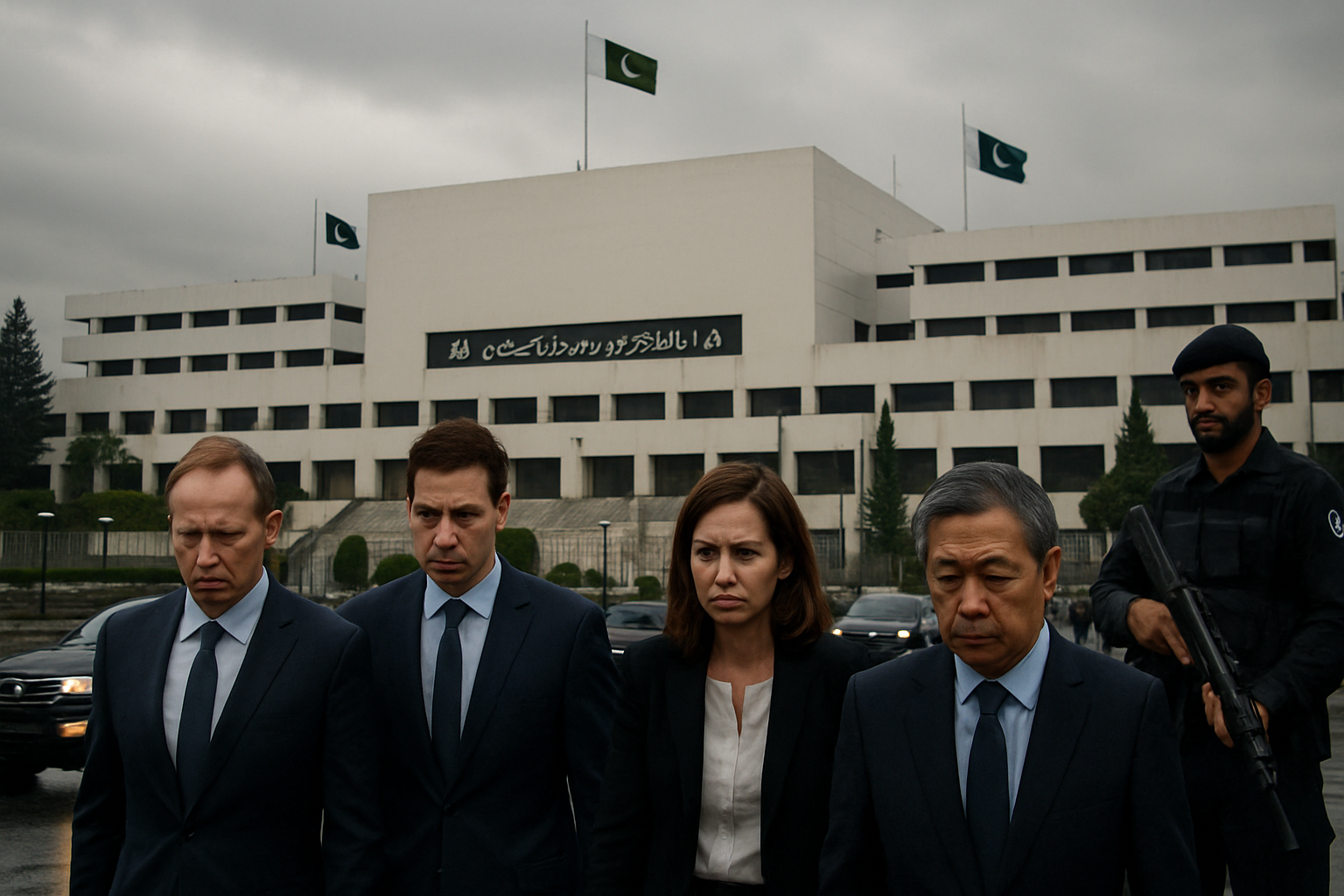
Vice President JD Vance announced Sunday that the United States had failed to reach an agreement with Iran after 21 hours of marathon negotiations in Islamabad, Pakistan, marking the collapse of the most direct diplomatic engagement between the two adversaries since the 1979 Islamic Revolution.
Speaking at a press conference in Pakistan's capital, Vance expressed disappointment at the outcome of talks that had been hailed as historic when they commenced Saturday afternoon. "We have been at it now for 21 hours, and we've had a number of substantive discussions with the Iranians. That's the good news," the Vice President told reporters. "The bad news is that we have not reached an agreement, and I think that's bad news for Iran, much more than that, it's bad news for the United States of America."
Pakistan's Unprecedented Mediation Efforts
The talks represented the culmination of Pakistan's extraordinary diplomatic achievement in mediating the "Islamabad Accord" ceasefire framework, which had ended the most dangerous international crisis since the Cold War just days earlier. Prime Minister Shehbaz Sharif and Field Marshal Asim Munir had successfully brokered a breakthrough ceasefire just 88 minutes before President Trump's "whole civilization will die tonight" deadline on April 8.
That initial success had triggered a dramatic 20% crash in oil prices from $119.50 Brent to below $100, ending the global energy crisis and allowing for the resumption of aviation routes after 18,000+ flights had been cancelled worldwide.
Pakistani officials had facilitated the talks through an innovative "message relay system," maintaining round-the-clock contact between US and Iranian officials when direct communication proved impossible. The venue for the formal negotiations was the luxury Serena Hotel in Islamabad's Red Zone, secured with over 10,000 security personnel and the declaration of two local holidays.
High-Stakes Delegations and Framework Discussions
The US delegation was led by Vice President Vance, accompanied by Special Envoy Steve Witkoff and potentially Jared Kushner, representing the highest-level American engagement with Iran in decades. Iran's delegation was headed by Parliament Speaker Mohammad Bagher Qalibaf and Foreign Minister Abbas Araghchi, with President Pezeshkian's participation confirmed after a "warm and cordial" call with PM Sharif.
The talks centered around Iran's comprehensive 10-point proposal addressing Strait of Hormuz protocols, sanctions relief, regional conflicts, and security guarantees—the most detailed US-Iran framework since the 2015 nuclear deal. However, fundamental disagreements persisted over Iran's ballistic missile program and regional proxy relationships, which Tehran maintained as "red lines" against US demands for comprehensive disarmament.
"We could not come to a place where the Iranians wanted to accept our conditions."
— Vice President JD Vance
Critical Lebanon Loophole Threatens Agreement
A major complicating factor emerged from Netanyahu's explicit exclusion of Lebanon from the ceasefire framework, creating what analysts called a "critical loophole." Israeli strikes on Lebanon had killed 254+ people in a single day during the negotiations—the deadliest bombardment since March—leading to the displacement of 1.2 million Lebanese civilians, representing 25% of the population.
Iran had threatened withdrawal from the talks unless comprehensive ceasefire enforcement covered all fronts, including Lebanon. VP Vance acknowledged Iran's "legitimate misunderstanding" about Lebanon's inclusion but clarified that the US had never agreed to include Israeli-Hezbollah operations in the ceasefire framework.
Global Economic and Energy Implications
The failure of the talks threatens to reverse the economic relief that had begun following the initial ceasefire. Oil markets had stabilized after Iran agreed to reopen the Strait of Hormuz—through which 40% of global oil transit flows—using an innovative cryptocurrency payment system requiring $1 per barrel for oil tankers to circumvent sanctions.
The International Energy Agency had begun reducing its record 400 million barrel strategic reserves release, the largest in 50-year history, as supply concerns eased. Asian markets had experienced explosive rallies, with Pakistan's KSE-100 achieving a record 8.15% surge. Consumer relief was anticipated globally, with Bangladesh reviewing fuel rationing for 170 million people and Pakistan considering reversing wartime austerity measures.
Nuclear Diplomacy Context and Stakes
The negotiations took place against the backdrop of a collapsed nuclear diplomacy framework. The current crisis had emerged from the complete breakdown of Geneva talks despite achieving "broad agreement on guiding principles"—the most progress since the 2018 JCPOA collapse. Iran continues 60% uranium enrichment with 400kg+ of weapons-grade material, while maintaining its nuclear program as leverage.
The urgency of diplomatic resolution was heightened by the expiration of the New START treaty in February 2026, marking the first time in 50+ years without US-Russia nuclear constraints, creating broader nuclear governance concerns globally.
Regional Coalition Under Strain
Despite the diplomatic setback, the regional coalition of Saudi Arabia, UAE, Qatar, and Egypt has been preserved throughout the crisis, even after Iranian attacks during "Operation True Promise 4" resulted in casualties across member territories—1 killed in UAE, 32 injured in Kuwait, and 8 wounded in Qatar. Egyptian President Sisi's warnings about "comprehensive chaos" appear to have been heeded, with the coalition maintaining support for diplomatic solutions.
International support for Pakistan's mediation efforts remained strong, with Chinese Foreign Minister Wang Yi expressing "full support" for the initiative and Germany noting "positive signs" for continued diplomatic momentum.
Template for 21st Century Diplomacy
UN Secretary-General António Guterres had described the talks as "the greatest test of multilateral cooperation in the modern era." Pakistan's emergence as a crucial mediator demonstrated the potential for middle power diplomacy to bridge major adversaries when traditional great power mechanisms fail.
The innovative "message relay system" developed by Pakistani officials provided a template for diplomatic solutions during maximum-stakes crises affecting energy security, nuclear governance, and international law enforcement simultaneously.
Immediate Aftermath and Future Prospects
The collapse leaves the two-week critical window for lasting peace framework in jeopardy. The failure threatens to return the region to the most dangerous crisis since the Cold War's end, with implications extending decades beyond current events and affecting global approaches to territorial sovereignty, energy paradigms, and conflict resolution.
Vice President Vance indicated the US delegation would leave Islamabad after presenting what he termed a "final and best offer" to Iranian negotiators. The main sticking point remained Iran's nuclear program, with Iranian media claiming Washington's "excessive demands" had collapsed the negotiations, while the US maintained that Iran had refused to accept American terms regarding nuclear weapons development.
Despite the immediate failure, the talks represented an unprecedented diplomatic achievement in bringing the world's most bitter adversaries to the negotiating table. Pakistan's mediation success in preventing broader regional war demonstrated that diplomatic innovation remains possible even in the darkest hours of international crisis.
The coming days will determine whether this represents merely a temporary setback in ongoing diplomatic efforts or a return to the dangerous military escalation that had threatened global energy security and regional stability. The stakes remain maximum, affecting not just US-Iran relations but the broader framework for international conflict resolution in an increasingly volatile world.