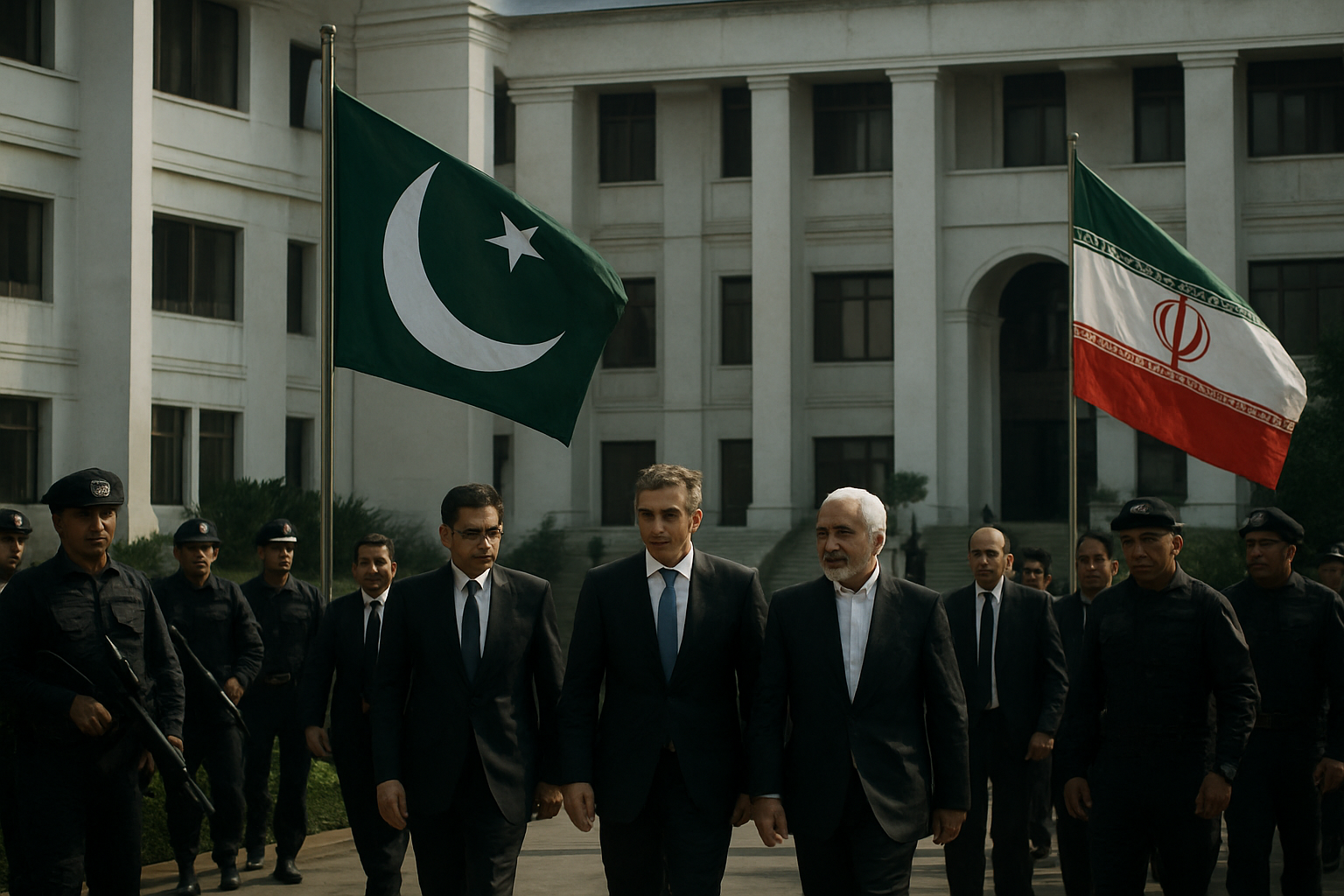
Historic peace negotiations between the United States and Iran officially commenced in Islamabad, Pakistan on Saturday, as Vice President JD Vance led the highest-level American delegation for the most direct diplomatic engagement with Tehran in decades, following Pakistan's unprecedented mediation success in averting what could have been a catastrophic regional war.
The talks represent a dramatic diplomatic breakthrough after Pakistan's Prime Minister Shehbaz Sharif and Field Marshal Asim Munir successfully mediated a ceasefire just 88 minutes before President Trump's "whole civilization will die tonight" deadline on April 8, 2026. The intervention prevented what officials described as the most dangerous international crisis since the Cold War.
Pakistan's Historic Mediation Success
Pakistan's role as mediator has been nothing short of extraordinary. Through what officials described as a sophisticated "message relay system," PM Sharif and Field Marshal Munir maintained round-the-clock contact with VP Vance and Iranian Foreign Minister Abbas Araghchi when direct US-Iran communication proved impossible.
Deputy Prime Minister and Foreign Minister Ishaq Dar officially confirmed Pakistan's mediation role for the first time in March, stating: "US-Iran indirect talks taking place through messages relayed by Pakistan. United States shared 15 points, being deliberated by Iran."
"This represents the most significant middle power diplomatic breakthrough in preventing regional warfare in decades"
— UN Secretary-General António Guterres
The "Islamabad Accord" framework that emerged from Pakistan's mediation represents the most comprehensive US-Iran diplomatic framework since the 2015 nuclear deal. Iran's 10-point proposal, accepted as a "workable basis for negotiations" by the Trump administration, addresses crucial issues including Strait of Hormuz protocols, sanctions relief, regional conflicts, and security guarantees.
Delegations and Key Players
The US delegation arriving in Islamabad includes Vice President JD Vance, Trump's special envoy Steve Witkoff, and potentially Jared Kushner. This represents the most senior American engagement with Iran since 2015. On the Iranian side, President Masoud Pezeshkian confirmed his participation following what officials described as a "warm and cordial" 45-minute call with PM Sharif.
The Pakistani delegation is led by Prime Minister Shehbaz Sharif, Deputy Prime Minister Ishaq Dar, and Chief of Army Staff Field Marshal Asim Munir, who have emerged as crucial bridge-builders between the adversaries.
Iranian Parliament Speaker Mohammad Bagher Qalibaf and Foreign Minister Abbas Araghchi are leading Tehran's negotiating team, though Iran has set strict preconditions for the talks to proceed.
Critical Challenges and Lebanon Loophole
Despite the diplomatic breakthrough, significant challenges remain. A critical loophole has emerged regarding Lebanon, where Israeli Prime Minister Netanyahu explicitly excluded the country from the ceasefire framework. This has created what VP Vance acknowledged as a "legitimate misunderstanding" by Iran, which had expected comprehensive coverage of all regional fronts.
The Lebanon exclusion has proved dangerous, with Israeli strikes killing 254+ people in a single day this week - the deadliest bombardment since the conflict began. Over 1.2 million Lebanese are now displaced (25% of the population), and systematic targeting of medical personnel has resulted in 26 paramedics killed and 51 wounded since March.
Iran has threatened to withdraw from the Islamabad talks unless comprehensive ceasefire enforcement covers all fronts, including Lebanon. This represents one of the most serious threats to the fragile diplomatic progress.
Economic and Energy Impact
The ceasefire's immediate impact on global markets was dramatic. Oil prices crashed nearly 20% from their crisis peak of $119.50 per barrel for Brent crude to below $100 - the steepest decline in six years. The reopening of the Strait of Hormuz, which handles 40% of global oil transit, provided immediate relief to energy markets worldwide.
Asian markets responded with explosive rallies, with Pakistan's KSE-100 achieving a record 8.15% surge. The International Energy Agency began reducing its record 400 million barrel strategic reserve release - the largest in 50-year history - as supply concerns eased.
Aviation recovery has begun after 18,000+ flights were cancelled during the crisis, with Dubai International Airport preparing to reopen after being shut due to missile damage. Consumer relief is anticipated globally, with Bangladesh reviewing fuel rationing for 170 million people and Pakistan considering reversing wartime austerity measures.
Nuclear Diplomacy Window
The crisis emerged from the complete collapse of Geneva nuclear talks despite what had been described as "broad agreement on guiding principles" - the most progress since the 2018 JCPOA breakdown. Iran continues 60% uranium enrichment with 400kg+ of weapons-grade material stockpiled, but the ceasefire creates a crucial diplomatic window to address nuclear concerns.
The timing is critical given that the New START treaty expired in February 2026, marking the first time in 50+ years without US-Russia nuclear constraints. UN Secretary-General Guterres has called nuclear risks "the highest in decades."
Regional Coalition Dynamics
Despite severe strain during the crisis, the regional coalition of Saudi Arabia, UAE, Qatar, and Egypt has been preserved. Iranian attacks during "Operation True Promise 4" killed 1 person in the UAE, injured 32 in Kuwait, and wounded 8 in Qatar. However, Egyptian President Sisi's warnings of "comprehensive chaos" were heeded, and the coalition has maintained support for diplomatic solutions.
China has provided "full support" for Pakistan's mediation initiative, while Germany noted "positive signs" for the direct talks. This international backing strengthens the framework for sustainable negotiations.
Stakes and Historical Significance
The talks carry immense stakes extending far beyond the immediate US-Iran relationship. Success could establish a template for 21st-century conflict resolution, demonstrating how middle powers can effectively bridge major adversary divides when traditional mechanisms fail. Failure could return the region to the most dangerous crisis since the Cold War's end.
The two-week window created by the ceasefire is seen as decisive. Success in converting this temporary pause into a lasting framework could reshape approaches to territorial sovereignty, energy security paradigms, and conflict resolution for decades.
Template for Future Diplomacy
Pakistan's emergence as a crucial mediator demonstrates innovative diplomatic solutions are possible even in the "darkest hours" of international crisis. The "message relay system" that facilitated indirect talks when direct communication proved impossible provides a template for future crisis management in an increasingly volatile and interconnected world.
"Pakistan's mediation represents a watershed moment for multilateral cooperation, showing that diplomatic innovation can triumph over military escalation even when the stakes are at their maximum"
— European diplomatic source
The success of the "Islamabad Accord" demonstrates the preference of both financial markets and the international community for diplomatic credibility over military confrontation. This precedent could influence how future territorial and nuclear disputes are approached globally.
Critical Days Ahead
As the talks proceed, fundamental disagreements persist. Iran maintains that its ballistic missiles and regional proxies represent "red lines" that cannot be compromised, while the US demands comprehensive agreements covering missiles, armed groups, and human rights issues - the same structural obstacles that prevented breakthroughs since the 2018 JCPOA collapse.
The coming days will determine whether innovative diplomatic solutions can bridge decades-old US-Iran disagreements or whether the fundamental positions remain unbridgeable. The stakes affect not only regional stability but also global energy architecture, nuclear governance credibility, and international law enforcement mechanisms.
This historic moment in Islamabad represents more than bilateral negotiations - it's a test of whether multilateral cooperation and diplomatic innovation can prevent catastrophic conflict in an increasingly multipolar world. The eyes of the international community remain fixed on Pakistan's capital, where the future of Middle Eastern stability and global crisis management precedents hang in the balance.