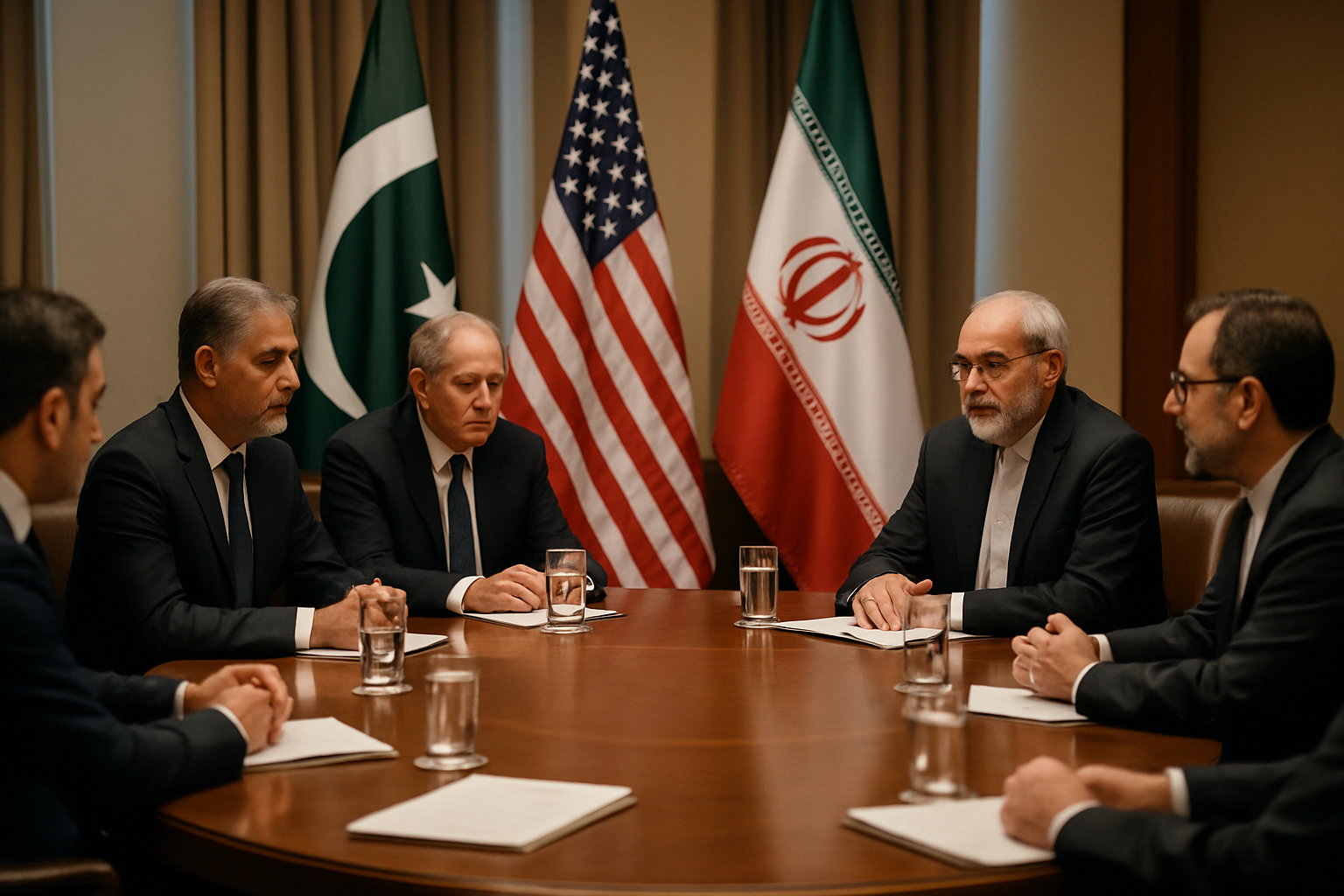
High-stakes diplomatic negotiations between the United States and Iran are scheduled to begin Friday in Pakistan's capital, Islamabad, following a historic ceasefire agreement mediated by Pakistani Prime Minister Shehbaz Sharif and Field Marshal Asim Munir. The talks represent the most direct US-Iran engagement in decades.
The breakthrough came just 88 minutes before President Trump's deadline, with Pakistan serving as the crucial intermediary through what officials describe as a sophisticated "message relay system." The agreement, dubbed the "Islamabad Accord," created a two-week ceasefire window that has already seen dramatic global market responses.
Dramatic Last-Minute Breakthrough
According to sources from multiple countries, the ceasefire was secured through round-the-clock diplomatic efforts by Pakistan's leadership, maintaining constant contact with US Vice President JD Vance and Iranian Foreign Minister Abbas Araghchi. The urgency was palpable, with Trump having issued an ultimatum stating "whole civilization will die tonight" if no agreement was reached.
Iran's 10-point proposal was ultimately accepted by the Trump administration as a "workable basis for negotiations," marking a dramatic reversal from earlier apocalyptic threats. The agreement includes Iran's commitment to reopen the Strait of Hormuz for "safe passage" coordinated with Iranian forces during the ceasefire period.
"Pakistan has successfully facilitated indirect talks between the US and Iran through messages being relayed by Pakistan. The United States has shared 15 points, being deliberated upon by Iran."
— Ishaq Dar, Pakistani Foreign Minister
Global Crisis Resolution
The immediate impact of the ceasefire has been profound. Oil prices crashed nearly 20% from their peak of $119.50 per barrel to below $100, marking the steepest decline in six years. The Strait of Hormuz, which had been effectively closed by Iranian naval mines affecting 40% of global oil transit, began showing signs of reopening.
Aviation markets experienced immediate relief, with over 18,000 cancelled flights worldwide beginning to resume operations. Dubai International Airport, which had been shut down due to missile damage, started preparing for reopening. The International Energy Agency announced it would reduce its record 400 million barrel strategic petroleum reserve release—the largest intervention in 50 years.
High-Level Delegations Convene
The US delegation arriving in Islamabad is expected to include Vice President JD Vance, Special Envoy to the Middle East Steve Witkoff, and potentially Jared Kushner, former senior advisor to President Trump. This represents the most senior American diplomatic engagement with Iran since the 2015 nuclear agreement.
Iranian President Masoud Pezeshkian confirmed his participation following what Pakistani officials described as a "warm and cordial" 45-minute telephone call with Prime Minister Sharif. The Iranian delegation will include Foreign Minister Abbas Araghchi, Parliament Speaker Mohammad-Bagher Ghalibaf, and other senior security officials.

Pakistan's Diplomatic Triumph
Pakistan's emergence as a crucial mediator represents a significant diplomatic achievement for the country. Unlike previous intermediaries who came under criticism from Iran during the conflict, Pakistan maintains close ties with both Washington and Tehran, positioning it uniquely to bridge the divide.
The venue for the crucial talks has been revealed as the Serena Hotel in Islamabad, located within the capital's heavily fortified Red Zone. Pakistani authorities have declared two local holidays and deployed over 10,000 security personnel to ensure the safety of all delegations.
China has expressed "full support" for Pakistan's mediation initiative, with Foreign Minister Wang Yi calling the talks "conducive to restoring normal navigation" in the Strait of Hormuz. Germany has also noted "positive signs" for the direct engagement.
Comprehensive Framework Ahead
Iran's 10-point proposal, now accepted as the foundation for negotiations, addresses multiple critical areas including Hormuz protocols, sanctions relief, regional conflicts, and security guarantees. This represents the most comprehensive US-Iran framework since the 2015 nuclear agreement, extending beyond nuclear issues to broader regional arrangements.
However, significant challenges remain. Iran maintains that its ballistic missiles and regional proxies are "red lines" excluded from nuclear-only discussions, while the US continues to demand comprehensive agreements addressing missiles, armed groups, and human rights issues—the same fundamental disagreement that led to the collapse of previous negotiations.
Regional Coalition Dynamics
The talks take place against the backdrop of a strained but preserved regional coalition. Saudi Arabia, UAE, Qatar, and Egypt maintained their diplomatic consensus despite Iranian attacks that killed one civilian in Abu Dhabi, injured 32 in Kuwait, and wounded eight in Qatar during the recent conflict.
Egyptian President Abdel Fattah el-Sisi's warnings about "comprehensive chaos" spreading throughout the region appear to have been heeded, with the coalition supporting the Pakistani-mediated diplomatic process throughout the crisis.
Nuclear Diplomacy Window
The current diplomatic opening comes after the complete breakdown of Geneva nuclear talks, despite achieving what was described as "broad agreement on guiding principles"—the most progress since the 2018 JCPOA collapse. The crisis coincides with the February 2026 expiration of the New START treaty, leaving the world without US-Russia nuclear constraints for the first time in over 50 years.
Iran continues uranium enrichment at 60% purity—approaching weapons-grade levels—with over 400 kilograms stockpiled, sufficient for multiple weapons if weaponized. The ceasefire creates a critical opportunity to address these nuclear concerns within a broader diplomatic framework.
Economic Relief Begins
Global markets have responded positively to the diplomatic breakthrough. Asian stock markets experienced explosive rallies, led by Pakistan's KSE-100 index recording a record 8.15% surge. Airlines are planning to resume Middle East routes, and shipping companies are mobilizing over 150 stranded tankers worth billions in cargo.
Consumer relief is anticipated globally, with Bangladesh reviewing fuel rationing for 170 million people and Pakistan considering reversing wartime austerity measures. European households are expected to see energy cost reductions as Qatar resumes LNG production, representing 20% of global exports.
Template for 21st-Century Diplomacy
UN Secretary-General António Guterres described the crisis as the "greatest test of multilateral cooperation in the modern era." Pakistan's successful mediation demonstrates how middle powers can effectively bridge major adversary divides when traditional mechanisms fail, potentially providing a template for future crisis management.
The success of the "message relay system" shows that diplomatic innovation remains possible even in the darkest hours, affecting energy security, nuclear governance, and international law enforcement simultaneously.
"This represents a watershed moment in 21st-century conflict resolution, determining whether diplomatic credibility strengthens over military escalation preference."
— European diplomatic source
Critical Two-Week Window
The talks in Islamabad represent a critical juncture. Success in converting this temporary ceasefire pause into a lasting framework could reshape post-Cold War international order sustainability. Failure could return the region to the most dangerous crisis since the Cold War's end, with global implications for energy security, nuclear governance credibility, and international stability mechanisms.
The stakes extend far beyond bilateral US-Iran relations, affecting territorial sovereignty enforcement, energy security paradigms, and conflict resolution approaches that could influence international relations for decades to come.
As world leaders and global markets watch closely, the coming days in Islamabad will determine whether innovative diplomacy can triumph over military confrontation in an increasingly volatile and interconnected world.