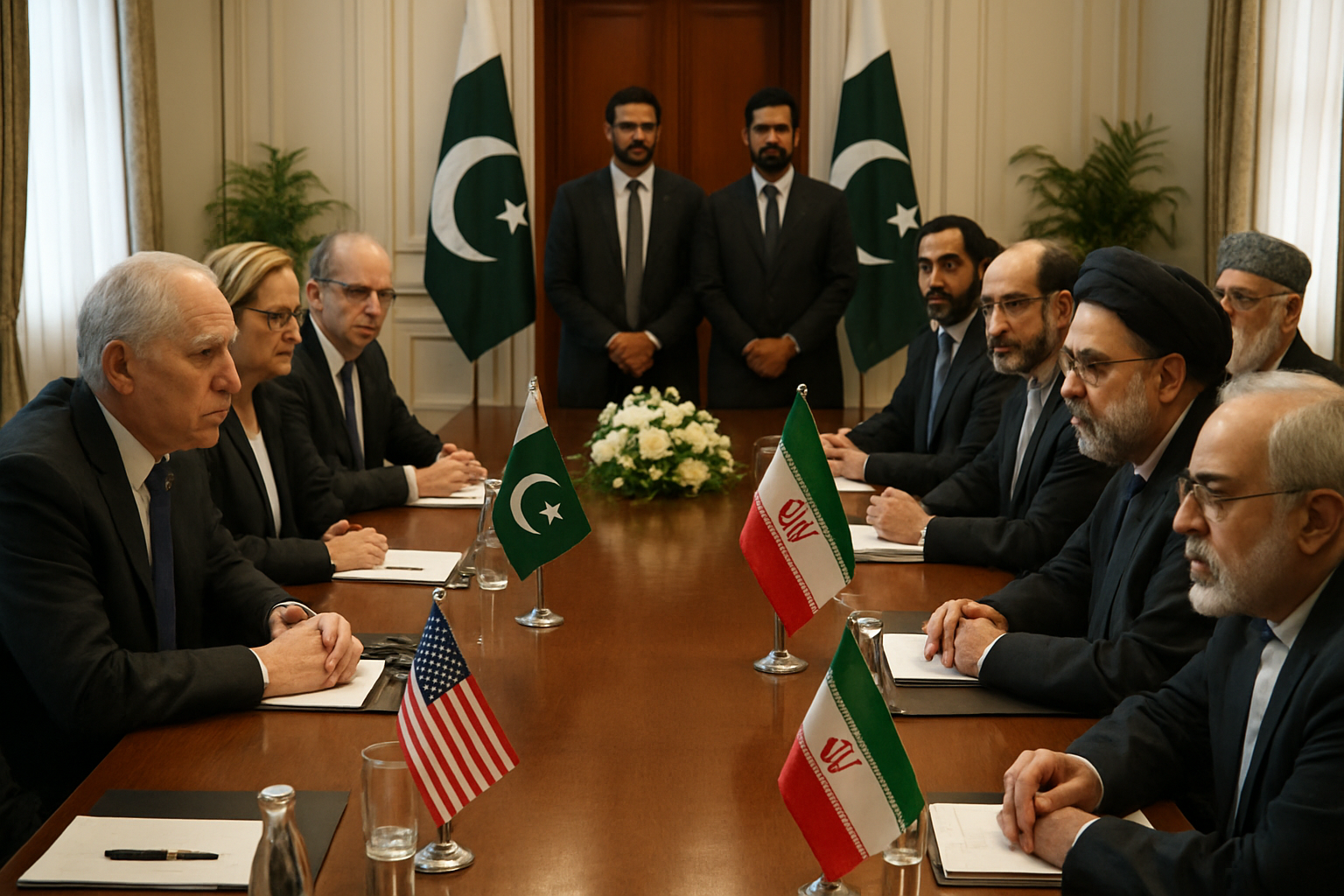
In a dramatic diplomatic development, President Donald Trump has dispatched his special envoys Steve Witkoff and Jared Kushner to Pakistan for renewed peace negotiations with Iran, marking the latest chapter in Pakistan's unprecedented role as mediator between the world's most bitter adversaries.
White House press secretary Karoline Leavitt announced Friday that the delegation would travel to Islamabad on Saturday morning to meet with Iranian officials, describing "some progress" from Tehran in recent days. The announcement comes as Iranian Foreign Minister Abbas Araghchi arrived in Pakistan's capital to participate in what sources describe as the second phase of peace talks.
Pakistan's Historic Mediation Role
Pakistan has emerged as the crucial intermediary in what observers are calling the most significant diplomatic engagement between the United States and Iran since the 1979 Islamic Revolution. Prime Minister Shehbaz Sharif and Field Marshal Asim Munir previously achieved a historic breakthrough through their innovative "message relay system," successfully mediating a ceasefire in April that prevented global catastrophe.
The "Islamabad Accord" framework, as it has become known, represents a template-setting example of middle power diplomacy. The Pakistani mediators maintained round-the-clock contact between Vice President JD Vance and Iranian officials when direct communication proved impossible, demonstrating how smaller nations can bridge major adversaries when traditional mechanisms fail.
"Steve and Jared will be heading to Pakistan tomorrow to hear the Iranians out. We hope progress will be made and we hope that positive developments will come from this meeting."
— Karoline Leavitt, White House Press Secretary
Complex Diplomatic Landscape
The renewed talks face the same fundamental challenges that have prevented a US-Iran breakthrough for decades. Iran maintains that its ballistic missiles and regional proxy activities are "red lines" excluded from nuclear-focused negotiations, while the US demands a comprehensive agreement addressing missiles, armed groups, and human rights concerns.
The nuclear program remains the core sticking point, with Iran continuing to enrich uranium at 60% purity—approaching the 90% weapons-grade threshold—while maintaining a stockpile of over 400 kilograms of weapons-grade material. This represents sufficient material for multiple nuclear weapons if weaponized, according to international experts.
Adding complexity to the negotiations is the "Lebanon loophole"—Israeli Prime Minister Benjamin Netanyahu's explicit exclusion of Lebanon from any ceasefire arrangements. This created a critical gap that contributed to the collapse of previous talks, as Iranian officials have threatened withdrawal unless comprehensive enforcement applies to all fronts.
Regional and International Stakes
The talks carry enormous implications for global energy security, as Iran controls the Strait of Hormuz, through which 40% of global oil transits. During previous crises, Iranian mining operations and cryptocurrency payment requirements have severely disrupted shipping, leading to oil price volatility and supply chain disruptions affecting millions worldwide.
An unprecedented regional coalition comprising Saudi Arabia, UAE, Qatar, and Egypt has maintained support for diplomatic solutions despite Iranian attacks on their territories during recent tensions. This extraordinary Middle Eastern consensus reflects the high stakes involved in preventing broader regional war.
China has provided "full support" for Pakistan's mediation initiative, while Germany has noted "positive signs" for the diplomatic process. The international backing underscores the global community's investment in preventing military confrontation that could destabilize the entire Middle East.
Nuclear Governance Crisis
The talks occur against the backdrop of a broader nuclear governance crisis. The New START treaty between the US and Russia expired in February 2026, marking the first time in over 50 years without nuclear constraints between the superpowers. China's nuclear expansion adds further urgency to establishing successful diplomatic precedents.
Iran's advanced nuclear infrastructure, including sophisticated centrifuges and expanded facilities, would require verification mechanisms exceeding the complexity of the original 2015 nuclear deal (JCPOA). Any agreement would need unprecedented monitoring capabilities to address Iran's nuclear advancement since the JCPOA's collapse in 2018.
Potential April 27 Breakthrough
According to informed sources cited by international media, direct US-Iran talks could take place on April 27, following separate bilateral consultations between the delegations and Pakistani mediators. This timeline represents the most concrete schedule provided since the ceasefire breakthrough earlier this month.
The framework under discussion includes Iran's 10-point proposal addressing Hormuz protocols, sanctions relief, regional conflicts, and security guarantees—the most comprehensive US-Iran negotiating framework since 2015. However, fundamental disagreements persist over the scope of any potential agreement.
Iran has signaled potential flexibility on verification measures, with President Pezeshkian expressing openness to international monitoring—a significant policy shift that could enable technical solutions to verification challenges.
Domestic Pressures and Constraints
Both administrations face significant domestic pressures affecting their negotiating positions. Congressional opposition to military operations has reached historic levels, with only 25% American support for Operation Epic Fury—representing unprecedented unpopularity that has created financial market constraints forcing preference for diplomatic solutions.
Iran faces its own internal challenges, with over 42,000 arrests since 2022 and severe economic sanctions creating regime survival pressures. However, Iranian officials have prioritized maintaining nuclear capabilities over economic relief, complicating potential concessions.
Template for 21st Century Diplomacy
UN Secretary-General António Guterres has described the situation as the "greatest test of multilateral cooperation in the modern era." The success or failure of Pakistan's mediation could establish precedents for diplomatic versus military solutions in future international crises.
The innovative "message relay system" pioneered by Pakistani officials demonstrates how middle powers can facilitate dialogue when traditional diplomatic channels fail. This approach has proven effective in the most dangerous circumstances, showing that diplomatic solutions remain possible even when military confrontation seems inevitable.
Economic and Humanitarian Implications
The economic relief from previous diplomatic breakthroughs has been substantial. When Pakistan successfully mediated a ceasefire in April, oil prices crashed 20% from $119.50 to below $100 per barrel—the steepest decline in six years. Asian markets surged, with Pakistan's KSE-100 achieving a record 8.15% rally.
Consumer relief has begun in multiple countries, with Bangladesh reviewing fuel rationing affecting 170 million people and Pakistan considering reversing wartime austerity measures. European households have also benefited from reduced energy costs, while Qatar has resumed LNG production representing 20% of global exports.
However, humanitarian concerns remain acute. The conflict has resulted in over 787 civilian casualties according to Iran's Red Crescent, including controversial strikes on educational facilities that have prompted war crimes investigations.
Looking Ahead
The coming days represent a critical window for determining whether diplomatic innovation can convert temporary stability into a lasting peace framework. The stakes extend far beyond the bilateral US-Iran relationship, affecting territorial sovereignty principles, energy security paradigms, and conflict resolution approaches for decades to come.
Success would provide a template for 21st-century crisis resolution, demonstrating that multilateral cooperation can be effective in an increasingly volatile and interconnected world. Failure could accelerate military solutions, encourage nuclear proliferation elsewhere, and undermine diplomatic credibility in future territorial and security disputes worldwide.
As envoys Witkoff and Kushner prepare for their departure to Pakistan, the world watches to see whether innovative diplomacy can bridge decades-old disagreements and prevent the return of the most dangerous international crisis since the end of the Cold War. The outcome will likely reshape approaches to international conflict resolution for generations to come.