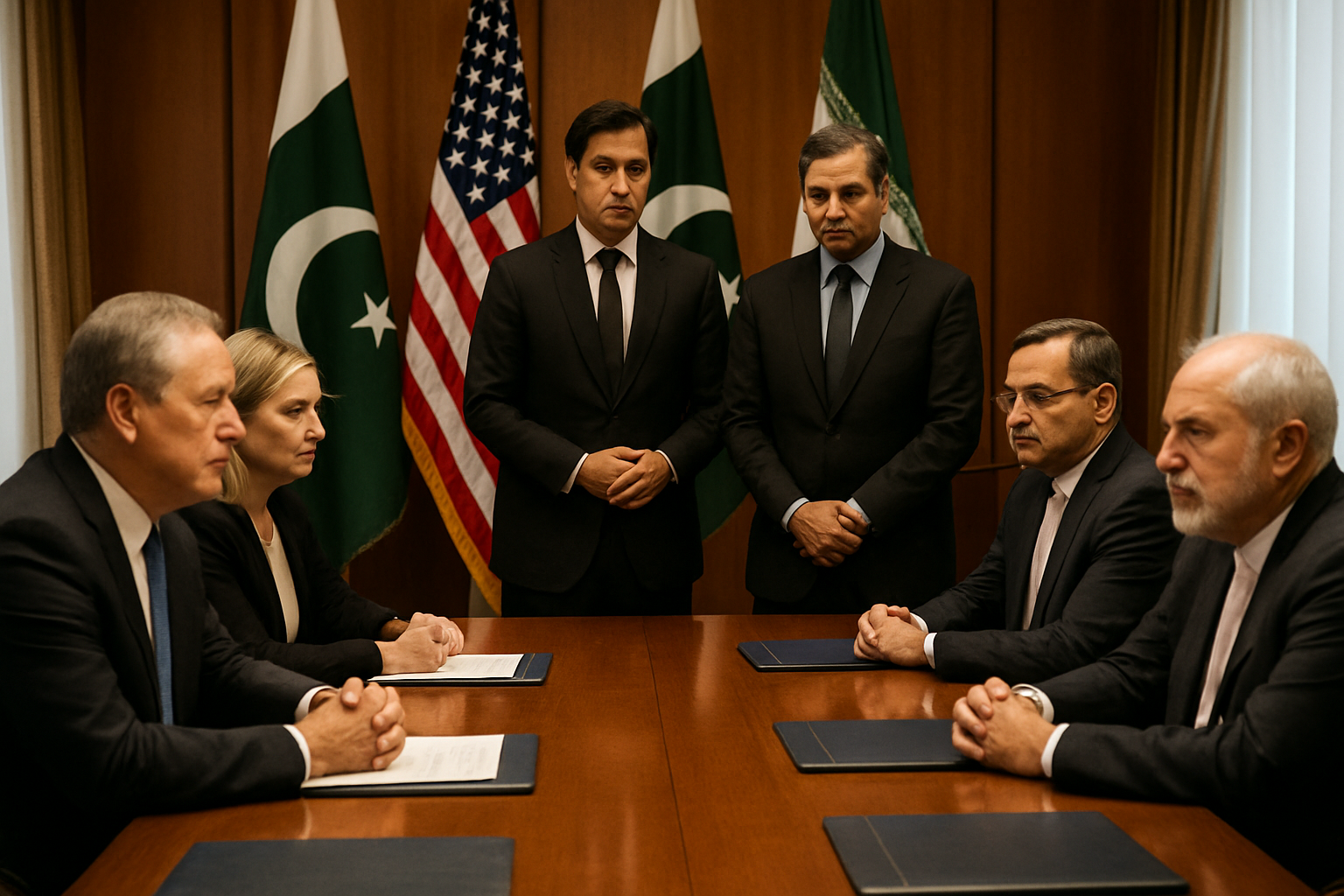
US negotiators are traveling to Pakistan on Saturday for potential peace talks with Iran, as mixed signals from Tehran create uncertainty about whether direct negotiations will actually take place in what could be a crucial diplomatic moment.
President Donald Trump's special envoy Steve Witkoff and son-in-law Jared Kushner are departing for Islamabad Saturday morning, the White House confirmed, following Iranian Foreign Minister Abbas Araghchi's arrival in Pakistan's capital on Friday evening. The mission represents the latest attempt to revive the diplomatic process that briefly ended the most dangerous international crisis since the Cold War.
However, Iran's Foreign Ministry has sent contradictory signals about its willingness to engage directly with the US delegation. Spokesperson Esmaeil Baghaei stated categorically that "no meeting is planned to take place between Iran and the US," emphasizing that Tehran's "observations would be conveyed by Pakistan."
Pakistan's Historic Mediation Role
Pakistan has emerged as the critical mediator in US-Iran relations, building on its unprecedented success with the "Islamabad Accord" that achieved a ceasefire just 88 minutes before Trump's "whole civilization will die tonight" deadline on April 8. This breakthrough crashed oil prices 20% from $119.50 to below $100 per barrel and ended a global aviation crisis affecting 18,000 flights.
Prime Minister Shehbaz Sharif and Field Marshal Asim Munir have maintained an innovative "message relay system" facilitating communication between VP JD Vance and Iranian officials when direct channels proved impossible. The template-setting middle power diplomacy demonstrated that innovative solutions are possible even in the most dangerous circumstances.
"Pakistan has positioned itself as a net regional stabilizer alongside Egypt and Turkey,"
— European Diplomatic Source
The Pakistani approach represents a significant departure from traditional Western-led mediation, showcasing the emergence of regional powers developing their own crisis management mechanisms. China's Foreign Minister Wang Yi has expressed "full support" for Pakistan's initiative, while Germany has noted "positive signs" for potential direct talks.
Iran's Contradictory Signals
While Iranian Foreign Ministry spokesman Baghaei ruled out direct talks, Parliament Speaker Mohammad Bagher Ghalibaf has left the door open, highlighting a "trust deficit" with the US while not categorically rejecting future negotiations. This reflects the complex internal dynamics within Iran's government as it navigates between hardline positions and potential diplomatic openings.
Iranian media reports suggest the final decision on participation has not yet been made, despite state television denying plans for delegation departure. The mixed messaging underscores the delicate nature of the diplomatic moment and the significant internal pressures facing Iranian leadership.
Nuclear Program Remains Core Obstacle
The fundamental disagreement that collapsed previous talks remains unchanged. The US demands that Iran commit to not pursuing nuclear weapons development and suspend uranium enrichment activities. Iran maintains uranium enrichment at 60% purity levels with over 400kg of weapons-grade material - sufficient for multiple weapons if weaponized.
Abbas Araghchi previously declared that Iran would "never abandon enrichment even if war is imposed," highlighting the structural disagreement that has prevented breakthroughs since the JCPOA collapse in 2018. This occurs against the backdrop of the New START treaty's expiration in February 2026 - the first time in over 50 years without US-Russia nuclear constraints.
Lebanon Loophole Creates Critical Gap
A significant complication stems from Israeli Prime Minister Netanyahu's explicit exclusion of Lebanon from the Pakistan-mediated ceasefire, creating what analysts describe as an "unbridgeable gap." Israeli strikes killed over 254 people in a single day during previous talks, with 1.2 million Lebanese displaced representing 25% of the population.
Iran has threatened withdrawal from negotiations unless comprehensive enforcement covers all fronts, while the US maintains that Lebanon operations remain separate from bilateral US-Iran frameworks. VP Vance had acknowledged this as a "legitimate misunderstanding" but stressed the US never agreed to include Israeli-Hezbollah operations in the scope.
Energy Crisis and Economic Implications
The stakes extend far beyond bilateral relations. Oil prices have surged to over $106 per barrel for Brent crude and $104.29 for WTI - the second time in 2026 that prices have breached $100. The Strait of Hormuz, handling 40% of global oil transit, remains partially closed due to Iranian mining operations and a cryptocurrency payment system requiring $1 per barrel from tankers.
Major shipping companies Maersk and MSC have suspended Persian Gulf operations indefinitely, with over 150 tankers stranded carrying billions in cargo. The International Energy Agency maintains its record 400 million barrel strategic reserve release - the largest in 50-year history - to stabilize global markets.

Consumer impacts are already evident globally. Bangladesh is reviewing fuel rationing affecting 170 million people, Pakistan is considering reversing wartime austerity measures, and European households face potential energy cost reductions if diplomatic progress materializes.
Congressional Opposition and International Response
The US faces unprecedented domestic opposition, with only 25% public support for Operation Epic Fury - a historic low for early-stage military operations. Senator Richard Blumenthal has expressed being "more concerned than ever" about potential ground troop deployment, while Pentagon operations are projected through September, well beyond initial timelines.
Internationally, NATO allies have largely rejected US escalation demands. UK Prime Minister Keir Starmer declared Britain "will not be dragged into Iran war," while France and Germany continue emphasizing diplomatic approaches. Australia and Japan declined to provide naval vessels - the most significant rejection of American military leadership since the Iraq War in 2003.
Recent Naval Complications
Diplomatic efforts have been complicated by the US seizure of the Iranian cargo vessel M/V Touska in the Gulf of Oman on Sunday. The USS Spruance fired on the ship's engine room before Marines conducted a helicopter assault to capture the vessel. Iran has threatened "swift retaliation against armed piracy" and cites the ongoing US naval blockade of Iranian ports as a major obstacle to renewed negotiations.
The incident highlights how military actions continue to undermine diplomatic progress, even as both sides express willingness to engage through Pakistani mediation.
Regional Coalition Under Maximum Strain
The unprecedented consensus among Saudi Arabia, UAE, Qatar, and Egypt supporting diplomatic solutions faces maximum strain following Iranian attacks on their territories during "Operation True Promise 4." The UAE suffered one civilian killed in Abu Dhabi, Kuwait had 32 injured at airports, and Qatar reported 8 wounded while intercepting Iranian missiles and drones.
Egyptian President Abdel Fattah el-Sisi's warnings about "comprehensive chaos" spreading to "sisterly countries" have proven increasingly prophetic as diplomatic challenges mount. However, the coalition has preserved its unity in supporting peaceful resolution, understanding that failure could lead to broader regional war.
Template-Setting Significance for 21st Century Diplomacy
UN Secretary-General António Guterres has described the current situation as the "greatest test of multilateral cooperation in the modern era." The stakes extend far beyond US-Iran bilateral relations, affecting territorial sovereignty enforcement, energy security paradigms, nuclear governance credibility, and international law enforcement mechanisms with implications lasting decades.
Pakistan's emergence as a crucial mediator demonstrates the capability of middle powers to bridge major adversaries when traditional mechanisms fail. The success or failure of this mediation effort will establish precedents for diplomatic versus military solutions in 21st-century international relations.
"This represents the most dangerous crisis since the Cold War end, with template-setting implications for how we manage international conflicts going forward,"
— Senior European Diplomat
Humanitarian Toll Mounts
The Iranian Red Crescent reports over 787 civilian casualties from US-Israeli strikes, including a Pentagon-acknowledged elementary school strike that killed 165-185 students due to "outdated targeting data," prompting war crimes investigations. International evacuations have reached Arab Spring scale, with Australia reporting 115,000 citizens trapped and Germany having evacuated 30,000.
The EU activated its ESTIA crisis mechanism for the first time in bloc history following Iranian drone strikes on RAF Akrotiri in Cyprus - the first attack on European territory since World War II.
Critical 48-Hour Window
As US negotiators depart for Pakistan, the coming 48 hours represent a critical juncture for determining whether innovative diplomatic compromise can bridge the fundamental disagreements that have prevented US-Iran breakthroughs for decades. The structural obstacles remain substantial: Iran's "red lines" excluding ballistic missiles and regional proxies from discussions versus US comprehensive demands including missiles, armed groups, and human rights.
The uncertainty surrounding Iranian participation highlights the delicate nature of the diplomatic moment. Whether Pakistan's historic mediation achievement can convert temporary ceasefires into a lasting peace framework will determine if the world averts a return to the most dangerous international crisis since the Cold War.
The stakes could not be higher. Success would demonstrate that multilateral cooperation and innovative diplomacy can resolve even the most intractable conflicts. Failure might accelerate military solutions as the preferred approach, encouraging proliferation and undermining diplomatic credibility worldwide, with implications extending decades beyond current events.
As Air Force Two prepares to depart for Islamabad, the world watches to see whether diplomatic innovation can triumph over military confrontation in what may be the defining crisis of the 21st century.