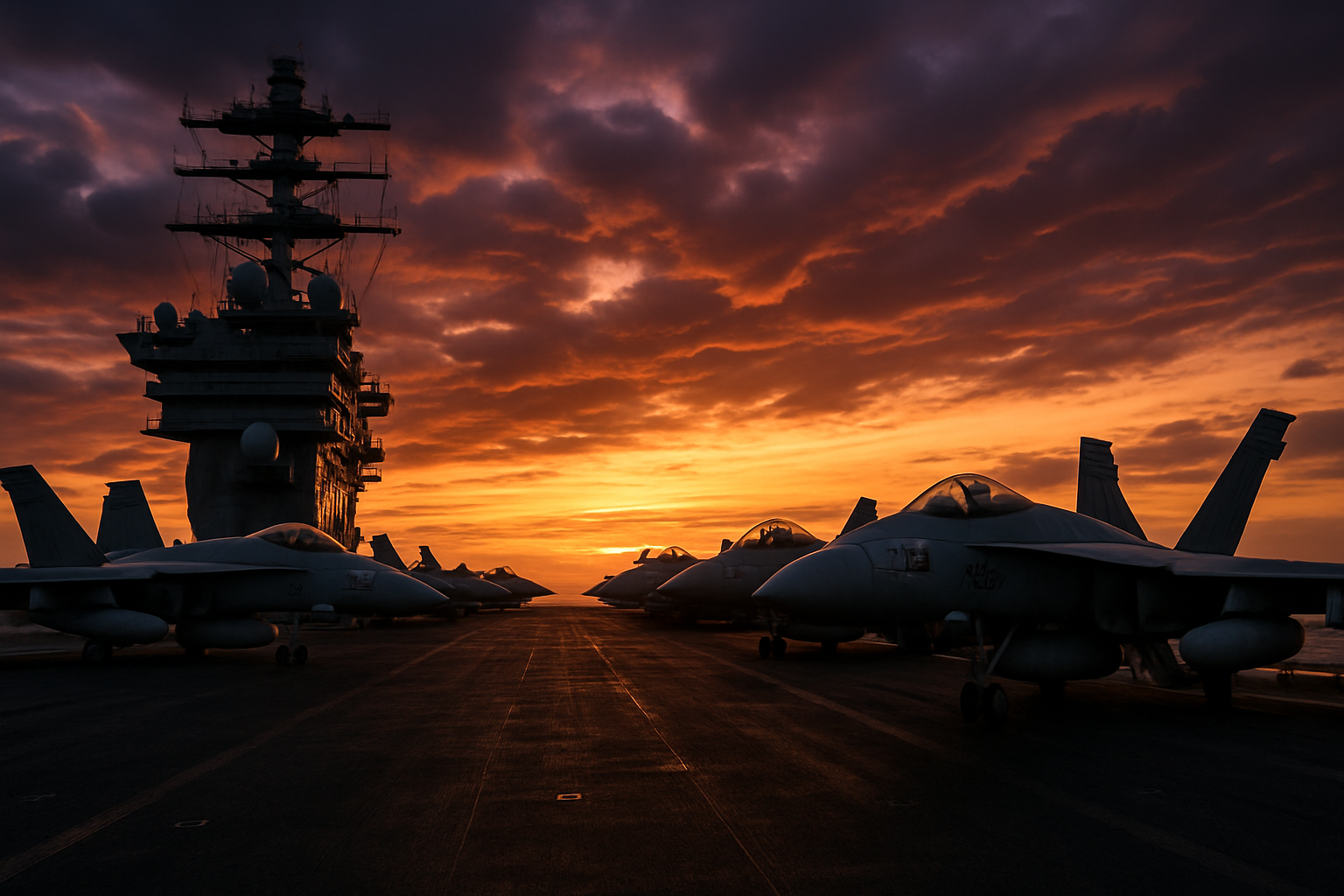
President Donald Trump has issued Iran a stark 10-day ultimatum to reach a "meaningful deal" on its nuclear program, warning that "bad things will happen" if negotiations fail, as the United States deploys its largest military force in the Middle East since the 2003 Iraq invasion.
Multiple international sources confirm that American military forces are now prepared to strike Iranian targets as early as this weekend, with the Pentagon having briefed the White House that dual-carrier strike groups could be operationally ready by Saturday. The unprecedented military buildup comes as diplomatic talks in Geneva achieved what Iranian Foreign Minister Abbas Araghchi called "broad agreement on guiding principles" – the most significant breakthrough since the collapse of the 2015 nuclear accord.
Unprecedented Military Escalation
The deployment of the USS Gerald R. Ford alongside the USS Abraham Lincoln represents approximately one-third of the active U.S. Navy fleet positioned just 800 kilometers from Iran's coast. According to European intelligence sources, this constitutes the largest concentration of American naval power in the region since the invasion of Iraq over two decades ago.
"The accumulation of U.S. air power is unprecedented, but it's still a fraction of what we had in 2003," a senior Pentagon official told reporters, speaking on condition of anonymity. Military planners have prepared scenarios ranging from targeted strikes on nuclear facilities to comprehensive campaigns against Revolutionary Guard infrastructure, expecting "weeks-long operations" with inevitable Iranian retaliation cycles.
The military tensions have already produced several dangerous incidents. An F-35C fighter jet from the Abraham Lincoln shot down an Iranian Shahed-139 drone that aggressively approached the carrier, while Iranian Revolutionary Guard vessels harassed U.S. tankers in the Strait of Hormuz – a critical chokepoint handling 40% of global oil transit. Oil prices have risen by over $1 per barrel on escalating tensions.
Trump's Ultimatum and Regime Change Rhetoric
Speaking at the inaugural Board of Peace meeting on Wednesday, Trump delivered his most explicit warning yet: "Iran has 10 days to make a meaningful deal with the United States, or else bad things will happen." The ultimatum represents a dramatic escalation from the president's previous diplomatic overtures.
"Over the years, it has proven difficult to make a meaningful deal with Iran. We must achieve a meaningful deal, otherwise bad things will happen."
— Donald Trump, U.S. President
Perhaps more significantly, Trump has begun using explicit regime change language, declaring that "a change in power in Iran would be the best thing that could happen." This marks the most direct advocacy for toppling Iran's government since Trump took office, signaling a potential policy evolution from nuclear-focused negotiations to broader political transformation objectives.
Nuclear Crisis at Critical Threshold
Iran's nuclear program has reached alarming levels that intelligence officials describe as approaching a "point of no return." The Islamic Republic is currently enriching uranium to 60% purity – far beyond the 3.67% limit established in the 2015 Joint Comprehensive Plan of Action (JCPOA) and dangerously close to the 90% threshold required for weapons-grade material.
According to multiple intelligence assessments, Iran now possesses sufficient enriched uranium to produce multiple nuclear weapons if it chooses to weaponize its stockpile. The advanced centrifuge technology and sophisticated nuclear infrastructure Iran has developed since withdrawing from international agreements in 2018 represents capabilities far exceeding those that existed during previous diplomatic frameworks.
Despite the military pressure, Iranian Foreign Minister Abbas Araghchi has remained defiant, declaring that Iran will "never abandon uranium enrichment even if war is imposed." This hardline stance persists even as Iran's President Masoud Pezeshkian has indicated the country is "open to verification" – a potential concession that represents a significant shift from previous positions.
Geneva Breakthrough Amid Crisis
The diplomatic breakthrough achieved in Geneva this week provides a stark contrast to the military buildup. Switzerland and Oman facilitated talks that evolved from earlier negotiations in Muscat, representing growing international investment in a diplomatic solution.
Araghchi announced that both sides had reached "broad agreement on a set of guiding principles" and committed to "working on the text of a potential agreement" – the most substantial progress since the JCPOA collapsed in 2018. However, fundamental disagreements persist over the scope of any deal.
Iran maintains that ballistic missiles and support for regional proxy groups remain "red lines" that cannot be included in nuclear-only negotiations. Meanwhile, U.S. Secretary of State Marco Rubio insists that any comprehensive agreement must address Iran's missile program, support for armed groups, and human rights violations – the same structural disagreement that has prevented breakthrough attempts for over a decade.
Unprecedented Regional Coalition
One of the most remarkable aspects of the current crisis is the unprecedented regional coalition supporting diplomatic resolution. Saudi Arabia, the United Arab Emirates, Qatar, and Egypt have all backed the negotiation process – an extraordinary consensus among Middle Eastern powers that typically find themselves on opposing sides of regional disputes.
This unified stance reflects shared concerns about the economic and security implications of military conflict. The Persian Gulf region handles 40% of global oil transit, and any disruption to shipping lanes could trigger worldwide energy market destabilization with implications extending far beyond the Middle East.
Oman has played a particularly crucial role, leveraging its historical neutrality and successful mediation of the original 2015 nuclear accord. The sultanate's diplomatic expertise has proven essential for maintaining structured dialogue despite profound trust deficits between Washington and Tehran.
Israeli Security Coordination
Israel's security establishment has coordinated closely with the Trump administration throughout the escalating crisis. Prime Minister Benjamin Netanyahu has held multiple meetings with Trump, emphasizing Israeli red lines that require any agreement to include "limiting ballistic missiles and ending support for the Iranian axis."
From Israel's perspective, nuclear-only agreements that fail to address Iran's missile capabilities and support for proxy groups like Hezbollah, Hamas, and the Houthis are insufficient to address existential security threats. The integrated nature of Iran's missile and proxy network means that partial agreements could still leave Israel vulnerable to the very threats that prompted military preparations in the first place.
Domestic Pressures on Both Sides
The crisis unfolds against a backdrop of severe domestic pressures affecting both governments' negotiating positions. Iran faces its worst internal unrest in decades, with over 42,000 arrests documented since 2022 protests began. The regime has continued its crackdown even during diplomatic talks, sentencing Nobel Peace Prize laureate Narges Mohammadi to an additional 7.5 years in prison.
Economic sanctions have created what analysts describe as a regime survival crisis, yet Iranian leadership appears to prioritize maintaining nuclear capabilities over economic relief through sanctions removal. This calculation reflects the government's assessment that nuclear leverage provides more security than international integration.
Trump faces different but equally complex political pressures. Republican hawks in Congress view engagement with Iran as appeasement, preferring military solutions to diplomatic compromise. However, the administration also seeks foreign policy victories that demonstrate effective leadership without the risks associated with a regional war that could engulf multiple countries and global energy markets.
International Nuclear Governance Crisis
The Iran crisis occurs within a broader breakdown of international nuclear governance mechanisms that adds urgency to finding resolution. The New START treaty between the United States and Russia expired on February 5, 2026 – marking the first time in over 50 years that the world's two largest nuclear powers operate without binding arms control constraints.
Simultaneously, China has been expanding its nuclear arsenal from an estimated 350 to over 500 warheads, creating new multilateral complications for future arms control frameworks. UN Secretary-General António Guterres has warned that nuclear risks are at their "highest level in decades," making successful resolution of the Iran crisis a critical test case for 21st-century nuclear diplomacy.
Technical Verification Challenges
Any potential agreement would face unprecedented technical challenges that far exceed the complexity of previous nuclear frameworks. Iran's advanced centrifuge technology, sophisticated infrastructure, and dispersed nuclear facilities would require monitoring mechanisms that go well beyond what was established in the original JCPOA.
The country's current 60% enrichment capability represents a technological threshold that creates inherent "breakout" risks – the ability to rapidly produce weapons-grade material. Verification experts emphasize that rebuilding trust and establishing effective oversight would require years of implementation even if political agreements were reached immediately.
Reports suggest Iran has considered potential concessions including a three-year enrichment halt and transferring existing stockpiles to Russia. However, the technical infrastructure and know-how acquired over recent years cannot be easily reversed, creating permanent changes to the strategic balance.
Economic and Energy Security Stakes
The global economic implications of military confrontation extend far beyond immediate participants. Oil market volatility has already produced price increases, and natural gas prices have risen 24% in Europe and 78% in the United States amid geopolitical pressures.
A regional conflict could disrupt supply chains worldwide, particularly affecting industries dependent on stable energy costs and maritime shipping routes. The interdependence of global markets means that Middle Eastern instability would rapidly translate into economic disruption affecting employment, inflation, and growth across multiple continents.
Iran has positioned potential agreements as offering "trillion-dollar opportunities" in energy and mineral access for American firms, framing commercial propositions as essential for deal durability. However, maximum pressure campaigns that continue during negotiations complicate the trust-building necessary for comprehensive agreements.
Weekend Decision Point
Multiple international intelligence sources indicate that Trump has yet to make a final decision on military authorization, despite Pentagon confirmation that forces could be operationally ready by the weekend. White House discussions reportedly include active debate weighing escalation risks against the political and military consequences of continued Iranian nuclear advancement.
The president's inner circle is said to be divided, with some advisers arguing that only military pressure will compel Iranian concessions, while others warn that regional conflict could spiral beyond American control with global implications. Trump himself has privately argued both for and against military action while polling advisers and allies.
Template-Setting Moment for International Relations
The resolution of this crisis – whether through diplomatic breakthrough or military escalation – will establish precedents affecting international relations far beyond the current administration. Success in preventing regional war while addressing nuclear proliferation could provide templates for resolving other territorial and nuclear disputes in an increasingly multipolar world.
Conversely, failure to find diplomatic solutions may accelerate trends toward military solutions for international crises, potentially encouraging nuclear proliferation elsewhere and undermining the credibility of diplomatic mechanisms for conflict resolution.
The stakes extend beyond immediate participants to fundamental questions about whether innovative diplomatic approaches can bridge longstanding disagreements or whether military confrontation becomes inevitable when core security interests appear irreconcilable.
Critical Hours Ahead
As the world watches Trump's weekend decision on potential military action, the next 48 hours may determine whether diplomacy or military force shapes Middle Eastern geopolitics for decades to come. The unprecedented military buildup demonstrates both American deterrent capabilities and strike readiness, while the diplomatic framework established in Geneva shows that structured negotiations remain possible despite profound disagreements.
The convergence of nuclear technology advancement, regional coalition building, domestic political pressures, and international governance challenges creates a unique moment in modern international relations. How these forces resolve – through innovative diplomatic solutions or military escalation – will influence approaches to nuclear proliferation, territorial sovereignty, and conflict resolution well into the future.
With Iran's 10-day deadline now ticking, the world faces perhaps the most dangerous phase in U.S.-Iran relations since the 1979 Islamic Revolution, with implications extending far beyond the Persian Gulf to global energy security, nuclear governance, and the fundamental mechanisms through which nations resolve their most intractable disputes.